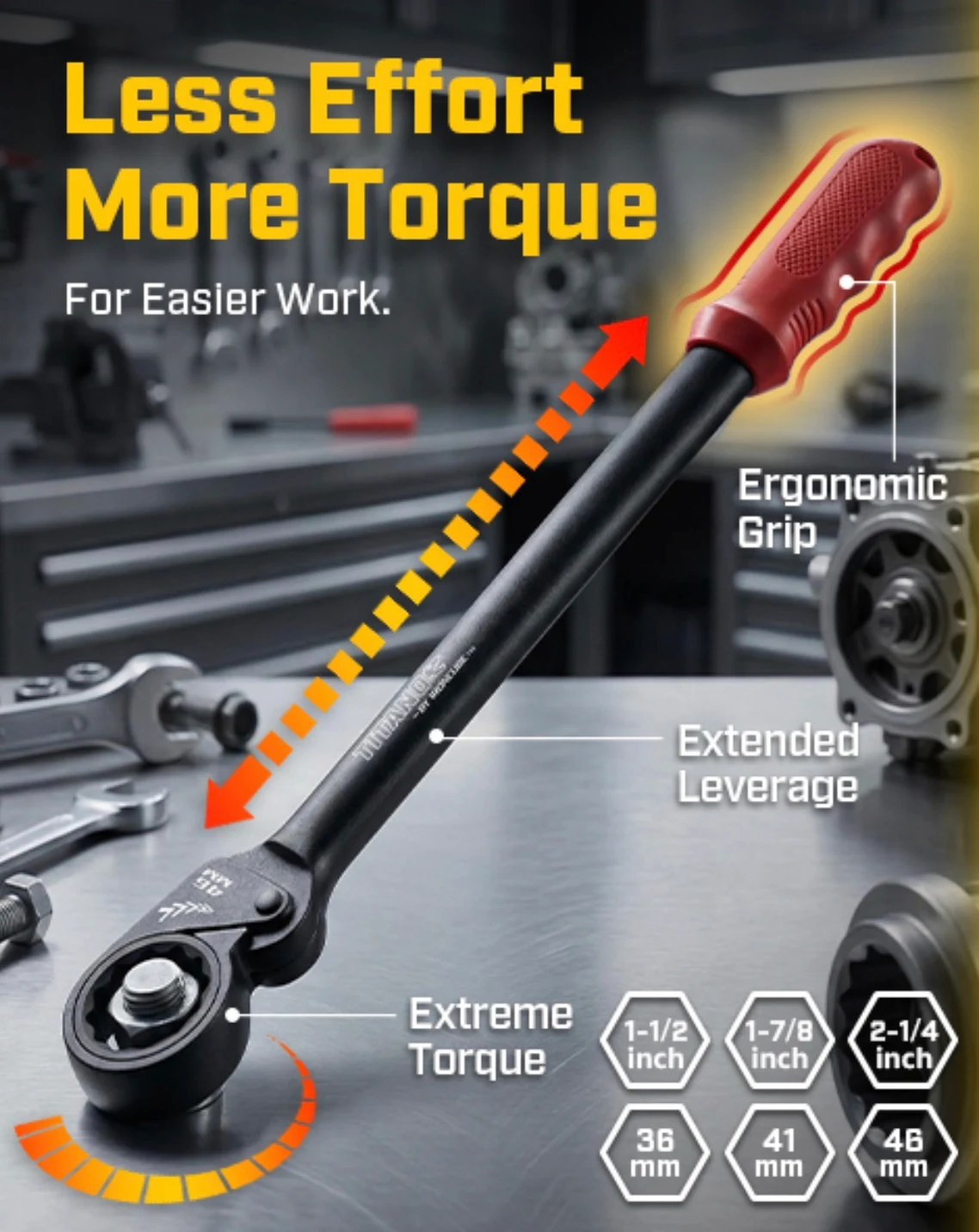
When it comes to professional plumbing and HVAC work, having the right tools can make the difference between a frustrating day and a productive one. A Head Ratchet Wrench Set has become an indispensable tool collection for professionals and DIY enthusiasts alike, offering the versatility and efficiency needed to tackle tight spaces and challenging angles that traditional wrenches cannot reach.
IRONCUBE has revolutionized the way professionals approach mechanical work with their innovative tool designs. Their commitment to quality and functionality has made them a trusted name in the industry, particularly for those working in demanding environments like plumbing and HVAC systems.
Understanding the Flex Head Ratchet Wrench
To appreciate the game-changing nature of this tool, we must first look at its core components and how they dramatically improve on traditional wrench designs.
The Anatomy of Precision: What Makes It ‘Flex Head’ and ‘Ratcheting’?
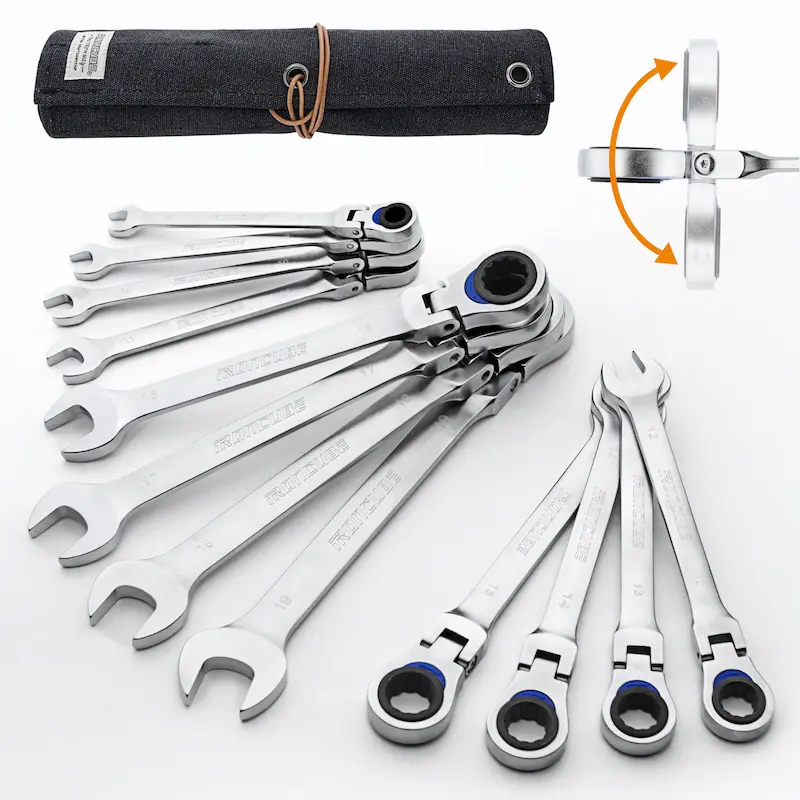
A standard wrench offers a fixed angle—usually about a 15-degree offset—which is often insufficient for maneuverability around obstructions. The flex head design changes this by incorporating a pivoting joint at the box end of the wrench.
- The Pivoting Power: The head typically pivots up to 180 degrees (a full semi-circle) in either direction. This range of motion allows the user to angle the wrench head around pipes, duct corners, unit housings, or bulky equipment to land perfectly on the fastener. This enhanced accessibility means you can reach bolts and nuts that would be absolutely impossible with a fixed wrench, saving you the time and effort of disassembling surrounding components.
- The Ratcheting Advantage: The ratcheting mechanism, built into the box end, is a miracle of efficiency. Instead of the cumbersome “swing and reposition” technique required with a standard wrench, the ratcheting mechanism allows for continuous turning action without removing the tool from the fastener. This is achieved through a fine-tooth gear system inside the box end. High-quality sets, like the IRONCUBE Ratcheting Screwdriver Set Amazon SHOP often feature a fine-tooth count, ranging from 72 to 144 teeth.
- The Arc Swing Factor: The tooth count directly determines the arc swing—the minimal movement required to engage the next tooth in the ratchet mechanism. A higher tooth count (e.g., 72 or 90 teeth) translates to a smaller arc swing (as low as 4 to 5 degrees). This is crucial in extremely tight locations where you only have a tiny amount of space to move the handle back and forth. This dramatically increases speed and minimizes user fatigue, particularly during repetitive loosening or tightening tasks.
Material Science and Durability: Built for Professional Rigor
For tools used in the demanding environments of plumbing and HVAC, the material composition is paramount. A superior Head Ratchet Wrench Set is forged from premium alloys, typically Chrome Vanadium Steel (Cr-V) or Chrome Molybdenum Steel (Cr-Mo).
- Strength and Torque: These alloy steels are heat-treated, providing exceptional strength and the ability to withstand the high-torque applications often required to break loose rusted or overtightened fasteners common in older systems.
- Corrosion Resistance: Plumbing and HVAC work frequently involve exposure to moisture, chemicals, and extreme temperatures. A fully polished, mirror chrome, or black chrome finish not only makes the wrenches easy to clean but also provides a vital layer of corrosion resistance, ensuring the longevity of your investment.
- Ergonomics and Comfort: Professional-grade sets, such as the https://ironcubeworks.com/product/ironcube-12pcs-flexible-head-ratcheting-wrench-set-with-canvas-storage-bag/, often feature I-Beam handles or ergonomic grips designed to reduce hand strain over extended use. Comfort is a factor that directly impacts productivity.
Why Plumbers and HVAC Pros Need This Tool
The unique design of the flexible ratcheting wrench makes it uniquely suited for the common challenges in plumbing and heating, ventilation, and air conditioning (HVAC).

Plumbing Perfection: Getting Under the Sink and Behind the Walls
Plumbers constantly encounter obstacles like sink basins, supply lines, cabinets, and waste traps. The flex head wrench is a lifesaver in these situations.
- Faucet and Sink Installations: Think about tightening the mounting nuts on a kitchen or bathroom faucet. These are often tucked directly behind the sink basin, making them virtually inaccessible to a standard wrench or even a basin wrench. The flexible head allows the plumber to angle the box end onto the nut while maintaining a comfortable, high-leverage grip on the handle.
- Toilet and Water Heater Connections: Working on water supply lines or drainage components involves dealing with nuts and bolts in tight corners, often near walls or other fixtures. The ratcheting action speeds up the process significantly, while the flex head navigates the tightest clearances.
- Valve and Flange Work: In commercial or industrial plumbing, tightening flange bolts in densely packed mechanical rooms is a common task. The flex head allows for off-angle entry to the bolt, avoiding adjacent pipes or structural beams.
HVAC Efficiency: Inside Compressors and Ductwork
HVAC technicians deal with a different, but equally challenging, set of confined spaces—primarily inside system casings, around compressors, and within duct joints.
- Compressor and Condenser Maintenance: Fasteners that hold compressors, fan motors, and condenser coils are often nested deep within the outer housing of the unit. The Flex Head Ratchet Wrench Set saves time, auto-repears, enabling the technician to reach these bolts with minimal arc swing, significantly reducing the time spent on unit disassembly.
- Ductwork Installation and Repair: Installing or repairing ductwork involves securing many sheet metal screws and bolts, often right against a ceiling joist or wall stud. The flexibility of the head allows for quick, reliable tightening in these awkward positions.
- Refrigerant Line Service: Tightening flare nuts on refrigerant lines requires precision and control. While flare nut wrenches are the ideal primary tool, in a pinch or for pre-tightening, a thin-profile flex-head box end can sometimes offer superior access when obstacles are present.
For a deeper dive into the tool types essential for your trade, check out our selection of Wrenches Ratcheting Amazon SHOP and other hand-tool/ offerings.
Key Selection Criteria: Choosing the Right Set
Not all flex head ratcheting wrench sets are created equal. When investing in a new set, especially one that will be used daily in professional work, several critical features should guide your decision.
Size and Measurement System (SAE vs. Metric)
Both plumbing and HVAC work utilize both measurement systems, often depending on the equipment’s origin.
- Combination Sets: For maximum versatility, consider purchasing a combination set that includes both SAE (Standard American English/Imperial) and Metric sizes.
- Common Sizes: In plumbing and HVAC, the most frequently used sizes are generally within the 8mm to 19mm range for Metric, and 1/4″ to 3/4″ for SAE. The IRONCUBE 12PCS Flexible Head Ratcheting Wrench Set is a perfect example of a comprehensive set covering the most essential professional sizes.
Reversible vs. Non-Reversible Head
This feature greatly impacts functionality and convenience, especially when working in extremely confined quarters.
- Non-Reversible: These require the wrench to be flipped over to change the direction of rotation (tightening to loosening). They are generally simpler in design and can sometimes be thinner, which is an advantage in the tightest of gaps. However, if the wrench is hard to access, flipping it can be impossible.
- Reversible: These feature a small lever or switch on the head of the wrench that instantly changes the direction of the ratcheting action without removing or flipping the tool. While the head may be slightly bulkier, the time savings and convenience in awkward positions are invaluable. Most professionals prefer reversible models for day-to-day work.
Gear Tooth Count (Arc Swing)
As previously noted, this is a direct measure of efficiency in restricted areas.
- Fine-Tooth Ratchets (72+ Teeth): Look for gear systems with 72, 90, or even 144 teeth. The resulting small arc swing (typically 5 degrees or less) is paramount for working with bolts located mere millimeters from an obstruction. A high-tooth count minimizes wasted motion, directly translating into faster work completion.
Handle Type and Length
The handle design influences leverage, comfort, and reach.
- Standard Length: Great for general use, offering a balance between leverage and manageability.
- Extra-Long (XL): Provides maximum leverage for breaking loose extremely stubborn fasteners. While excellent for high-torque situations, they can be impractical in the smallest spaces.
- Stubby: Extremely short handles designed specifically for ultra-tight clearances where a standard handle simply will not fit. Every plumber and HVAC technician should have a stubby set for truly microscopic work areas.
Comparison of Wrench Types for Confined Space
Understanding where the Flex Head Ratchet Wrench sits in the tooling hierarchy helps justify the investment. The table below compares the performance of three common wrench types in a typical service environment.
| Wrench Type | Advantage | Disadvantage | Ideal Application in HVAC/Plumbing |
| Standard Combination Wrench | Maximum strength, lowest cost, slimmest profile. | Requires a full handle swing; it must be removed to reposition. Slow. | Breaking loose extremely tight, easily accessible fasteners. |
| Fixed Ratcheting Wrench | High speed, continuous turning without removal. | Fixed position makes it unusable around obstructions. | Fast tightening/loosening of accessible fasteners (e.g., bench work). |
| Flex Head Ratchet Wrench | High speed, pivots up to 180° for unmatched accessibility in tight corners. | Slightly bulkier head than a standard combination wrench. | 90% of field service work in confined spaces (under sinks, inside unit casings, near walls). |
The IRONCUBE Advantage
Our commitment at https://ironcubeworks.com/ is to provide tools that solve real-world professional problems. The IRONCUBE Flex Head Ratchet Wrench Set is engineered specifically for the demands of tradesmen, featuring high-strength Cr-V steel, a fine-tooth ratcheting mechanism, and a non-slip finish. Our focus on quality and customizability (visit https://ironcubeworks.com/customized/ to learn more) means you get a tool built to last a career.
Features to Look for in a Professional Grade Head Ratchet Wrench Set
Not all ratchet wrench sets are created equal, and understanding the features that distinguish professional-grade tools from consumer-grade options will help you make an informed investment. Build quality and materials form the foundation of tool performance and longevity.
Chrome vanadium steel remains the gold standard for wrench construction, offering an optimal balance of hardness, toughness, and fatigue resistance. This alloy can withstand the repeated stress cycles of ratcheting action without developing cracks or permanent deformation. Some manufacturers use chrome molybdenum steel for even greater strength, though this typically comes at a higher price point.
The ratcheting mechanism itself deserves close examination. A 72-tooth ratchet requires only 5 degrees of arc swing, while a 90-tooth design needs just 4 degrees. Premium sets may feature 120-tooth mechanisms requiring only 3 degrees of movement, which proves invaluable in extremely confined spaces. The pawl system should engage smoothly and positively, with no play or sloppiness that could round off fastener corners.
Surface finish quality affects both performance and durability. Mirror chrome plating provides maximum corrosion resistance and allows the wrench to slide easily against adjacent surfaces. Some professionals prefer satin or matte finishes that show less fingerprinting and wear patterns, though these may sacrifice some corrosion protection.
Size range and progression matter significantly for practical utility. A comprehensive set should include both metric and SAE sizes, with logical progression that eliminates gaps in coverage. The IRONCUBE 12-piece flexible head ratcheting wrench set exemplifies thoughtful size selection, covering the most frequently encountered fastener dimensions in professional applications.
Reversing mechanism design impacts usability and durability. Switch-style reversers located on the wrench head offer quick operation but add bulk and create potential snag points. Some designs integrate the reverser into the ratchet box itself, maintaining a low profile while still allowing tool-free direction changes. The best systems operate positively without requiring excessive force or creating annoying rattle when not engaged.
Complete Size Range and Conversion Chart for Professional Applications
Understanding wrench sizes and their equivalents across different measurement systems is crucial for professional work. Here is a comprehensive conversion chart for the most common sizes found in plumbing and HVAC applications:
| SAE (Inch) | Metric (mm) | Common Applications | Thread Types |
|---|---|---|---|
| 1/4″ | 6 mm | Small compression fittings, electrical terminals | 5/16″-18, 5/16″-24 |
| 5/16″ | 8 mm | Supply line connections, mounting hardware | 3/8″-16, 3/8″-24 |
| 3/8″ | 10 mm | Standard supply valves, mounting bolts | 7/16″-14, 7/16″-20 |
| 7/16″ | 11 mm | Compression nuts, flare fittings | 1/2″-13, 1/2″-20 |
| 1/2″ | 13 mm | Main shut-off valves, large compression fittings | 9/16″-12, 9/16″-18 |
| 9/16″ | 14 mm | HVAC refrigerant lines, condenser bolts | 5/8″-11, 5/8″-18 |
| 5/8″ | 16 mm | Blower assemblies, large mounting hardware | 3/4″-10, 3/4″-16 |
| 11/16″ | 17 mm | Heat exchanger connections | 3/4″-10, 3/4″-16 |
| 3/4″ | 19 mm | Main water lines, furnace gas connections | 7/8″-9, 7/8″-14 |
| 13/16″ | 21 mm | Large commercial fittings | 1″-8, 1″-12 |
| 7/8″ | 22 mm | Industrial HVAC equipment | 1″-8, 1″-12 |
| 15/16″ | 24 mm | Commercial plumbing mains | 1-1/8″-7, 1-1/8″-12 |
This conversion chart helps professionals working with equipment manufactured in different countries or dealing with mixed measurement systems common in renovation work. Always verify the actual fastener size before applying torque, as visual estimation can lead to rounded corners and damaged hardware.
Material Quality and Manufacturing Standards That Matter
The durability and performance of a Head Ratchet Wrench Set directly correlate with material selection and manufacturing processes. Chrome vanadium steel (Cr-V) has become the industry standard for quality hand tools due to its exceptional properties. This alloy typically contains 0.4-0.6% carbon, 0.8-1.1% chromium, and 0.15-0.25% vanadium, creating a material that can be heat-treated to achieve optimal hardness while maintaining good toughness.
The heat treatment process is critical to achieving proper material properties. Through-hardening followed by tempering creates a uniform structure that resists both sudden impact and gradual fatigue. Surface hardness typically ranges from 42-48 HRC (Rockwell C scale), providing excellent wear resistance while avoiding brittleness that could cause fracturing under shock loads.
Forging versus casting represents another crucial manufacturing distinction. Forged wrenches feature superior grain structure with continuous flow lines that follow the tool shape, creating maximum strength. Cast tools have random grain structure with potential voids and inclusions that serve as crack initiation sites. All professional-grade flex head ratchet wrenches should be forged.
Chrome plating thickness and quality affect both appearance and functionality. Industrial chrome plating specifications typically require minimum thickness of 0.0005 inches over a nickel base layer, creating corrosion resistance that can withstand years of professional use. The plating should be uniform, with no skip areas, bubbling, or flaking.
Quality control during manufacturing ensures consistent performance across every tool in a set. Reputable manufacturers like IRONCUBE implement rigorous testing protocols, including torque testing of ratchet mechanisms, dimensional verification of box end openings, and metallurgical sampling to confirm heat treatment effectiveness.
Maintenance and Care for Maximum Tool Life and Performance
Investing in quality tools requires commitment to proper maintenance for realizing full service life potential. Regular cleaning forms the foundation of tool care. After each use session, especially in dirty or wet environments, wipe tools with a clean cloth to remove surface contamination. For heavily soiled tools, use a degreaser or solvent, followed by thorough drying.
Lubrication of moving parts should occur on a regular schedule based on usage intensity. The ratchet mechanism benefits from periodic oil application—just one or two drops of lightweight machine oil at the reverser location, then operating the mechanism through several cycles to distribute lubricant. Excess oil should be wiped away to prevent attracting dirt.
The flex head joint requires similar attention. Apply light oil at the pivot point and work the head through its full range of motion. Some designs use grease rather than oil for longer-lasting lubrication, though this makes the mechanism slightly stiffer. Avoid using heavy greases that can thicken in cold weather.
Inspection protocols should become routine, particularly before important jobs. Check each wrench for cracks, especially near the box end where stress concentration is highest. Examine chrome plating for chips or flaking that could expose base metal to corrosion. Test ratchet mechanisms for positive engagement without skipping or backlash.
Replacement considerations depend on damage type and severity. Minor chrome flaking is cosmetic and doesn’t affect function. Worn ratchet teeth that skip under load require replacement, as ratchet internals are rarely cost-effective to repair. Cracks or permanent deformation definitely necessitate retirement, as these represent safety hazards.
Storing tools in a controlled environment protects against corrosion. Moisture and temperature fluctuations accelerate rust formation even on chrome-plated tools. If tools must be stored in humid environments, consider silica gel packets or vapor corrosion inhibitor (VCI) storage solutions.
Metric versus SAE Sizing and When Each System Applies
The coexistence of metric and SAE (Society of Automotive Engineers) measurement systems creates challenges for professionals working across different equipment types. Understanding which system applies in various situations prevents fastener damage and improves efficiency. Generally, equipment manufactured in the United States, especially older systems, uses SAE fasteners, while equipment from European and Asian manufacturers typically employs metric sizing.
However, this distinction has blurred considerably in recent decades. Many domestic manufacturers have transitioned to metric hardware for international compatibility and simplified production. Conversely, some imported equipment destined for U.S. markets incorporates SAE hardware for service parts compatibility.
Residential plumbing systems in North America predominantly use SAE sizing for supply lines, shut-off valves, and fixture connections. Common sizes include 3/8-inch, 1/2-inch, and 5/8-inch. Commercial plumbing may incorporate more metric components, particularly in newer construction following modern building codes.
HVAC equipment shows greater variation. Refrigerant line fittings traditionally used SAE fractional dimensions, while many electrical connections and mounting hardware have shifted to metric. Service technicians frequently encounter both systems on single units, necessitating comprehensive tool coverage.
Automotive applications heavily influence tool standards, and the automotive sector’s metric transition has driven wrench set composition. Modern comprehensive sets typically include both systems in ranges that cover crossover sizes. Some near-equivalent sizes like 13mm and 1/2-inch can sometimes be interchanged in emergencies, though this practice risks fastener damage.
The product category wrenches section offers various set configurations for different professional needs, including metric-only, SAE-only, and combination sets.
a Complete Tool Kit Around Your Head Ratchet Wrench Set
A flex head ratchet wrench set forms an excellent foundation for a professional tool collection, but complete job site preparedness requires complementary tools. Ratcheting screwdrivers address different fastener types while providing similar efficiency benefits. The Ratcheting Screwdriver Set: 56-Piece Magnetic Multi Bits Tool Kit with Case offers comprehensive coverage for screw-type fasteners in various materials.
Socket sets complement wrenches by addressing fasteners with adequate clearance and protrusion, where sockets work more efficiently. Quarter-inch drive sets handle small fasteners, three-eighths-inch drive provides versatility for medium applications, and half-inch drive delivers power for larger hardware.
Adjustable wrenches remain valuable despite their limitations, offering size flexibility for odd-sized fasteners and emergencies where dedicated sizes are unavailable. Premium adjustable wrenches with minimal jaw play and smooth adjustment mechanisms justify their cost through reliability.
Pliers and locking pliers provide gripping capability for round, irregular, or damaged fasteners. Channel-lock pliers, slip-joint pliers, and various locking plier configurations each serve specific purposes in comprehensive tool kits.
Specialty tools for particular applications complete professional setups. Basin wrenches, spud wrenches, and faucet seat wrenches address specific plumbing challenges. HVAC work benefits from refrigerant line tools, duct crimpers, and sheet metal equipment.
Diagnostic equipment increasingly integrates with mechanical work. Digital multimeters, pressure gauges, temperature probes, and leak detectors transform guesswork into precise measurements.
Power tools accelerate certain tasks while requiring careful application to avoid damage. Cordless impact drivers and wrenches provide speed for appropriate fasteners but can destroy threads or crack components if misapplied.
The Ratcheting Screwdriver Set and Interchangeable Ratchet Screwdriver Set demonstrate how ratcheting mechanisms improve efficiency across multiple tool categories.
Final Thoughts
The Flex Head Ratchet Wrench Set is a paradigm shift in the world of professional hand tools. For plumbing and HVAC technicians who consistently work in the most challenging, confined environments, this set offers an unparalleled combination of speed, accessibility, and ergonomic comfort. Its flexible, pivoting head eliminates the need for frustrating maneuvers, and its fine-tooth ratcheting mechanism slashes labor time on repetitive tasks.
By investing in a durable, high-quality set like the ones offered by professionals, professionals are not just buying a tool; they are buying efficiency, productivity, and a significant reduction in on-the-job frustration. Remember the key criteria: a high-tooth count (72+), durable Chrome Vanadium Steel construction, and the convenience of a reversible head. Equip yourself with the right gear, and turn those impossible jobs into routine successes.
For more information or to explore other tools, visit IronCubeWorks or check out their Amazon Store. And more tools and resources, explore IronCubeWorks’ Hand Tool Collection.
FAQs
In the following section, we address the most common questions from professionals and serious DIYers regarding the use, care, and selection of these essential tools.
Q1: What is the main difference between a regular ratcheting wrench and a flex-head ratcheting wrench?
The critical difference is the pivot joint. A regular ratcheting wrench has a fixed box end that allows for high-speed turning but must be used straight-on. A flex-head ratcheting wrench incorporates a hinge or pivot that allows the box end to be angled up to 180 degrees. This flexibility allows the tool to navigate obstructions like pipes, brackets, and casings to reach the fastener from an offset angle, which is the primary reason for its massive utility in plumbing and HVAC.
Q3: What tooth count is best for a professional set?
For professional plumbing and HVAC work in tight spaces, a high tooth count is highly recommended. Look for a set with a minimum of 72 teeth and preferably 90 teeth or more. A higher tooth count results in a smaller arc swing (e.g., a 72-tooth wrench has a $5^\circ$ arc swing), meaning you can turn the fastener even when you can only move the handle a tiny distance, which is often the reality inside mechanical units.
Q5: Where can I find other ratcheting tools from IRONCUBE?
You can explore our full range of high-quality ratcheting solutions on our website. For a versatile system, check out our Ratcheting Screwdriver Set: 56-Piece Magnetic Multi Bits Tool Kit with Case or our standard Ratcheting Screwdriver Set and options. You can also view our tool reviews and usage tips on our website and shop our full range of tools directly.