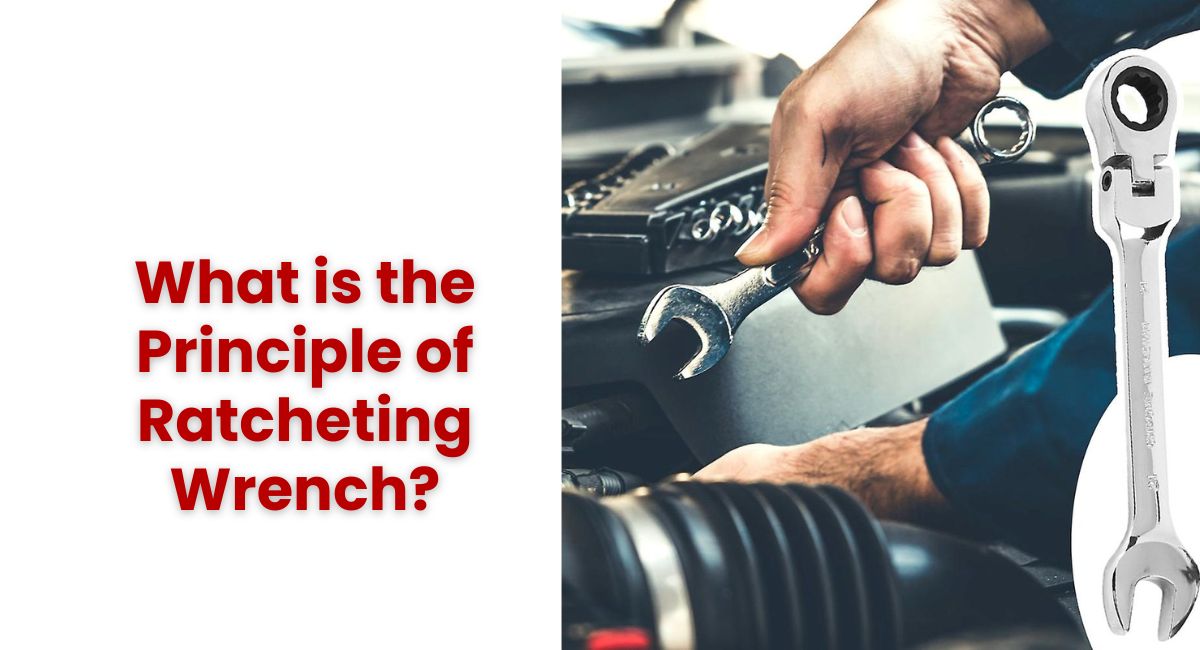
The principle of ratcheting wrench lies in its ability to tighten or loosen fasteners without having to remove and reposition the tool on the nut or bolt. This is achieved by an internal ratcheting gear-and-pawl mechanism that allows for continuous motion in one direction while preventing motion in the opposite direction. Unlike traditional wrenches, which require frequent repositioning, ratcheting wrenches save time, reduce fatigue, and provide easier access in tight spaces.
Ratcheting wrenches combine innovation, engineering precision, and real-world usability, making them indispensable in automotive, mechanical, construction, and home improvement industries. In this comprehensive guide, we will explore the exact working principle of ratcheting wrenches, their internal mechanism, applications, benefits, different types, comparisons with standard wrenches, and much more.
Introduction to Ratcheting Wrenches
According to Wikipedia – Wrench, a wrench is a tool used to provide grip and mechanical advantage in applying torque to turn objects. A ratcheting wrench is a specialized type of wrench that includes a ratchet mechanism allowing for incremental turns without lifting the tool off the fastener.
The tool is especially useful in tight spaces where there isn’t enough room for a full rotation of a traditional wrench. This makes ratcheting wrenches popular among professional mechanics, engineers, and DIY enthusiasts.
At Ironcube Works, you can explore a wide collection of high-quality ratcheting wrench sets designed for durability and efficiency, such as the 12pcs Metric Fixed Ratcheting Wrench Set and the 10pcs New Type Metric Ratcheting Wrench Set.
The Engineering Principle of Ratcheting Wrench
The principle of ratcheting wrench revolves around the ratcheting gear and pawl mechanism.
The ratchet gear is a toothed wheel inside the wrench head.
The pawl is a lever or latch that engages with the teeth, allowing the gear to rotate in one direction but locking in the opposite direction.
When you push or pull the wrench in the tightening direction, the pawl engages the gear to turn the fastener. When you move it back, the pawl slides over the gear teeth without moving the fastener, preparing for the next tightening stroke.
This back-and-forth movement allows continuous operation without lifting the wrench off the fastener, which is the cornerstone principle of ratcheting tools.
Key Components of a Ratcheting Wrench
To fully grasp the principle of ratcheting wrench, it’s essential to understand its key components:
- Head: The head of the wrench houses the ratcheting mechanism. It is typically designed to accommodate various fastener sizes.
- Gear and Pawl: These are the core components responsible for the ratcheting action. The gear rotates when torque is applied, while the pawl locks the gear in one direction.
- Handle: The handle provides leverage and comfort during use. Some models feature ergonomic designs for better grip.
- Directional Switch: This switch allows users to change the direction of the ratcheting action, enabling both tightening and loosening of fasteners.
For a closer look at high-quality ratcheting wrenches, check out our IronCube 12PCS Metric Fixed Ratcheting Wrench Set.
How Does a Ratcheting Wrench Work?
The principle of ratcheting wrench can be explained through its working mechanism:
- Engagement: When the wrench is turned in the desired direction, the pawl engages the gear, transferring torque to the fastener.
- Disengagement: When the wrench is turned in the opposite direction, the pawl disengages, allowing the wrench to rotate freely without moving the fastener.
- Continuous Motion: This cycle of engagement and disengagement enables continuous motion, reducing the time and effort required for repetitive tasks.
For a visual demonstration, watch our video on YouTube.
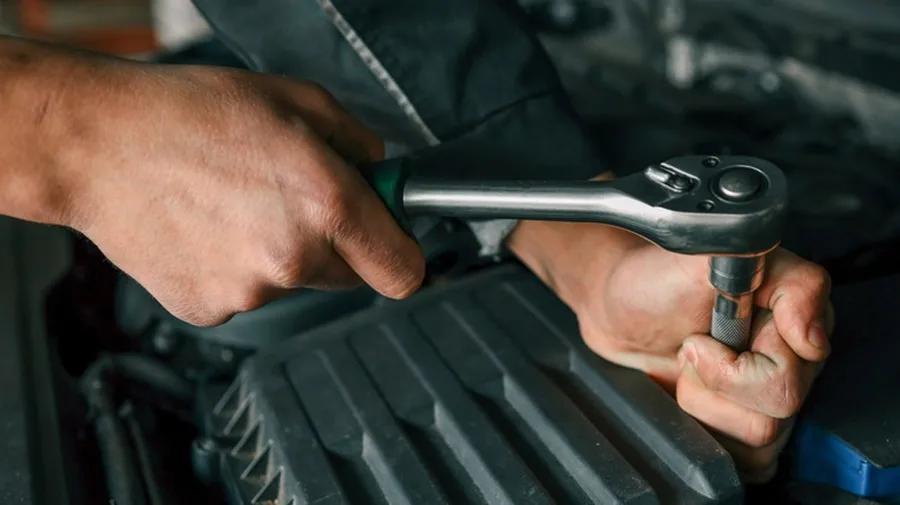
Detailed Working Mechanism
Return Stroke: As you reposition the wrench back, the pawl disengages and “clicks” over the gear teeth.
Readiness for Next Turn: The wrench is repositioned automatically without lifting, ready for another turn.
This mechanism reduces time and increases work efficiency, especially in tight or awkward spaces where a standard wrench would fail.
For professionals working in dense engine bays or compact assemblies, the flex-head ratcheting sets from Ironcube, such as these Flex Head Ratcheting Sets for Tight Spaces, provide even greater flexibility and usability.
Types of Ratcheting Wrenches: Tailored for Every Task
The principle of ratcheting wrench manifests in diverse forms, each optimized for specific scenarios. Let’s explore the spectrum, from classics to cutting-edge.
Fixed-Head Ratcheting Wrenches: The OG design, with a rigid box-end head. Ideal for standard automotive work, they offer max torque but limited flex. Our 12-piece metric set exemplifies this, covering 6-19mm sizes for everyday versatility.
Flex-Head Ratcheting Wrenches: Here, a hinged head pivots up to 180°, conquering awkward angles. Perfect for plumbing or engine bays—think accessing manifold bolts without contortions. Discover more in our flex-head ratcheting sets guide.
Reversible Ratcheting Wrenches: Dual pawls enable instant direction flips without tools. A mechanic’s dream for alternating tighten-loosen cycles, boosting workflow by 40%.
Combination Ratcheting Wrenches: Open-end on one side for initial grip, ratcheting box on the other. Hybrid heroes for mixed jobs, though slightly bulkier.
Adjustable Ratcheting Wrenches: One-size-fits-most via a sliding jaw, infused with ratchet tech. Less common but invaluable for oddball fasteners.
Socket-Style Ratcheting Wrenches: Paired with drive sockets for 1/4″ to 1″ impacts. High-speed for assembly lines.
Gearless Ratcheting Wrenches: Friction-based, no teeth—silent and smooth for precision trades like watchmaking.
Torque-Limiting Ratcheting Wrenches: Preset click-out at exact ft-lbs, preventing over-tightening in electronics.
| Type | Best For | Swing Arc | Drawback | Ironcube Recommendation |
|---|---|---|---|---|
| Fixed-Head | General Auto | 5-10° | No Flex | 12pcs Metric Set |
| Flex-Head | Tight Spaces | 5° | Slightly Weaker | Flex-Head Collection |
| Reversible | Quick Switches | 5° | Complex Internals | 10pcs New Type Set |
| Combination | Versatile Grip | 8° | Bulkier Profile | Standard Wrenches |
| Adjustable | Odd Sizes | Variable | Less Precise | Custom Picks |
| Socket-Style | High-Volume | 3-5° | Needs Sockets | Full Kits |
| Gearless | Quiet Precision | N/A | Lower Torque | Specialty Tools |
| Torque-Limiting | Calibrated Jobs | 5° | Fixed Settings | Pro Series |
This lineup, drawn from industry standards, shows how the principle adapts. For instance, flex-heads use a universal joint infused with ratchet gears, maintaining integrity under 200 ft-lbs.
In practice, selecting boils down to workspace: Cramped? Go flex. Heavy-duty? Fixed. Our complete guide to types (hypothetical internal, but adapt) offers tested reviews to match your needs.
History and Evolution of Ratcheting Wrenches
The concept of the ratchet dates back hundreds of years, first used in windlasses and clocks. As mechanical engineering advanced, ratchet systems found their way into hand tools. Ratcheting socket wrenches were among the earliest ratcheted tools, followed later by open-end and box-ratchet combination wrenches.
Over decades, manufacturers refined the gear tooth design, pawl strength, and material hardness to create wrenches that can sustain heavy workloads while maintaining precision. Today, companies like Ironcube Works have perfected ratcheting wrench sets with ergonomic designs, slim profiles, and rolling pouches for easy portability. You can browse Ironcube’s full wrench collection for more advanced options.
Real-World Applications and Uses of Ratcheting Wrenches
The principle of ratcheting wrench transcends theory, fueling diverse sectors. In automotive repair, it’s the go-to for under-hood work: Removing exhaust manifolds or swapping brake lines in 1/4-turn arcs, where space is premium.
Plumbing and HVAC: Flex-heads navigate pipe clusters, tightening compression fittings without disassembly. Pros report 30% faster installs.
Aerospace and Manufacturing: Torque-limiting variants ensure FAA-compliant fasteners, with unidirectional precision preventing strip-outs on titanium alloys.
DIY Home Projects: From IKEA assemblies to deck builds, combinations handle hex bolts effortlessly. Electricians use them for junction box security.
Marine and Off-Road: Corrosion-resistant models withstand saltwater, ratcheting trailer hitches or ATV frames amid vibrations.
Industrial apps include conveyor maintenance and wind turbine servicing, where high-torque sets apply 1000+ ft-lbs safely.
Across boards, the principle enhances safety—locked motion averts slips, reducing accidents. Watch real demos on our YouTube channel for inspiration.
For hybrid tasks, pair with screwdriver sets like our 56-Piece Ratcheting Screwdriver Kit on Amazon, extending the ratchet ethos to slotted drives.
Summary
The principle of ratcheting wrench is based on the internal ratchet gear and pawl mechanism that provides continuous tightening or loosening without the need to lift and reposition the tool. This makes them faster, more efficient, and vital in tight or complex spaces. Compared to standard wrenches, ratcheting wrenches offer higher productivity, lower fatigue, and greater versatility.
At Ironcube Works, you can explore a complete selection of durable and ergonomic ratcheting wrench sets, including both fixed and flex designs, suitable for professionals and home users alike. Whether you’re dealing with automotive work, industrial repairs, or home projects, these tools embody the perfect balance between engineering precision and everyday usability.
FAQs
Q1: What is the core working principle of ratcheting wrench?
The ratcheting wrench uses a gear-and-pawl mechanism allowing continuous torque application in one direction while permitting free movement in the other direction.
Q2: Why is a ratcheting wrench preferred over a standard wrench?
It eliminates the need to reposition the wrench constantly, saving time, reducing fatigue, and allowing work in confined areas.
Q3: Can ratcheting wrenches handle heavy torque?
Yes, high-quality wrenches like those from Ironcube Works are designed with durable steel for heavy-duty applications.
Q4: What types of ratcheting wrenches are available?
Fixed, flex-head, reversible, stubby, and combination types.
Q5: Where can I buy authentic Ironcube Ratcheting Wrenches?
You can get them directly from Ironcube’s Official Website or on Amazon Stores.