
Heavy industrial environments push tools far harder than typical workshop settings. That’s why choosing a 24 Piece Wrench Set requires a deeper look at material strength, size accuracy, ratcheting performance, ergonomics, corrosion resistance, and long-term reliability. Professional mechanics, maintenance teams, and plant technicians rely on these tools every single day. A weak wrench can round a fastener, slip under pressure, or fatigue a worker after repeated tasks.
This guide breaks down everything that matters when selecting a set meant for industrial, automotive, construction, mechanical, and factory-level use. You’ll also find references to top-performing wrench sets such as the 24-Piece Ratcheting Wrench Set and the IRONCUBE 24-Piece Ratcheting Wrench Set.
Understanding Industrial-Grade 24 Piece Wrench Set Requirements
Industrial facilities operate differently than automotive shops or residential construction sites. Equipment runs continuously across multiple shifts. Maintenance windows shrink as production demands increase. Tool failures during repairs create cascading problems affecting entire production schedules.
Material composition forms the foundation of industrial tool performance. Chrome vanadium steel alloy combines chromium’s hardness and corrosion resistance with vanadium’s strength and shock absorption. The specific alloy ratio determines performance characteristics. Industrial applications demand higher vanadium content for impact resistance when breaking loose seized fasteners on aging equipment.
Manufacturers like IRONCUBE® produce tools meeting these elevated standards through controlled forging processes. Drop-forging aligns the steel’s grain structure along stress lines, creating tools capable of handling repeated high-torque applications without deformation. This process costs more than casting but produces significantly stronger results.
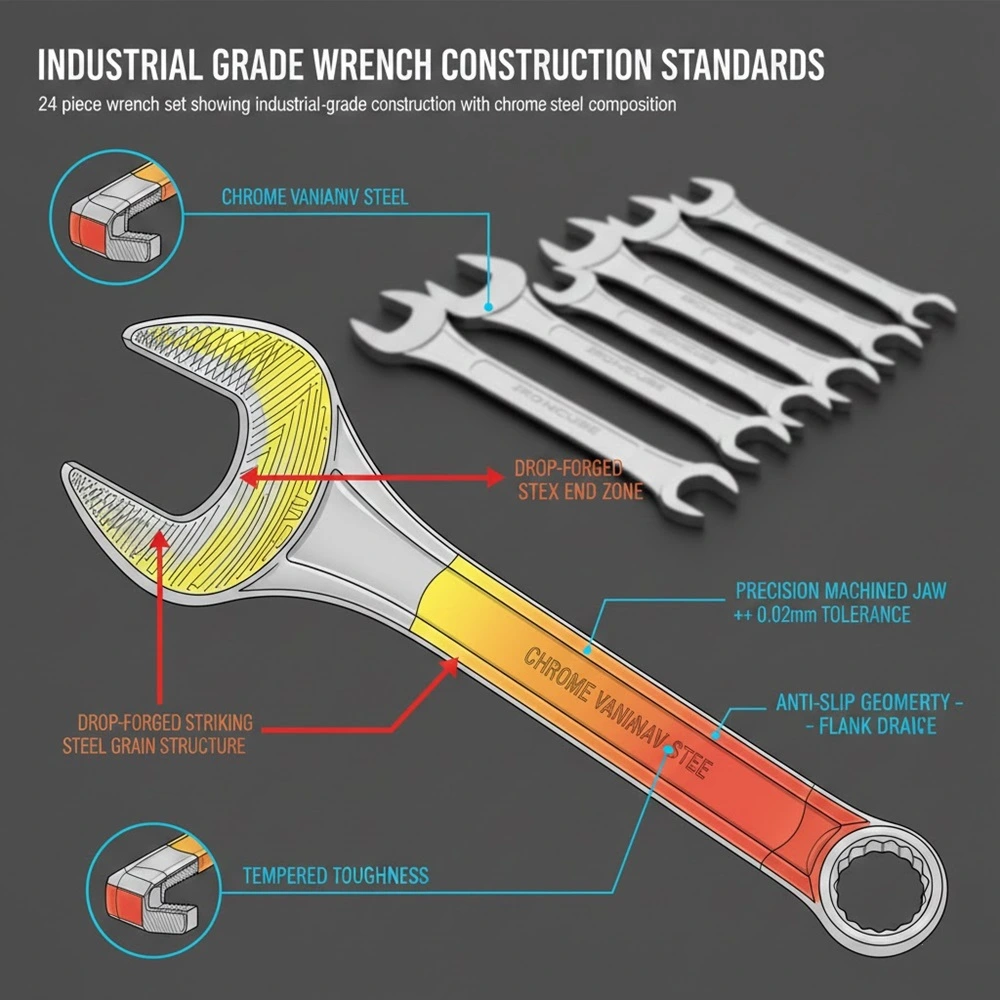
Heat treatment protocols separate professional-grade tools from hardware store products. Industrial wrenches undergo precisely controlled heating and cooling cycles that achieve specific Rockwell hardness ratings. Too soft causes deformation under load. Too hard leads to brittleness and cracking. Proper heat treatment produces tools that flex slightly under extreme stress rather than breaking catastrophically.
The chrome plating applied to finished wrenches serves multiple purposes beyond appearance. This coating resists corrosion from cutting oils, hydraulic fluids, and coolants present in industrial environments. Quality chrome plating also creates a smooth surface that sheds contaminants, making tools easier to clean between uses.
Dimensional accuracy matters more in industrial applications than casual use. Production equipment often features fasteners installed with specific torque requirements. Loose-fitting wrenches allow slippage that rounds bolt heads and damages expensive components. Precision-machined box ends provide six-point contact that distributes force evenly across the fastener.
Industrial facilities frequently handle equipment from multiple countries and different manufacturing eras. A complete 24 piece wrench set bridges these variations with comprehensive size coverage. Both metric and SAE dimensions become necessary rather than optional when maintaining diverse machinery.
Why a 24-Piece Wrench Set is Essential for Industrial Work
A 24-piece wrench set provides a comprehensive range of sizes, reducing the need for multiple tools. Industrial environments demand tools that can withstand high torque, corrosion, and frequent use. Here’s why investing in a premium set matters:
- Versatility – Covers a wide range of bolt and nut sizes, minimizing tool swaps.
- Durability – Industrial-grade materials like chrome vanadium steel resist wear and deformation.
- Efficiency – Ratcheting mechanisms and ergonomic handles speed up repetitive tasks.
- Cost-Effectiveness – Buying a complete set is more economical than purchasing individual wrenches.
For professionals who rely on precision and reliability, the IRONCUBE 24-Piece Ratcheting Wrench Set offers superior performance in demanding conditions.
Metal Quality: Why Steel Grade Matters
A wrench’s durability comes from its steel composition. In heavy industry, wrenches must endure:
High torque loads
Sudden impacts
Oil and chemical exposure
Temperature fluctuations
Long-term metal fatigue
Most high-performance wrench sets use:
1. Chrome Vanadium Steel (Cr-V)
This is the industry standard for strength and affordability. It resists deformation and offers a balance between toughness and flexibility.
2. Chrome Molybdenum Steel (Cr-Mo)
Often seen in impact-rated tools. Stronger than Cr-V and holds up well under extreme torque.
3. Heat-Treated Alloy Steel
Manufacturers like IronCube Works use precision-hardening processes to increase tool life.
A high-quality 24 Piece Wrench Set should use forged, heat-treated alloy steel with a corrosion-resistant finish.
Complete Size Coverage: Metric and SAE Requirements
A proper 24-Piece Ratcheting Wrench Set provides comprehensive coverage eliminating the frustration of missing sizes during time-sensitive repairs. Production equipment mixes fastener standards based on component origin and installation date.

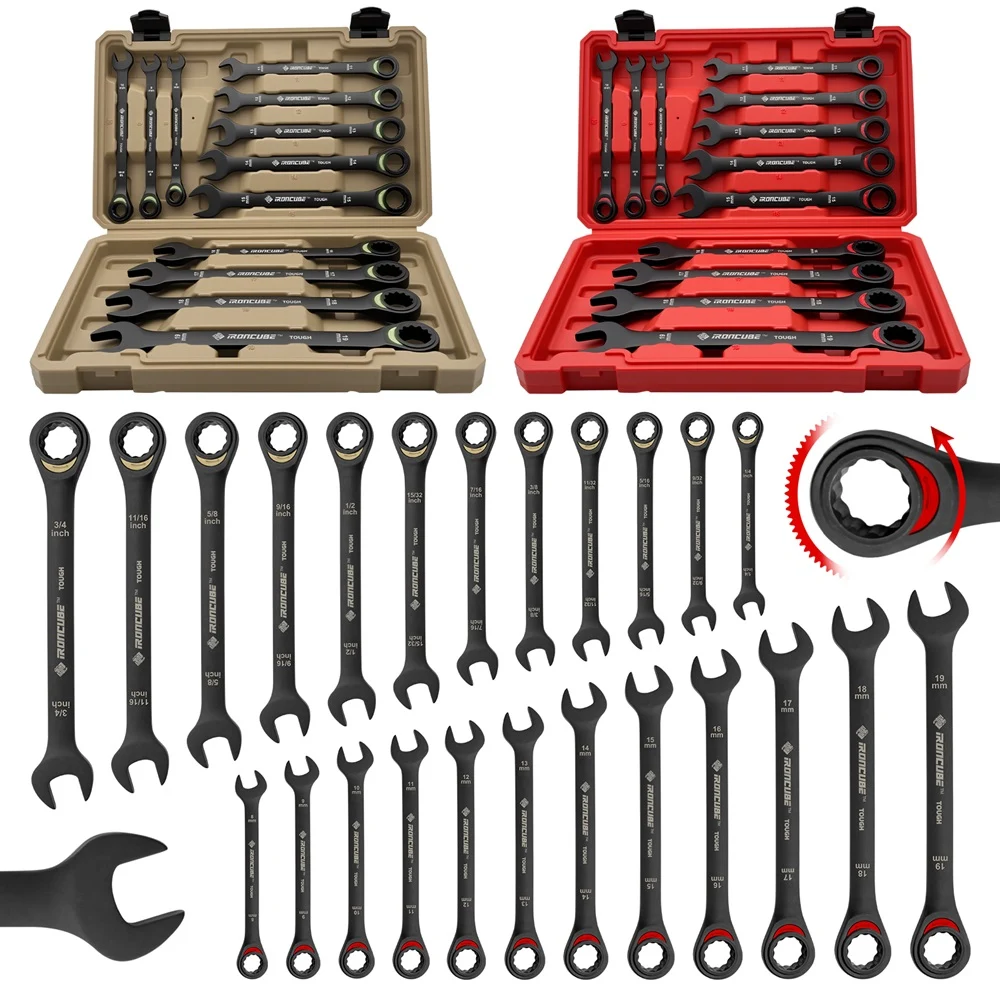
Metric sizes dominate modern manufacturing equipment. Packaging machinery from Italy, robotics from Japan, and CNC equipment from Germany all use metric fasteners. A complete metric range typically includes: 8mm, 9mm, 10mm, 11mm, 12mm, 13mm, 14mm, 15mm, 16mm, 17mm, 18mm, and 19mm sizes. Some sets extend to 22mm or 24mm for larger applications.
SAE (fractional inch) sizes appear on older American equipment and specialized machinery. Food processing plants operating vintage conveyors, paper mills maintaining legacy equipment, and automotive parts manufacturers all encounter SAE fasteners regularly. Complete SAE coverage includes: 1/4″, 5/16″, 3/8″, 7/16″, 1/2″, 9/16″, 5/8″, 11/16″, 3/4″, 13/16″, 7/8″, and 15/16″ sizes.
The IRONCUBE 24-Piece Ratcheting Wrench Set delivers this comprehensive range in a single organized kit. Technicians no longer waste time searching for the correct size or improvising with adjustable wrenches that damage fastener heads.
Production facilities benefit from standardizing tool specifications across maintenance teams. When every technician carries identical wrench sets, tool accountability improves and training becomes consistent. New hires learn a single tool system rather than adapting to individual preferences.
Industrial Application Size Requirements
Different industries emphasize specific size ranges based on their equipment profiles. Understanding these patterns helps facilities stock appropriate tools.
Food and Beverage Processing relies heavily on stainless steel equipment with metric fasteners. Sizes between 10mm and 17mm handle most maintenance tasks on mixing equipment, pumps, and conveyor systems. Sanitary equipment design often uses specific sizes repeatedly throughout a facility.
Automotive Manufacturing demands comprehensive metric coverage with emphasis on 10mm, 12mm, 13mm, and 17mm. These sizes appear constantly on assembly tooling, robotic work cells, and material handling equipment. SAE sizes remain relevant for legacy tooling and fixtures.
Paper and Pulp Mills operate massive machinery mixing both standards. Older American-made equipment uses SAE fasteners while newer European components employ metric. Maintenance teams require both systems to service production lines effectively.
Chemical Processing Plants maintain equipment exposed to harsh environments. Corrosion makes fasteners difficult to remove, requiring high-quality wrenches capable of applying significant torque without failure. Extended wrench length provides the leverage needed for seized bolts.
Workplace Safety and Proper Tool Usage
Industrial safety regulations require proper tool selection and usage procedures. Using wrenches correctly protects workers and extends tool life while preventing equipment damage.
Correct size selection forms the foundation of safe wrench usage. Never use wrenches on fasteners larger or smaller than the tool’s designed capacity. Oversized wrenches slip off bolt heads, causing injuries and rounded fasteners. Undersized wrenches spread open under load, permanently deforming the tool.
Pull rather than push when operating wrenches. Pulling provides better control and reduces injury risk if the wrench slips or the fastener suddenly breaks loose. Position yourself so slippage won’t cause falls or collisions with equipment. Many industrial injuries occur when technicians push wrenches and lose balance when fasteners release.
Inspect tools before each use. Examine box ends for rounding or cracks. Check open ends for spreading. Test ratcheting mechanisms for smooth operation. Remove any damaged tools from service immediately. A broken wrench becomes a projectile causing serious injuries.
Keep wrenches clean and lightly oiled. Dirt and grime in ratcheting mechanisms cause premature wear and unreliable operation. Oil residue on handles reduces grip, increasing slippage risk. Clean tools provide better tactile feedback and operate more reliably.
Wear appropriate personal protective equipment when using hand tools. Safety glasses protect against flying debris if fasteners or tools break under load. Gloves protect hands from sharp edges and provide better grip on oily surfaces. Steel-toed boots protect feet from dropped tools or heavy components.
Store tools properly when not in use. Scattered tools create tripping hazards. Tools left on machinery can fall into moving components causing catastrophic failures. Establish and enforce tool storage protocols throughout the facility.
Manufacturing Tolerance: Precision Engineering for Torque
In heavy industry, the fit of the wrench onto the fastener head is paramount. A sloppy fit leads to “slop” or movement before the wrench engages, which dramatically increases the risk of rounding the corners of the bolt (fastener deformation).
Head Clearance and Jaw Precision
Premium industrial wrenches are manufactured to extremely tight tolerances.
Minimal Head Clearance: High-end brands ensure that the jaw opening or box end diameter is as close as possible to the nominal fastener size (e.g., a 19mm wrench is precisely 19.00mm, with minimal positive tolerance). This is achieved through precision machining after forging.
Anti-Slip Technology: Many manufacturers incorporate proprietary designs into the box end (sometimes called “Flank Drive” or similar names). These designs shift the contact points away from the corners and onto the flat surfaces of the fastener. This significantly increases the gripping area and allows the tool to transfer maximum torque without damaging the fastener, an absolute must-have feature for working with rusted or stuck industrial bolts.
Open-End Jaw Angle and Thickness
Open-End Angle: Most combination wrenches feature a offset on the open end. This simple angle allows the user to flip the wrench over after each turn and achieve a new working angle, effectively doubling the access points and making it possible to work in tight increments.
Head Thickness: While thicker heads provide greater strength, they can hinder access. Industrial wrench design is a balance—the head must be strong enough to resist splaying under heavy load but thin enough to slide easily over low-profile nuts or bolts in constrained locations.
Selecting the Right Manufacturer and Supplier
Manufacturer selection impacts tool quality, delivery reliability, and long-term support. Established companies with proven track records reduce procurement risks.
Manufacturing capabilities reveal quality potential. Companies with in-house forging, CNC machining, heat treatment, and finishing operations maintain complete process control. Businesses outsourcing manufacturing steps lose quality oversight. IRONCUBE® operates integrated facilities with complete control from raw materials to finished tools.
Quality certifications indicate commitment to consistent manufacturing standards. ISO 9001 certification demonstrates documented quality management systems. While certification alone doesn’t guarantee superior products, its absence raises concerns about process consistency. IRONCUBE® maintains environmental compliance supporting both regulatory requirements and corporate responsibility.
Customer support infrastructure becomes valuable when problems occur. Can you reach technical support easily? Do they respond promptly to quality concerns? Companies serving industrial markets understand downtime costs and prioritize rapid problem resolution.
Customization capabilities serve facilities with specialized needs. Can the manufacturer modify standard products for specific applications? Do they offer custom branding for large orders? Flexible manufacturers partner with customers rather than simply selling commodity products.
Lead times and delivery reliability affect production planning. Manufacturers with adequate inventory and efficient logistics minimize supply disruptions. Ask about typical delivery times and their ability to expedite emergency orders.
Pricing transparency simplifies budgeting and comparison shopping. Hidden fees for packaging, shipping, or small order quantities complicate cost analysis. Straightforward pricing demonstrates respect for customer procurement processes.
The IRONCUBE Edge: A Commitment to Industrial Quality
Choosing an IRONCUBE set means choosing tools engineered specifically for the demands of a commercial and industrial environment. We pride ourselves on the precise heat treatment and durable alloy selection that ensures our tools meet and exceed professional standards.
Our IRONCUBE 24-Piece Ratcheting Wrench Set is a prime example of this commitment. It combines the speed of a fine-tooth ratcheting mechanism with the strength of Chrome Vanadium steel and a fully polished, corrosion-resistant finish.
For those with unique application requirements, remember that we also offer customized tool solutions. If you need a specific mix of Metric and Imperial sizes, or specialized finishes for unique environments, our team can work with you to build the perfect 24 Piece Wrench Set.
Summary
Selecting the right 24 Piece Wrench Set for heavy industrial use is a choice that affects safety, efficiency, and long-term cost. The decision must be driven by a clear understanding of material science (like Chrome Vanadium or Chrome Molybdenum steel), precision engineering (like minimal head clearance and anti-slip geometry), and the required sizing system (Metric or Imperial).
The most reliable industrial wrench set is one that has been drop-forged, precisely heat-treated, and engineered to offer a secure, non-slip grip on the fastener. When you invest in a premium 24 Piece Wrench Set, you are investing in a tool designed to withstand the relentless forces and corrosive environments of a heavy-duty workplace, ensuring the job is done right the first time, every time. Trust in IRONCUBE WORKS for tools that stand up to the toughest challenges in the world of industry.
FAQs
1. What’s the difference between metric and SAE wrenches?
- Metric (millimeters) is used globally, while SAE (inches) is common in the U.S. A 24-piece set should include both for versatility.
2. Can I use a ratcheting wrench for high-torque applications?While ratcheting wrenches are efficient, they may not handle extreme torque as well as solid wrenches. For heavy-duty tasks, use a standard wrench or breaker bar.
3. How do I choose between chrome and black oxide finishes?
- Chrome offers better corrosion resistance.
- Black oxide reduces glare and provides a firmer grip.
4. Where can I buy a reliable 24-piece wrench set?Check out the IRONCUBE 24-Piece Ratcheting Wrench Set on Amazon for a high-quality industrial-grade option.