When mechanics talk about a 72-tooth ratcheting wrench, they are not just discussing another hand tool. They are talking about speed, precision, comfort, and the ability to work in places where ordinary wrenches struggle. Whether you repair cars, install HVAC systems, maintain industrial machinery, or simply enjoy DIY garage work, the tooth count inside a ratcheting wrench directly affects how efficiently you can turn fasteners.
A modern 72-tooth ratchet has become the professional standard because it offers the ideal balance between smooth operation and long-term durability. With a tight 5-degree swing arc, users can loosen or tighten bolts even when there is almost no room to move the handle. That small detail makes a massive difference inside crowded engine bays or behind industrial panels.
At IRONCUBE Works, precision tools are designed for real-world professionals who demand reliability every day. If you are shopping for premium hand tools, the company’s wrench collection includes professional-grade solutions built for demanding environments.
In this guide, you will learn exactly how ratcheting tooth count works, why 72-tooth mechanisms dominate professional toolboxes, how they compare against lower and higher tooth designs, and how to choose the best option for your work.
What Does 72-Tooth Mean on a Ratcheting Wrench?
A ratcheting wrench contains a gear mechanism inside the box end of the tool. That gear has teeth cut into it. The number of teeth determines how far the wrench handle must move before the mechanism engages another tooth.
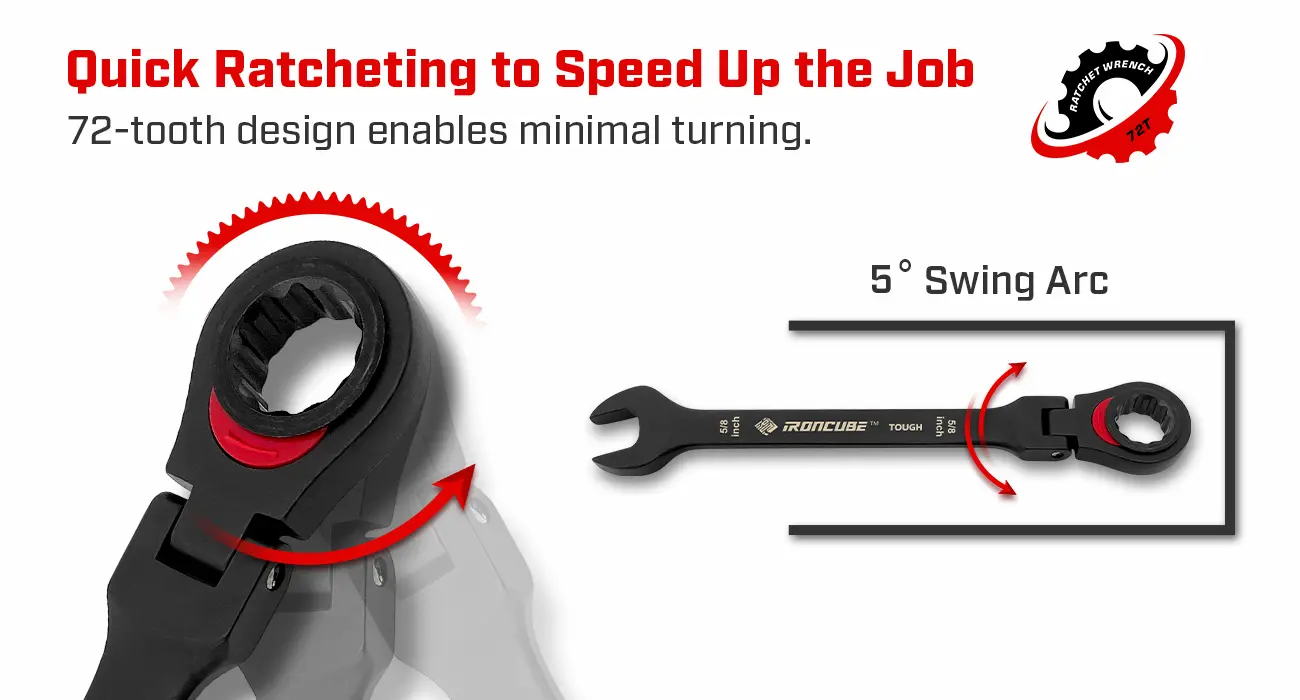
A 72-tooth ratcheting wrench uses a gear with 72 internal teeth. Because the gear has more teeth, the wrench requires less movement to engage the next click.
How Tooth Count Determines Swing Arc
The swing arc refers to the minimum angle needed for the wrench to advance the fastener.
The formula is simple:
360 degrees ÷ tooth count = swing arc
For a 72-tooth wrench:
360∘72=5∘\frac{360^\circ}{72}=5^\circ
That means the wrench only needs a 5-degree movement to continue tightening or loosening a fastener.
By comparison:
| Tooth Count | Swing Arc | Typical Use |
|---|---|---|
| 36-tooth | 10° | Basic home repairs |
| 72-tooth | 5° | Professional automotive and industrial work |
| 120-tooth | 3° | Ultra-tight spaces and specialty applications |
A smaller swing arc allows smoother work in cramped spaces. According to the engineering explanation published in the Wikipedia wrench overview, ratcheting systems evolved specifically to improve access in confined working conditions.
This is why a fine-tooth ratcheting wrench is often preferred by professional technicians.
72-Tooth vs 36-Tooth vs 120-Tooth Comparison
Many buyers assume a higher tooth count automatically means a better wrench. That is not always true.
A 36-tooth wrench is simple and strong, but it requires a wide turning motion. In modern engine compartments, there is often not enough clearance for a 10-degree swing.
A 120-tooth wrench provides extremely fine engagement, but ultra-high tooth counts sometimes sacrifice durability under heavy torque loads. More teeth can mean smaller gear surfaces handling the force.
The 72-tooth design sits directly in the middle. It offers excellent precision while still maintaining strong gear engagement and long-term durability.
Professional mechanics often choose 72-tooth systems because they deliver the best compromise between access and strength.
If you want to compare different wrench systems further, the detailed guide at Non-Ratcheting Wrenches Explained provides additional insights into wrench performance and applications.
Why 72-Tooth Is the Professional Sweet Spot
The popularity of the 72-tooth ratcheting wrench did not happen by accident. Mechanics, maintenance crews, and industrial technicians gradually adopted it because it solves multiple real-world problems at once.
5-Degree Swing Arc for Confined Engine Bay Work
Modern vehicles pack more components into smaller engine compartments. According to data from the U.S. Environmental Protection Agency automotive trends reports, manufacturers continue reducing vehicle size while increasing system complexity and efficiency.
As a result, mechanics often work in extremely restricted spaces.
Imagine trying to remove a bolt located behind an alternator bracket or near a firewall. A standard wrench may not have enough clearance to rotate fully. With a 72-tooth mechanism, only 5 degrees of movement is needed to advance the fastener.
That small swing arc dramatically improves productivity.
A 5-degree swing arc wrench reduces hand repositioning, saves time, and lowers user fatigue during repetitive repairs.
For automotive technicians who spend hours working inside tight engine compartments, that efficiency matters every single day.
Balancing Precision with Durability
Higher tooth counts sound impressive on marketing materials, but professional users understand the importance of durability.
Each tooth inside the ratcheting gear absorbs mechanical force. When tooth counts become extremely high, individual teeth may become smaller and more vulnerable under heavy torque.
A 72-tooth design offers enough engagement points for smooth operation while still preserving strong tooth geometry.
That balance is one reason why many tool manufacturers continue using 72-tooth systems in their flagship professional products.
In real-world use, professionals need tools that can handle:
- Rusted fasteners
- High torque loads
- Frequent daily operation
- Industrial environments
- Oil and chemical exposure
The best 72-tooth designs maintain consistent performance under all of these conditions.
If you are comparing premium hand tools for professional environments, the Best Ratcheting Wrench Set in 2026 guide explores some of the strongest-performing options currently available.
Why Most Pro Mechanics Prefer 72-Tooth Over Higher Counts
Professional mechanics rarely choose tools based purely on specifications. They care about reliability, feel, and long-term performance.
Many technicians prefer a 72 tooth ratchet because:
- It provides smooth engagement without excessive internal complexity
- It handles moderate-to-high torque effectively
- It works well in tight spaces
- It lasts longer under heavy daily use
- Replacement parts are widely available
Some ultra-high-tooth ratchets may feel smoother initially, but professionals often report faster wear when subjected to constant high-load applications.
In busy repair shops, downtime costs money. Mechanics need tools they can trust.
That practical reliability is why 72-tooth systems remain one of the most widely adopted standards across automotive, industrial, and mechanical industries.
Real-World Applications Where 72-Tooth Wrenches Shine
A 72-tooth ratcheting wrench is not limited to automotive repair. Its compact movement and smooth operation make it valuable across many industries.

Automotive Engine Compartment Repairs
Automotive repair remains the most common environment for ratcheting wrenches.
Modern engine bays contain:
- Turbochargers
- Wiring harnesses
- Tight coolant lines
- Emissions systems
- Compact mounting brackets
These components limit wrench movement.
A fine tooth ratcheting system allows mechanics to work efficiently around obstacles without repeatedly removing and repositioning the wrench.
Common automotive tasks include:
- Alternator replacement
- Battery terminal service
- Suspension repairs
- Brake assembly work
- Spark plug access
- Intake manifold repairs
Technicians also appreciate the speed advantage. Ratcheting mechanisms significantly reduce repair time compared to traditional fixed wrenches.
For sizing help during automotive repairs, the printable guide at Printable Metric to SAE Wrench Size Conversion Chart can simplify tool selection.
Plumbing and HVAC Installations
HVAC and plumbing systems often place fasteners in awkward locations behind ducts, water heaters, or wall-mounted systems.
A traditional wrench may require repeated repositioning due to limited movement space.
The small swing arc of a 72-tooth ratcheting wrench allows installers to continue turning fasteners even with minimal clearance.
HVAC professionals commonly use these wrenches for:
- Refrigeration line brackets
- Condenser installations
- Pipe support systems
- Furnace assembly
- Duct fastening
Plumbers also benefit when working beneath sinks or inside cabinetry where wrench movement is restricted.
Industrial Machinery Maintenance
Industrial maintenance teams frequently deal with machinery that contains hundreds of fasteners in hard-to-access locations.
Downtime in manufacturing facilities can become extremely expensive. According to industrial maintenance studies from Plant Engineering, even short production interruptions can cost thousands of dollars per hour in large facilities.
Because of this, maintenance crews prioritize tools that improve speed and efficiency.
A best 72-tooth wrench design helps technicians:
- Reach confined machinery sections
- Reduce maintenance time
- Improve workflow efficiency
- Minimize hand fatigue
- Maintain accuracy under pressure
Industrial environments also demand strong corrosion resistance and hardened steel construction.
High-quality ratcheting wrenches typically use chrome vanadium steel or chrome molybdenum alloys for maximum durability.
IRONCUBE 72-Tooth Ratcheting Wrench Sets — Built for Precision
Professional tools should feel dependable from the first turn. That is why many users look for carefully engineered ratcheting systems with tight tolerances and durable construction.
The <a href=”https://ironcubeworks.com/product-category/wrenches/”>IRONCUBE wrench collection</a> focuses on professional-grade reliability for automotive, industrial, and workshop environments.
What separates premium ratcheting wrench systems from cheap alternatives?
High-Strength Alloy Construction
Budget ratcheting wrenches often fail because of weak internal gears. Professional-grade tools use hardened alloys that resist deformation under torque.
Quality 72-tooth systems commonly feature:
- Chrome vanadium steel
- Heat-treated gear systems
- Corrosion-resistant finishes
- Precision-machined ratchet gears
These materials improve both lifespan and reliability.
Smooth Gear Engagement
A poorly manufactured ratchet may skip teeth or feel rough during operation.
High-end 72-tooth systems use precision-cut gears to maintain smooth engagement throughout the rotation cycle.
This smoother operation helps technicians maintain better control while reducing strain during repetitive work.
Ergonomic Design
Comfort matters during long repair sessions.
Professional wrench sets often include:
- Rounded handle edges
- Balanced weight distribution
- Slip-resistant finishes
- Compact head profiles
These features improve comfort while reducing hand fatigue.
Complete Tool Compatibility
Many mechanics combine ratcheting wrenches with screwdriver systems and socket sets for full workshop versatility.
IRONCUBE also offers compatible professional screwdriver solutions, including:
If you also work with electronics or precision fastening systems, the guides at Best Screwdriver Sets of 2026 and Best Magnetic Screwdriver Set Tips provide additional recommendations.
For product updates and demonstrations, the official IRONCUBE YouTube channel showcases real-world tool usage.
Users can also browse additional product availability through the official IRONCUBE Amazon storefront.
How to Choose the Best 72-Tooth Ratcheting Wrench
Not every wrench performs equally. Several important factors affect long-term performance.
Check the Material Quality
Look for:
- Chrome vanadium steel
- Heat-treated gears
- Corrosion-resistant coatings
- Precision-machined ratchet heads
Avoid low-cost stamped steel tools that may wear quickly.
Evaluate the Ratchet Mechanism
A quality mechanism should:
- Engage smoothly
- Produce consistent clicks
- Avoid gear skipping
- Handle high torque loads
The ratchet should feel solid without excessive internal looseness.
Choose the Correct Measurement System
Mechanics usually need both SAE and metric sizes.
If you regularly work on imported vehicles, metric tools are essential. Domestic applications may require SAE sizes.
Helpful comparison resources include:
Consider Reversible vs Fixed Ratcheting Heads
Some ratcheting wrenches include directional switches. Others require flipping the wrench over to reverse direction.
Reversible systems offer faster operation, but fixed-head designs sometimes provide slimmer profiles for tight spaces.
The right choice depends on your work environment.
How to Maintain the Ratcheting Mechanism for Long Life
Even premium tools require proper maintenance.
A neglected ratchet mechanism can eventually develop skipping, stiffness, or internal corrosion.
Fortunately, maintenance is simple.
Keep the Mechanism Clean
Dust, metal particles, and grease buildup can interfere with the gear teeth.
After heavy use:
- Wipe the wrench clean
- Remove debris from the ratchet head
- Store tools in a dry environment
Avoid exposing the mechanism to excessive moisture.
Lubricate Periodically
Professional mechanics often apply light machine oil to the ratchet head every few months.
Proper lubrication:
- Reduces friction
- Improves smoothness
- Prevents corrosion
- Extends gear life
Do not over-lubricate. Excess oil may attract debris.
Avoid Using Ratcheting Wrenches as Breaker Bars
A ratcheting wrench is designed for controlled torque, not extreme force.
For heavily seized fasteners, use:
- Penetrating oil
- Breaker bars
- Impact tools
Using excessive force on a ratcheting mechanism can damage the internal teeth.
Store Tools Correctly
Proper storage dramatically improves tool lifespan.
Use:
- Tool rolls
- Foam organizers
- Dry cabinets
- Portable mechanic cases
This prevents accidental impacts and moisture exposure.
Why Tooth Count Matters More Than Most Buyers Realize
Many first-time buyers focus only on price or brand names. However, ratcheting wrench tooth count significantly affects real-world performance.
A low-tooth ratchet may feel frustrating inside tight spaces.
An ultra-high-tooth design may not survive heavy daily use.
The 72-tooth system remains popular because it balances:
- Compact swing arc
- Smooth engagement
- Mechanical durability
- Long-term reliability
- Professional versatility
That balance is exactly why experienced mechanics continue choosing it year after year.
A Complete Precision Tool Ecosystem
A great wrench set forms the foundation of a mechanic’s toolbox, but precision work requires complementary tools. When you finish turning bolts with your ratcheting wrenches, you inevitably encounter screws that require an equally precise driver. Ratcheting screwdriver sets mirror the efficiency of a ratcheting wrench by allowing you to drive screws rapidly without repositioning your hand. If you are upgrading your wrench collection, you should absolutely consider adding a versatile 65-piece ratchet screwdriver and socket bit set to your arsenal. This specific kit handles virtually any screw head configuration you will find in modern machinery.
Alternatively, for technicians who prefer a slightly more compact carry solution, the 56-piece ratcheting screwdriver bits and sockets set provides exceptional versatility in a smaller footprint. We take screwdriver quality just as seriously as our wrenches. You can read about the different blade types and their specific uses in our guide to screwdriver types and uses. To see how our screwdrivers stack up against the competition, take a look at our comprehensive roundup of the best screwdriver set options currently on the market. We also highly recommend checking out the advantages of specialized magnetic tips in our article detailing the best magnetic screwdriver set tips. If you want to see our highest-rated driver combinations for the upcoming year, read our guide to the best screwdriver sets of 2026. You can view our entire inventory of precision drivers directly on our screwdrivers page.
Final Summary
The 72-tooth ratcheting wrench has earned its reputation as the professional sweet spot for precision fastening work. Its 5-degree swing arc delivers excellent access inside confined spaces without sacrificing durability or strength. Whether you work on automotive repairs, HVAC systems, industrial machinery, or home garage projects, a high-quality 72-tooth mechanism improves efficiency, comfort, and control.
Instead of chasing the highest tooth count available, experienced professionals usually prioritize balance. That is exactly what makes the 72-tooth design so effective. It combines smooth operation, reliable torque handling, and long-term durability in one versatile tool platform.
For professionals looking to upgrade their workshop setup, the precision-engineered solutions available at IRONCUBE Works offer dependable performance built for demanding real-world environments.
FAQs
Is a 72-tooth ratcheting wrench better than a 120-tooth wrench?
A 72-tooth ratcheting wrench is often better for general professional use because it balances precision and durability. A 120-tooth system provides a smaller swing arc, but some designs may sacrifice long-term strength under heavy torque.
What is the advantage of a 5-degree swing arc wrench?
A 5-degree swing arc wrench allows users to turn fasteners in tight spaces with minimal handle movement. This is especially useful inside engine bays, HVAC systems, and industrial machinery.
Are 72-tooth ratchets strong enough for automotive repairs?
Yes. A quality 72-tooth ratchet is strong enough for most automotive applications when manufactured from hardened chrome vanadium steel and properly maintained.
Why do mechanics prefer fine-tooth ratcheting wrenches?
Professional mechanics prefer a fine-tooth ratcheting wrench because it reduces repositioning in confined spaces, improves efficiency, and speeds up repetitive fastening work.
How long does a 72-tooth ratcheting wrench last?
A premium 72-tooth ratcheting wrench can last many years with proper lubrication, cleaning, and correct usage. Professional-grade models are designed for daily shop environments.
Can a ratcheting wrench replace sockets completely?
No. While a 72-tooth ratcheting wrench handles many tasks efficiently, sockets still provide better torque handling for heavily tightened fasteners and deep fastener access.