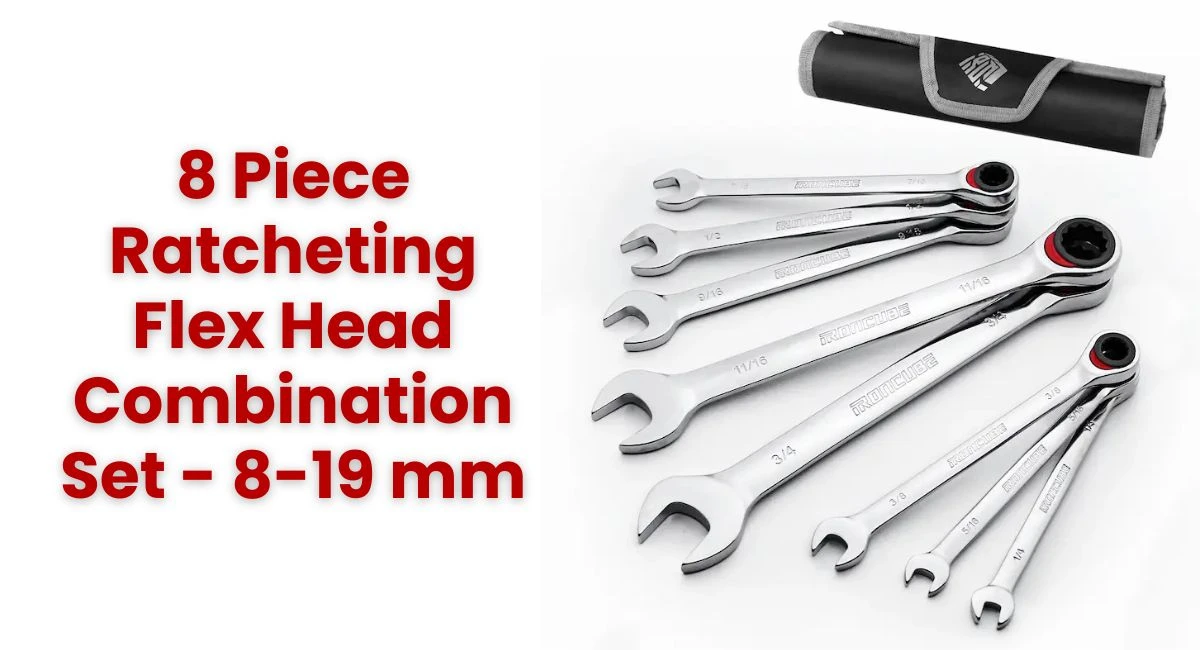
Finding the right tool for a specific job often feels like searching for a needle in a haystack. If you have ever spent an afternoon bruised and frustrated because a standard wrench wouldn’t fit into a cramped engine bay, you know the value of specialized gear. This is where the 8 Piece Ratcheting Flex Head Combination Set comes into play. It bridges the gap between traditional hand tools and modern efficiency. Whether you are a professional mechanic or a weekend warrior working in your home garage, having the right range of 8-19 mm sizes at your fingertips can transform a four-hour struggle into a twenty-minute breeze.
Efficiency in mechanical work is not just about speed; it is about precision and safety. A Ratcheting Flex Head Combination Set offers a unique pivot point that allows the user to reach around obstructions. According to industry insights from Wikipedia’s history of wrenches, the evolution of the wrench has always moved toward better torque application and ergonomics. Modern manufacturing has allowed us to shrink these concepts into a sleek 8-piece kit that covers the most common metric fasteners used in modern vehicles and machinery.
What Is a Ratcheting Flex Head Combination Set?
A ratcheting flex head combination set is a collection of wrenches that combine two essential features: a ratcheting mechanism and a flexible head. These tools allow users to tighten or loosen fasteners without removing the wrench after each turn, improving speed and efficiency.
According to Wrench fundamentals, a wrench is designed to provide grip and mechanical advantage in applying torque to turn objects, usually nuts and bolts. Modern ratcheting designs take this principle further by eliminating the need for repetitive repositioning.

For a deeper understanding of how these tools function, you can explore this detailed guide on
👉 https://ironcubeworks.com/how-does-a-ratchet-wrench-work/
What Exactly Is a Ratcheting Flex Head Combination Set?
A wrench is one of the oldest hand tools in existence, dating back centuries. The ratcheting combination variant brings together two ends on one handle: an open-end jaw on one side and a ratcheting box end on the other. Add a flex joint between the box end and the beam, and you get a tool that pivots up to 180 degrees, letting you access fasteners at angles a rigid wrench simply cannot reach.
The “combination” part is crucial. The open end slides onto a bolt from the side when there is no room to slip a box end over the top. The ratcheting box end then takes over once the bolt is finger-tight, spinning it down quickly without lifting the wrench off the fastener. This two-in-one design eliminates the need to carry separate open-end and box-end sets. If you want to understand the internal mechanism in more depth, IRONCUBE published a clear explainer on how a ratchet wrench works that breaks down the pawl-and-gear system inside.
The eight-piece metric format—covering 8, 10, 12, 13, 14, 15, 17, and 19 mm—is not arbitrary. These are the most frequently used metric fastener sizes across European and Asian automotive platforms, industrial machinery, and household appliances. Keeping the set to eight pieces also means a lighter, more compact roll pouch that fits in a motorcycle pannier or a belt-mounted tool roll without weighing you down.
Why the Flex Head Changes Everything in Confined Spaces
Rigid ratcheting wrenches are already faster than standard combination wrenches, but they share one critical limitation: you need a clear arc of swing directly above the fastener. In real-world applications—under a dashboard, behind an exhaust manifold, between tightly packed hydraulic lines—that clear arc rarely exists. The flex head solves this problem by letting the box end tilt away from the beam, often by as much as 180 degrees at any interval.
IRONCUBE has written extensively about this advantage. Their article on flex head ratcheting sets working in tight spaces walks through several real scenarios—motorcycle valve adjustments, sink faucet installations, and engine-bay work—where a flex head cut task time nearly in half compared to a rigid wrench. A separate resource on the benefits of a flexible head ratchet covers the ergonomic gains: less wrist strain, fewer skinned knuckles, and a more natural hand position when working overhead or at odd angles.
From a mechanical standpoint, the flex joint typically uses a spring washer or detent mechanism that holds the head at whatever angle you set it to. Better designs keep the joint tension consistent over thousands of cycles so the head does not flop around loosely after a year of daily use.
Features to Evaluate in Any Ratcheting Flex Head Combination Set
Tooth Count and Arc Swing
The tooth count of the ratcheting gear determines how small an arc you need to advance the fastener. A 72-tooth mechanism requires only 5 degrees of swing to engage the next tooth, compared to roughly 30 degrees on a standard combination wrench. Some premium sets push to 90 teeth (4-degree arc) or even 100+ teeth. For most automotive and maintenance work, 72 teeth strikes a good balance between precision and gear durability. Industry data from GearWrench confirms that a 72-tooth ratcheting box end needs as little as 5 degrees to move fasteners, making it ideal for confined areas with limited clearance.
Steel Grade and Hardness
Chrome vanadium (Cr-V) steel is the standard material for professional-grade wrenches. It offers an excellent combination of tensile strength, toughness, and corrosion resistance. Some manufacturers use chrome molybdenum (Cr-Mo) for higher-torque applications, though Cr-V remains the most widely specified alloy for combination wrenches up to 19 mm. According to a Wise Guy Reports market analysis, chrome vanadium steel dominates the global ratcheting combination wrench market, with manufacturers increasingly investing in advanced heat-treatment processes to improve tool life.
Surface finish also matters. A mirror-polished chrome plating resists corrosion, repels grease, and wipes clean easily. It is not just cosmetic—without a proper finish, bare steel starts rusting the moment it contacts moisture, which is inevitable in any working environment from garages to construction sites.
Beam Profile and Ergonomics
A thin-profile beam is essential for sliding into narrow gaps between adjacent fasteners or between a bolt head and a nearby component. IRONCUBE’s 8-piece metric super thin wrench set is designed with this exact principle in mind—the beam is slim enough to fit where standard-thickness wrenches cannot. At the same time, the cross-section retains enough material to handle respectable torque loads without flexing or twisting.
Ergonomic considerations extend to the handle shape and the presence of a serrated or knurled section near the box end, which helps you feel the ratcheting direction by touch alone. This is surprisingly useful when you are working blind—reaching into an engine bay by feel rather than by sight.
Reversing Mechanism
Every ratcheting wrench needs a way to switch between tightening and loosening. Most modern sets use a small lever or toggle on the back of the box end that reverses the pawl direction. The best designs position this lever so it is easy to flip with a gloved thumb but hard to bump accidentally. The IRONCUBE reversible ratcheting wrench on Amazon uses exactly this kind of flush-mount lever that stays put during use.
Size-by-Size Breakdown: What Each Wrench in the 8–19 mm Set Covers
Not every wrench in the set sees equal use. Here is a practical breakdown of each metric size, the fasteners it fits, and where you are most likely to reach for it. If you also work with SAE fasteners and need a conversion reference, IRONCUBE’s printable metric to SAE wrench size conversion chart is worth bookmarking.
| Size | Nearest SAE Equivalent | Common Applications | Usage Frequency |
| 8 mm | 5/16″ | Small hose clamps, electronics enclosures, trim fasteners | Moderate |
| 10 mm | 3/8″ | Battery terminals, intake manifolds, body panels, brackets | Very High—most-used metric size |
| 12 mm | 15/32″ | Suspension bolts, exhaust hangers, alternator mounts | High |
| 13 mm | 1/2″ | Brake caliper slides, transmission bolts, engine accessories | High |
| 14 mm | 9/16″ | Wheel lug bolts (some European cars), strut mounts | Moderate–High |
| 15 mm | 19/32″ | Fuel lines, steering components, frame bolts | Moderate |
| 17 mm | 11/16″ | Wheel lug nuts (many Japanese/European), axle nuts | Very High |
| 19 mm | 3/4″ | Wheel lug nuts (trucks, SUVs), larger suspension hardware | Very High |
The 10 mm wrench deserves special mention. It is legendary in automotive circles for being the most frequently used—and the most frequently lost—metric size. If your set does not include a 10 mm, it is incomplete by definition.
Ratcheting Flex Head Combination Set vs. Standard Wrench Sets: A Direct Comparison
| Feature | Ratcheting Flex Head Set | Standard Combination Set |
| Arc Swing Required | 5° (72-tooth) | 30° or more |
| Access in Tight Spaces | Excellent – flex head pivots to 180° | Limited – rigid head only |
| Speed of Fastening | Fast – no need to lift and reposition | Slow – must lift and reset after each pull |
| Wrist Fatigue Over 8-Hour Shift | Significantly reduced | Moderate to high |
| Typical Price (8-piece metric) | $35–$80 | $15–$35 |
| Weight per Wrench | Slightly heavier (ratchet mechanism adds mass) | Lighter |
| Durability Concern | Ratchet gear may wear – quality dependent | Fewer moving parts |
| Best For | Professional & frequent use in confined areas | Occasional use, open-access bolts |
The price premium for a ratcheting flex head combination set is real, but it pays for itself quickly in time saved. A professional mechanic who bills by the hour can recover the cost difference in a single afternoon of engine work. For a deeper pricing analysis, check out IRONCUBE’s breakdown of flex head wrench pricing across different brands and configurations.
Real-World Applications Where This Set Excels
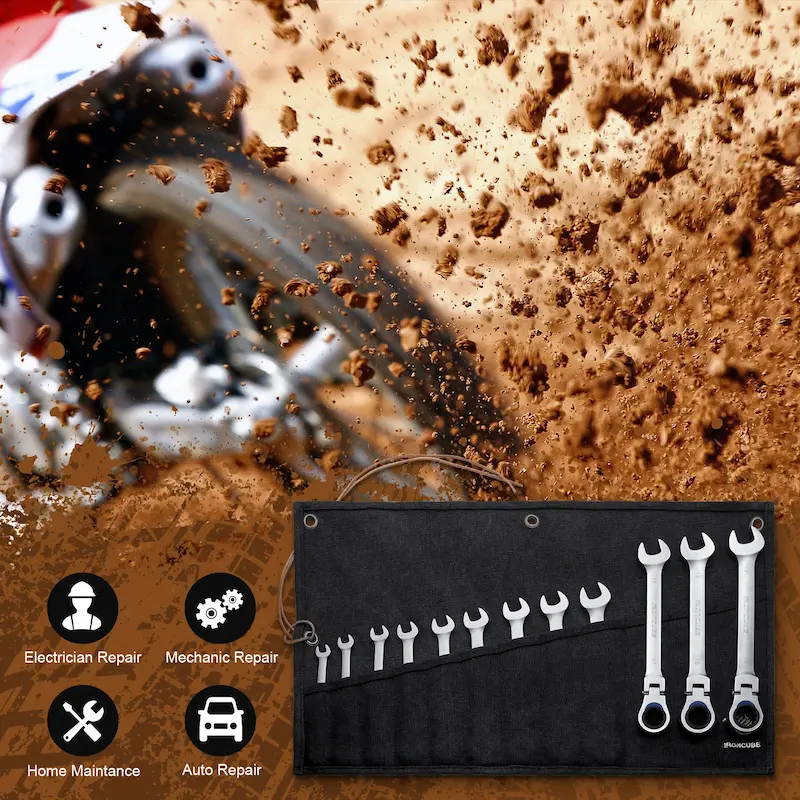
Automotive Maintenance and Repair
Under-hood work is where the ratcheting flex head combination set truly earns its keep. Modern engine bays are packed with components—turbocharger plumbing, catalytic converter heat shields, sensor wiring harnesses—that leave almost no clearance above fasteners. A flex head wrench slides into gaps of 15 to 20 mm and still ratchets the bolt with a 5-degree swing arc. Tasks like replacing an alternator, swapping brake pads, or servicing a timing belt tensioner become markedly faster when you do not have to remove adjacent parts just to swing a wrench.
Motorcycle and Powersport Servicing
Motorcycles are compact machines with metric fasteners everywhere. Valve adjustments, carburetor removal, chain tensioner access, and handlebar assembly work all benefit from a slim, flexible ratcheting wrench. The 8–19 mm range covers virtually every fastener on Japanese and European motorcycles. For a closer look at how IRONCUBE tools handle motorcycle work, watch their maintenance demonstrations on YouTube.
HVAC, Plumbing, and Appliance Repair
HVAC technicians frequently work in cramped mechanical rooms and attic spaces where traditional socket sets are impractical. A ratcheting flex head combination set fits in a belt pouch and handles refrigerant line fittings, compressor mount bolts, and ductwork fasteners without requiring a full socket set and breaker bar. Plumbers similarly benefit when accessing faucet mounting hardware or supply line connections beneath sinks and vanities.
Industrial Maintenance and Assembly
Factory maintenance crews often need to disassemble guards, conveyor sections, and machine housings quickly during planned downtime. A ratcheting flex head combination set speeds up these repetitive tasks significantly. In industrial environments, the ability to work with one tool instead of alternating between a socket wrench and an open-end wrench reduces both task time and the number of tools that need to be tracked, cleaned, and stored.
The Importance of the Metric Range (8-19 mm)
You might be curious about the specific sizing of this set. The metric system is the global standard for engineering, and the 8 mm to 19 mm range is the core of most mechanical work.
- 8 mm & 10 mm: These are the most common sizes for small fasteners, such as valve cover bolts, engine covers, and body trim. Mechanics often joke about the “lost 10 mm socket,” but having a dedicated wrench in this size is crucial.
- 12 mm & 13 mm: These sizes are staples for Japanese and European vehicles. They frequently secure engine mounts and suspension components.
- 14 mm & 15 mm: These are often found on Honda and Toyota products for drain plugs and caliper bolts.
- 17 mm & 19 mm: These larger sizes are critical for heavy-duty tasks. They fit many oil drain plugs, crankshaft bolts, and larger suspension hardware.
Having this progression available in a single Ratcheting Flex Head Combination Set ensures you are never left scrambling for a tool mid-job. If you need to cross-reference these metric sizes with SAE standards for older vehicles, Ironcube provides a helpful printable metric to SAE wrench size conversion chart.
Why Professional Technicians Trust IRONCUBE for Ratcheting Flex Head Combination Sets
IRONCUBE has built a reputation on delivering professional-grade hand tools at honest prices. Their ratcheting flex head combination sets use chrome vanadium steel with a mirror-polish chrome finish, high-tooth-count ratcheting mechanisms, and precision-ground flex joints that maintain consistent tension over years of use. Every set ships in a purpose-built rolling pouch that keeps tools organized and protected.
For mechanics who work with both metric and SAE fasteners, IRONCUBE also offers an 8-piece SAE ratcheting wrench set built to the same standards. And if your work involves larger fasteners—think truck axle nuts, heavy equipment, or industrial flanges—their large heavy-duty ratcheting wrench range extends well beyond 19 mm.
Have questions about which set fits your application? The IRONCUBE team is reachable through their contact page and responds quickly with honest, no-pressure advice.
FAQs
Q. What is the advantage of an 8 Piece Ratcheting Flex Head Combination Set over a standard set?
A. The primary advantage of an 8 Piece Ratcheting Flex Head Combination Set is the ability to work in confined spaces where a standard wrench cannot move. The 180-degree pivoting head allows you to reach bolts at odd angles, while the 72-tooth ratcheting mechanism requires only a 5-degree swing arc to turn the fastener. This significantly increases efficiency and reduces the time spent on complex repairs.
Q. Can I use the ratcheting end of the wrench to break loose stuck bolts?
A. While a high-quality Ratcheting Flex Head Combination Set is built to be durable, it is best practice to use the open end of the wrench to break loose extremely tight or rusted bolts. The internal gears of any ratcheting mechanism can be damaged by extreme “breakaway” torque.
Q. What sizes are usually included in an 8-19 mm wrench set?
A. An 8 Piece Ratcheting Flex Head Combination Set typically includes the most commonly used metric sizes for automotive and household repairs. These sizes usually consist of 8 mm, 10 mm, 12 mm, 13 mm, 14 mm, 15 mm, 17 mm, and 19 mm.
Q. Is a 72-tooth gear better for a Ratcheting Flex Head Combination Set?
A. Yes, a 72-tooth gear is considered the industry standard for a professional Ratcheting Flex Head Combination Set. It provides a 5-degree swing arc, which is ideal for tight spaces. While some wrenches offer higher tooth counts, 72 teeth provide the perfect balance between a fine swing arc and the physical strength of the gear teeth, preventing them from stripping under load.