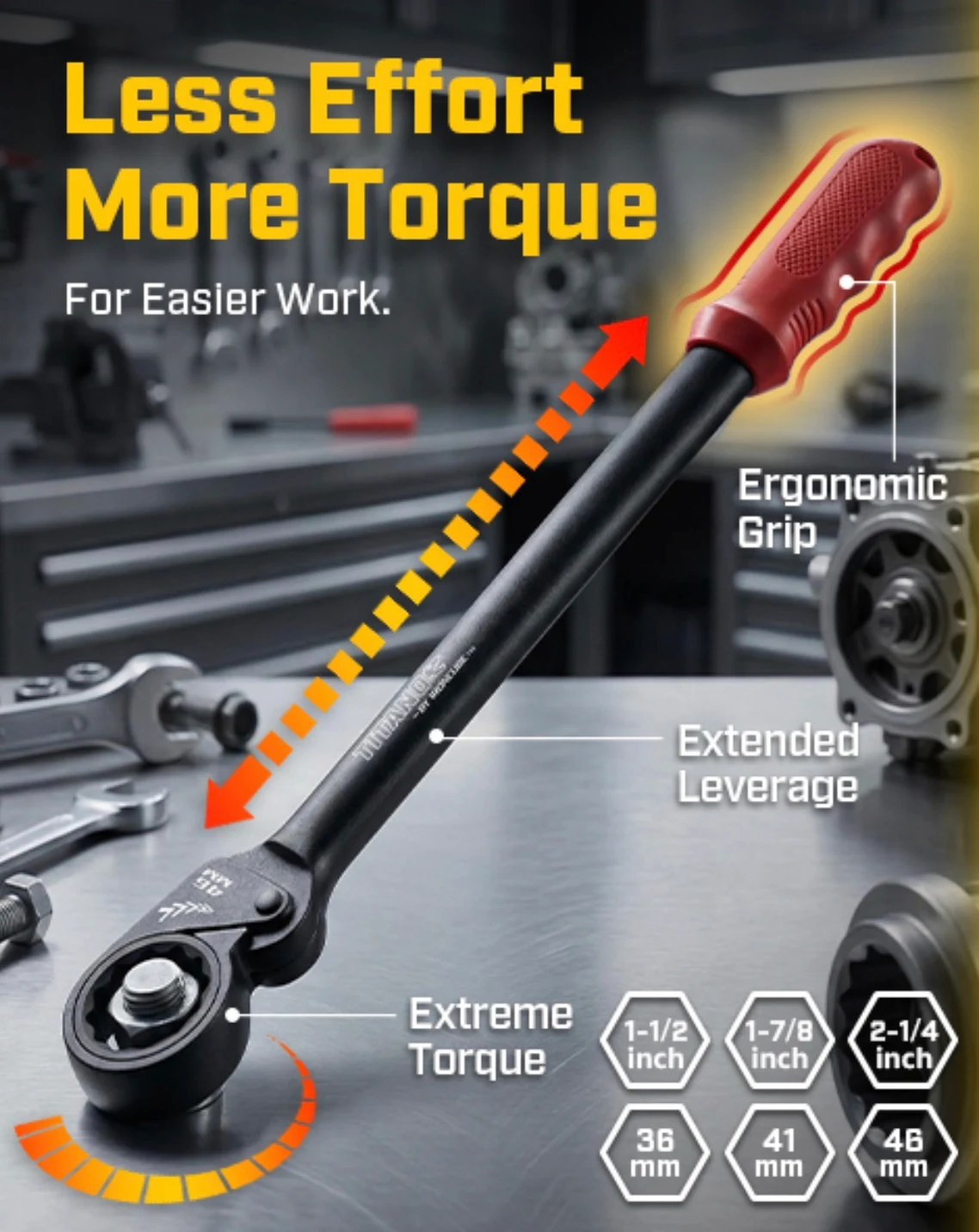
Every mechanic has felt it. You are turning a bolt in a tight engine bay, the wrench moves half a turn, then hits the firewall. You lift it off the bolt, reposition, and repeat. Lift. Reposition. Turn. Repeat. Five minutes for a bolt that should take thirty seconds. The ratcheting wrench set exists specifically to end that frustration.
A ratcheting wrench does what a standard open-end wrench cannot: it turns the bolt in one direction and freewheels in the other without leaving the fastener. That means no repositioning. No lifting. Just continuous forward progress, even in the tightest working conditions. It is one of those tool categories where the difference between owning one and not is felt on every single job.
This complete guide covers everything you need to know: how the ratchet mechanism actually works, the difference between metric and SAE sizing, what to look for when choosing a set, and how to keep your wrenches performing year after year. By the end, you will know exactly which ratcheting wrench set belongs in your toolbox — and why. The full IRONCUBE Works wrench range is a good starting point for serious buyers.
What Is a Ratcheting Wrench Set?
A ratcheting wrench set is a collection of combination wrenches that incorporate a ratchet mechanism in the box end — the closed ring end of the wrench. This mechanism allows the wrench to turn the fastener in one direction while moving freely in the return direction, eliminating the need to lift and reposition between each stroke.
How the Ratchet Mechanism Works
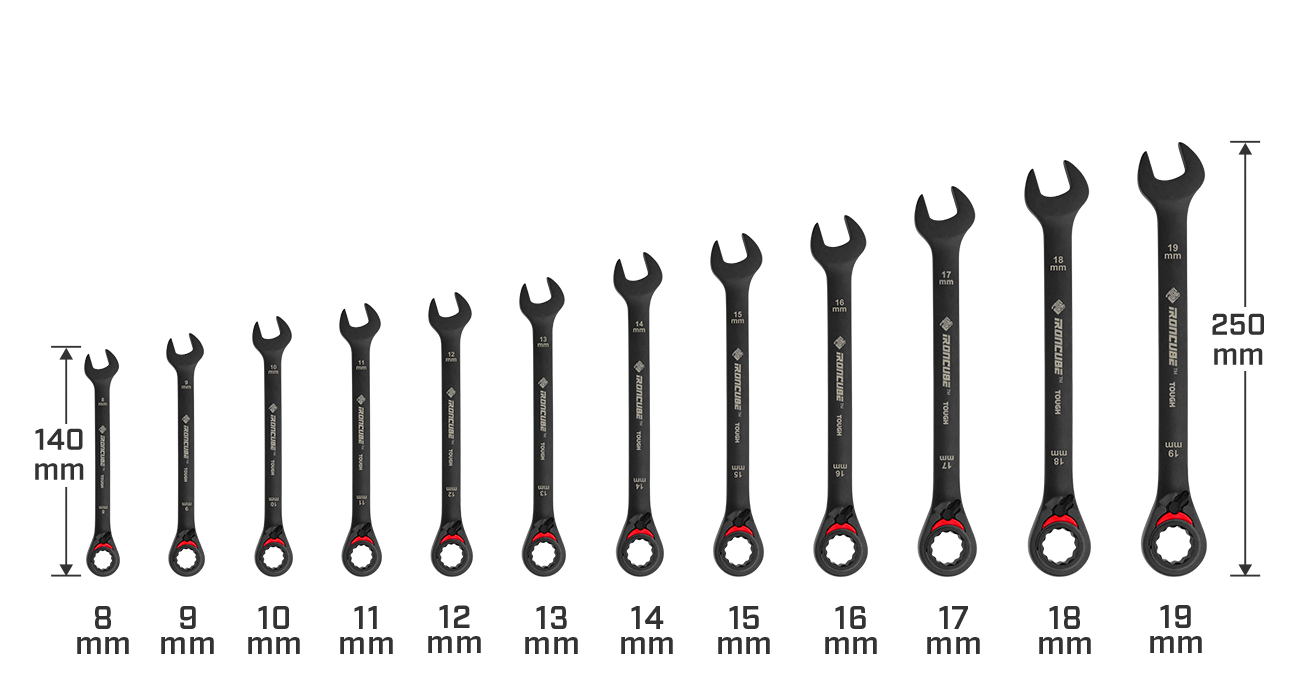
Inside the box end of a ratcheting wrench sits a set of hardened steel teeth arranged in a circular gear — called a ratchet gear or pawl gear. A spring-loaded pawl engages these teeth from one side. When you turn the wrench in the drive direction, the pawl locks into the gear and transmits force to the fastener. When you return the wrench, the pawl slides over the teeth without engaging — this is the familiar clicking sound that confirms the mechanism is working.
The number of teeth in this gear is one of the most important specifications in the wrench. According to the mechanical engineering overview on Wikipedia, the relationship between tooth count and swing arc is direct: more teeth means a smaller arc needed per advance. A 72-tooth ratchet needs only 5 degrees of swing to engage the next tooth. A 24-tooth wrench needs 15 degrees. In a 100mm clearance zone, that difference decides whether you can turn the bolt at all.
Open-End vs. Ratcheting — Key Differences
A standard open-end wrench grips two flat faces of a bolt or nut. It is fast to engage and works in a wide range of positions, but it requires full repositioning after each partial turn. A ratcheting wrench uses the closed box end — which grips all six faces — and advances without removal. The result is faster fastening in confined spaces, better torque distribution around the bolt head, and significantly less effort on repetitive work.
For a deeper look at the non-ratcheting side, the IRONCUBE guide to non-ratcheting wrenches covers open-end and standard combination wrench applications in detail — useful context for understanding when to reach for which tool.
When to Use Each Wrench Type
Ratcheting wrenches shine in three scenarios: confined engine bays where repositioning wastes time, repetitive fastening where speed matters, and situations where the box end’s full grip reduces the risk of rounding soft fasteners. Standard open-end wrenches are better for initial engagement on stiff or seized bolts — where the ratchet mechanism’s torque limit may be a concern — and for pipe fittings where the open jaw slides onto the fitting from the side.
Metric vs. SAE — What Is the Difference?
Every buyer faces this question. Metric and SAE (Society of Automotive Engineers, also called standard or imperial) are two separate measurement systems. Metric sizes are expressed in millimetres. SAE sizes are expressed in fractions of an inch. They are not interchangeable — a 10 mm wrench and a 3/8-inch wrench are close in size but not identical, and using one in place of the other risks rounding the fastener.
Metric Wrench Sizes Explained
Metric wrenches cover sizes from around 6 mm to 32 mm for hand tool use, with the most common range for automotive work spanning 8 mm to 19 mm. The table below shows common metric sizes and their applications:
| Metric Size | Common Applications | Typical Vehicles |
| 8 mm | Sensor bolts, small brackets | Japanese/Korean cars |
| 10 mm | Battery terminals, caliper pins | Universal — most common bolt |
| 12 mm | Alternator brackets, oil drain | European and Japanese cars |
| 13 mm | Wheel lug nuts (some), accessories | Volkswagen, Honda, Toyota |
| 14 mm | Suspension bolts, hub nuts | Ford, GM, European models |
| 15 mm | Wheel bearings, larger brackets | Heavy-duty and European |
| 17 mm | Wheel lug nuts, brake hardware | Most European vehicles |
| 19 mm | Large suspension, axle bolts | Trucks, SUVs, German cars |
The 10 mm is famous among automotive mechanics for being the most universally applicable bolt size on Japanese and Korean vehicles — to the point where it is frequently joked about as the most commonly lost tool in any workshop.
SAE Wrench Sizes Explained
SAE wrenches cover sizes from 1/4 inch to 1-1/4 inch and above for heavy equipment. The common automotive range runs from 3/8 inch to 3/4 inch. The table below covers the most frequently used SAE sizes:
| SAE Size | Common Applications | Typical Vehicles |
| 1/4″ | Small engine bolts, trim screws | Older American cars |
| 5/16″ | Hose clamps, accessory brackets | Ford, GM trucks |
| 3/8″ | Mid-size engine hardware | American domestic vehicles |
| 7/16″ | Fuel line fittings, chassis bolts | Classic American cars |
| 1/2″ | Larger brackets, exhaust hardware | American trucks and SUVs |
| 9/16″ | Suspension components | Full-size American trucks |
| 5/8″ | Wheel lug nuts (older trucks) | Pre-1990s American vehicles |
| 3/4″ | Heavy drivetrain hardware | Trucks, commercial vehicles |
Which System Does Your Vehicle Use?
Most Japanese, Korean, and European vehicles use metric fasteners exclusively. Most American-designed vehicles use a mix of both — metric on engine internals and electronics, SAE on drivetrain and structural components — particularly on models manufactured before the mid-2000s. Classic American cars from the 1960s to 1980s are predominantly SAE throughout. The printable metric to SAE conversion chart from IRONCUBE is a practical reference to keep in the toolbox. The wrench size chart provides the full cross-reference in a single view.
Why a Combined Metric and SAE Set Makes Sense
Unless you work exclusively on one type of vehicle, a combined metric and SAE ratcheting wrench set removes the guesswork. Most professional-grade sets — including the IRONCUBE 12-piece ratcheting wrench set on Amazon — include both metric and SAE sizes in a single case, which is the practical choice for anyone working across different vehicle makes and ages. Buying separate metric and SAE sets doubles the cost and the storage requirement for no meaningful benefit.
How to Choose the Best Ratcheting Wrench Set
A ratcheting wrench set is a long-term investment. The right set purchased once will outlast many cheaper sets purchased repeatedly. These are the specifications that actually matter.

Material — Chrome Vanadium vs. Chrome Molybdenum
The steel alloy used in the wrench body determines its strength, hardness, and longevity under professional use. The two dominant alloys in quality wrenches are chrome vanadium (Cr-V) and chrome molybdenum (Cr-Mo). The table below compares them:
| Property | Chrome Vanadium (Cr-V) | Chrome Molybdenum (Cr-Mo) |
| Strength | High under torque | Very high under shock loads |
| Toughness | Good | Excellent — preferred for impact |
| Hardness (HRC) | 38–45 | 35–42 |
| Typical use | Ratcheting and combination wrenches | Impact sockets, flex-head tools |
| Corrosion resistance | Good with chrome plate | Good with black oxide finish |
| Price | Lower to mid-range | Mid to higher range |
For standard ratcheting combination wrenches, chrome vanadium steel is the correct choice — it provides the tensile strength and hardness the ratchet mechanism and wrench body need without the cost premium of chrome molybdenum. Cr-Mo makes more sense in impact-rated tools where shock absorption matters more than raw hardness.
Number of Pieces — 8, 12, or 16?
Piece count directly maps to size coverage. An 8-piece set covers the most common sizes on a single vehicle type but creates gaps when you encounter less common fasteners. A 12-piece set is the practical sweet spot for most buyers — it covers the full range of common metric and SAE sizes without excessive duplication. A 16-piece set adds sizes that are useful for older vehicles, larger machinery, and trade-use scenarios where unusual fastener sizes are more common.
For the majority of automotive, home improvement, and light commercial work, 12 pieces is the right starting point. The best ratcheting wrench set guide on IRONCUBE compares the specific sets in detail — useful if you want to compare set configurations before buying.
Tooth Count and Swing Arc
| Tooth Count | Swing Arc | Best Use | Price Point |
| 24 teeth | 15° | Basic home repair | Budget |
| 36 teeth | 10° | General automotive repair | Mid-range |
| 45 teeth | 8° | Professional mechanics | Mid-high |
| 72 teeth | 5° | Tight-space pro work | High |
| 90+ teeth | 4° or less | Industrial / aerospace | Premium |
For professional automotive work, 45 to 72 teeth is the practical range. Below 36 teeth, the swing arc requirement becomes restrictive in typical engine bay conditions. Above 72 teeth, the cost premium increases significantly without a proportional practical benefit for most users. The reversible vs fixed head ratcheting wrench comparison covers how tooth count affects real-world use alongside mechanism type.
Reversible vs. Fixed Direction
A reversible ratcheting wrench has a direction selector — typically a switch or collar — that changes the drive direction from tightening to loosening. This is the most versatile configuration and the standard in professional sets. A fixed-direction ratchet wrench is simpler and more durable but requires you to flip the wrench end-for-end to change direction — manageable but less convenient.
For general-purpose use, choose reversible. For specific industrial applications where durability in one direction is the priority, fixed has merit. Most quality sets in the professional market use reversible mechanisms.
Handle Finish and Grip Comfort
The handle of a ratcheting wrench is where the user’s force meets the tool. A knurled finish — the cross-hatched pattern cut into the handle steel — provides grip without requiring a separate rubber layer that can deteriorate. Some sets add a thin polymer grip sleeve for comfort on long jobs. Both approaches work well; the key is that the finish remains grippy after oil or coolant contact.
Handle length affects mechanical advantage. Longer handles provide more torque at the fastener but reduce maneuverability in tight spaces. Most 12-piece professional sets use handles in the 150 to 200 mm range — long enough for useful torque on most fasteners, short enough for practical access in confined spaces.
Storage Case Quality
A set without a proper case is a set that loses pieces. A quality ratcheting wrench set includes a blow-mould plastic case or canvas roll pouch with individual labelled slots for each wrench size. The case should hold wrenches securely during transport without rattling — loose wrenches in a case damage each other’s finish and make the size markings harder to read over time.
Check that the case latches are solid and that the individual slots are sized correctly for each wrench — a generic tray with oversized slots offers less protection than a custom-fit moulded case. The IRONCUBE wrench sets are available with both case-packaged and pouch-packaged options.
Top Uses for a 12-Piece Metric and SAE Ratcheting Set
A well-chosen ratcheting wrench set covers far more than one task. Here are the three domains where a 12-piece metric and SAE set earns its place most often.
Automotive Repair and Maintenance
This is the environment the ratcheting wrench was designed for. Battery terminal bolts, brake calliper pins, alternator brackets, oil pan drain plugs, and sensor mounting bolts all respond well to ratcheting action in confined engine bays. The ability to turn a bolt continuously without repositioning reduces job time significantly — and reduces the risk of fatigue-induced slips that damage bolt heads or injure hands.
For brake line work specifically, the IRONCUBE 3-piece SAE brake line wrench set offers the flare-nut design that protects soft brake line fittings during removal — a complement to a standard ratcheting set for complete brake system work.
Home Improvement Tasks
Flat-pack furniture, water heater installation, gate hardware, shed assembly, and appliance connections all involve fasteners in positions where ratcheting wrenches save real time. The combined metric and SAE coverage means a single ratcheting wrench set handles both the metric bolts on European-designed furniture and the SAE hardware on American-made appliances and fixtures.
For buyers building a home workshop toolkit, the IRONCUBE 10 Pcs angle ratchet screwdriver set on Amazon pairs well with a ratcheting wrench set for covering both bolt-turning and screw-driving needs in a single, compact toolkit.
HVAC and Electrical Work
HVAC technicians tighten and loosen refrigerant line fittings, compressor mounting bolts, and condenser bracket hardware — all applications where ratcheting action in tight equipment enclosures reduces service time. Electricians use ratcheting wrenches on conduit locknuts, junction box studs, and equipment mounting hardware where confined panel enclosures make standard wrenches impractical.
For both trades, the combination of metric and SAE coverage in a single ratcheting wrench set eliminates the need to carry two separate sets to a job site.
How to Maintain and Store Your Ratcheting Wrench Set
A quality ratcheting wrench set maintained properly will last decades. These simple habits protect the investment.
Cleaning After Use
After use in an oily or dirty environment, wipe each wrench with a clean rag to remove oil, grit, and moisture. For ratcheting mechanisms specifically, avoid soaking the head in solvent — penetrating cleaners can wash out the factory lubricant inside the mechanism, causing premature wear on the pawl and gear. Instead, wipe the external surface and use a small brush or compressed air to clear debris from around the box end.
Preventing Rust and Corrosion
Chrome-plated wrenches are naturally corrosion-resistant, but the plating is not impermeable. Salt — from road spray, sweat, or marine environments — is the main threat. After cleaning, apply a light coat of machine oil or corrosion inhibitor spray to each wrench before storing. This is especially important for wrenches kept in unheated garages or workshop vans where temperature cycling causes condensation.
Watch for any chips in the chrome finish. Exposed steel corrodes quickly once the plating is broken. Minor rust spots can be removed with fine steel wool and re-protected with oil, but deep rust on the wrench body is a sign the tool should be replaced.
Proper Storage Tips
Always return wrenches to their designated slots in the storage case. This protects the finish from contact wear, keeps sizes in order so you can identify what is missing at a glance, and prevents wrenches from rolling off workbenches. For wrenches stored in a tool roll or pouch, roll the pouch tightly to prevent movement during transport.
Store the set in a dry location away from direct heat sources. The ratchet mechanism contains small spring-loaded components that can lose tension if stored for long periods at high temperature. For the IRONCUBE wrench range, the case or pouch included is designed for exactly this kind of protective, organised storage.
FAQs
What size ratcheting wrench set do professionals prefer?
Most professional automotive mechanics prefer a 12-piece combined metric and SAE ratcheting wrench set as their baseline. That configuration covers the full range of common fastener sizes on most vehicles without carrying excess pieces. Professionals who work on heavy trucks or older American vehicles often add a few larger SAE sizes. For the home workshop, a 12-piece set handles well over 90% of tasks. The IRONCUBE ratcheting wrench buying guide covers professional set configurations in detail.
Are ratcheting wrenches worth the extra cost over regular wrenches?
Yes — for any work done in confined spaces, a ratcheting wrench set is worth the cost difference within the first hour of use. The time saved by not repositioning after every half-turn adds up quickly on multi-bolt jobs. The risk reduction — fewer slips, less hand fatigue — is harder to quantify but very real. For straightforward open-access work, a standard combination wrench is adequate. But the confined-space scenarios where ratcheting is genuinely transformative arise on virtually every vehicle and in most professional installation environments.
Can I use metric wrenches on SAE bolts?
In theory, some metric and SAE sizes are close enough to engage a fastener — but in practice, you should never use a metric wrench on an SAE bolt or vice versa. Even a 0.3 mm size mismatch between the wrench jaw and the fastener creates enough play to round the bolt head under load. Rounded fasteners are significantly harder and more expensive to remove than properly fitted ones. A combined metric and SAE ratcheting wrench set eliminates any temptation to use the wrong size — because the right size is always in the case.
What is the best tooth count for a ratcheting wrench?
For most professional and serious DIY use, 45 to 72 teeth is the sweet spot in a ratcheting wrench set. At 45 teeth, the 8-degree swing arc is workable in typical engine bay conditions. At 72 teeth, the 5-degree arc handles the tightest access scenarios found on most vehicles. Below 36 teeth, the 10-degree requirement becomes genuinely restrictive in confined spaces. Above 72 teeth, the improvement in access is marginal for most users while the cost increases measurably.
How do I know if my ratcheting wrench mechanism needs servicing?
A ratcheting wrench set mechanism needs attention when the pawl begins to slip — where the wrench moves back in the drive direction instead of freewheeling cleanly. This usually indicates worn pawl teeth or a weakened spring. On quality wrenches, some manufacturers offer replacement mechanism kits. More often, a slipping ratchet is a sign the wrench has reached the end of its service life and should be replaced. Regular cleaning and light lubrication of the mechanism extend service life significantly — but they do not reverse wear once the teeth are damaged.
Summary
A quality ratcheting wrench set is one of the most useful tools in any workshop, vehicle, or home toolkit. The combination of continuous fastener engagement, full-face box-end grip, and compact storage makes it the practical choice for the vast majority of bolt-turning tasks.
The key factors: choose chrome vanadium steel for the wrench body, a 72-tooth ratchet mechanism for maximum access versatility, a reversible direction selector for convenience, and a 12-piece combined metric and SAE configuration for full coverage. Store the set in a labelled case, clean it after use, and protect it with light oil — and it will perform reliably for years.
The IRONCUBE 12-piece ratcheting wrench set meets all of these specifications at a price point that works for both professionals and serious DIY users. The full IRONCUBE wrench range — including combination sets, brake line wrenches, and thin-profile options — is at the wrenches product page. For screwdriver sets to complete your toolkit, see the IRONCUBE screwdriver range.
For custom or bulk orders, contact the IRONCUBE team at ironcubeworks.com/contact.