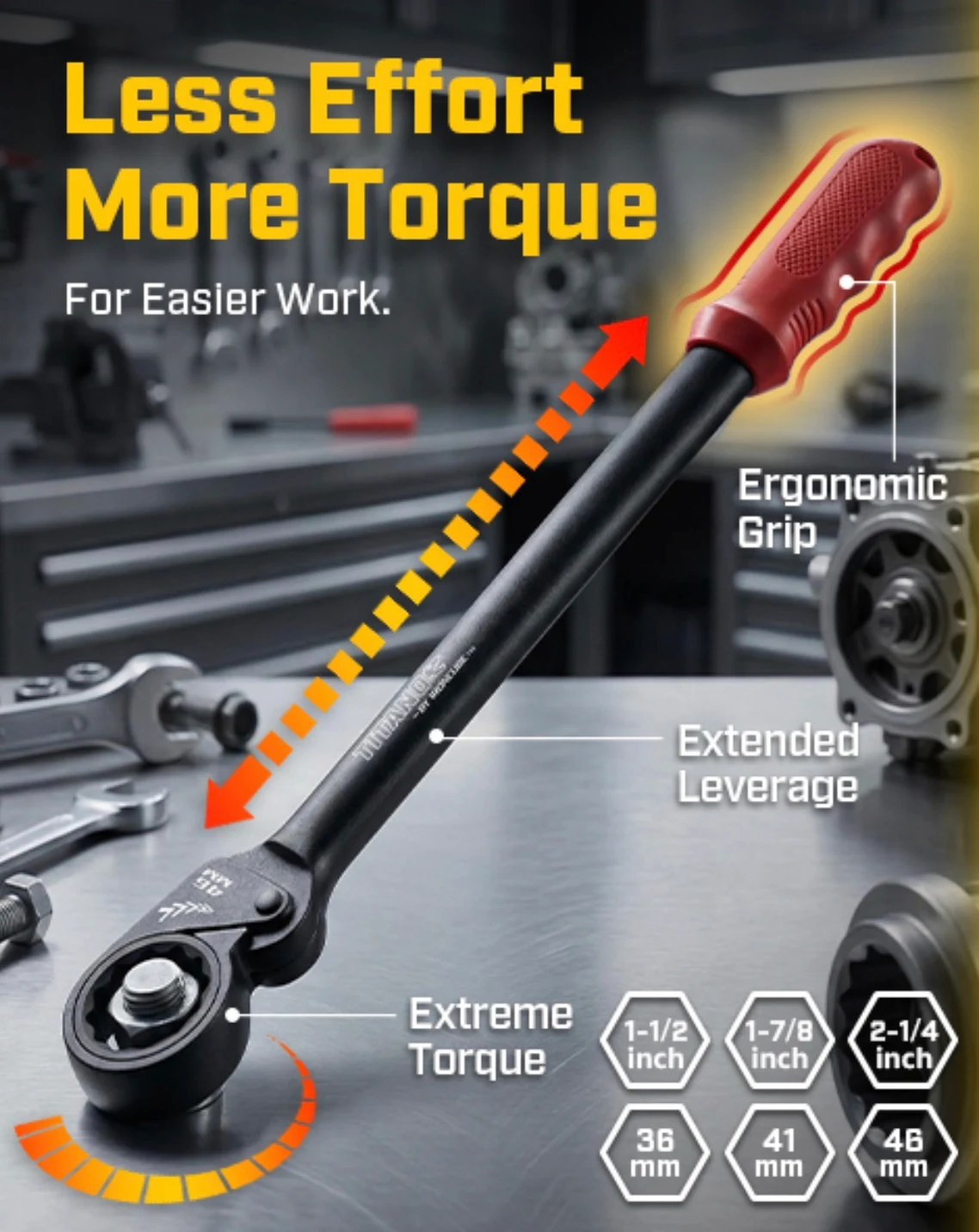
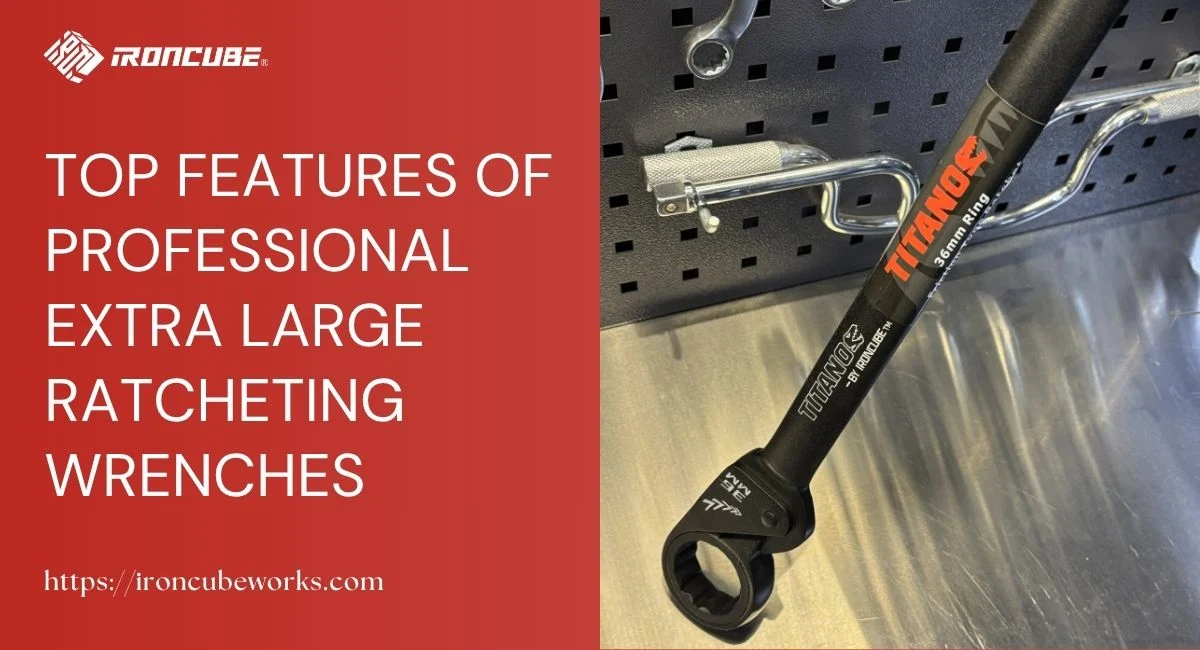
In heavy industries, construction sites, and mechanical workshops, tools are not just accessories—they are the backbone of efficiency and safety. Among these essential tools, Extra Large Ratcheting Wrenches stand out for their ability to handle oversized fasteners, high torque loads, and demanding environments.
Professionals working with heavy machinery, pipelines, and diesel equipment rely on these specialized tools to complete jobs faster and with less fatigue. According to the engineering overview of Wrench, wrenches are designed to apply torque to fasteners, and larger sizes are critical for industrial-scale operations.
If you are exploring premium-grade tools through IronCube Works, understanding the features of professional-grade ratcheting wrenches will help you make smarter purchasing decisions.
The Engineering Behind Extra Large Ratcheting Wrenches
Before we dive into the specific features, let’s look at the science. Why do these wrenches feel so different? It comes down to basic physics. Torque, the rotational force applied to a fastener, is a product of force and distance.
The formula is straightforward: $\tau = r \times F \times \sin(\theta)$. In simple terms, the longer the wrench handle, the greater the torque you can generate with the same amount of effort. By utilizing extra large ratcheting wrenches, you are effectively increasing that $r$ variable, allowing you to break loose rusted, stubborn bolts that would snap a smaller, standard wrench in seconds.
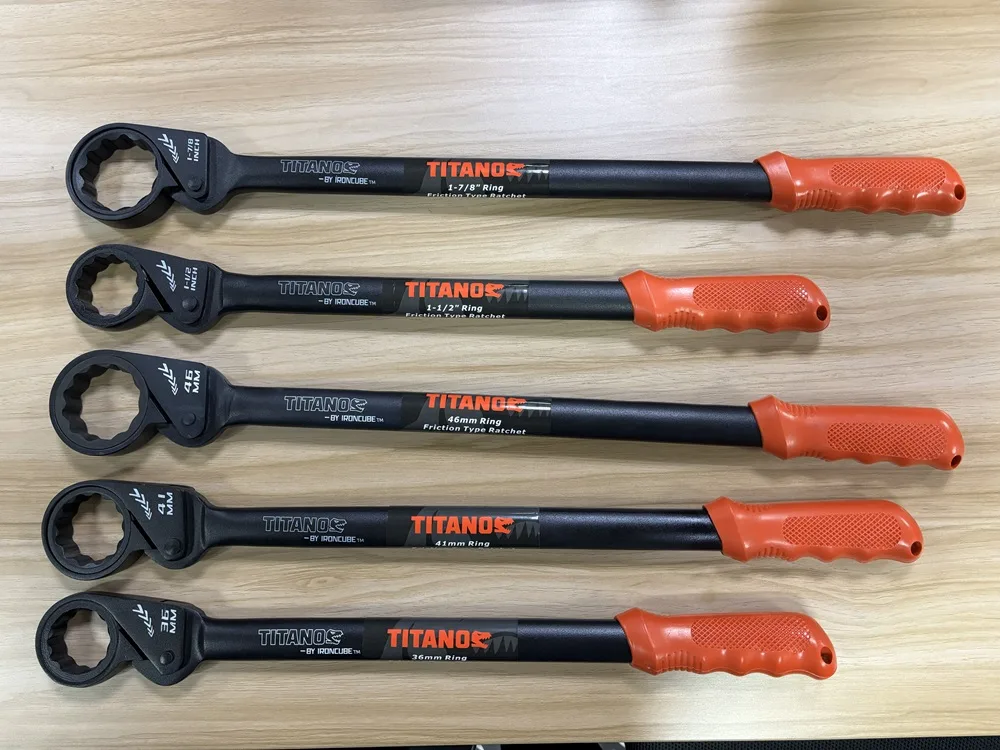
But length is only half the battle. The real magic happens inside the head of the tool. Unlike a standard wrench, which requires you to remove the tool from the nut after every turn, a ratcheting mechanism allows for continuous motion. Inside, a spring-loaded pawl clicks against specially machined gear teeth. This one-way clutch system allows the tool to engage in one direction and freewheel in the other.
Material Integrity and Heat Treatment
When you are dealing with industrial-grade fasteners, you are applying massive amounts of force. If the wrench is made from inferior steel, the gear teeth will strip, or the handle will bend. Professional-grade extra large heavy duty ratcheting wrenches are typically forged from high-alloy steel, such as Chrome Vanadium or Chrome Molybdenum.
These materials are not just strong; they are heat-treated to achieve a specific hardness level that balances brittleness and flexibility. Too hard, and the tool shatters under impact. Too soft, and it deforms under load. Manufacturers who prioritize quality ensure that every large ratcheting wrench set undergoes rigorous testing to handle the demands of professional mechanics.
Top Features of Professional Extra Large Ratcheting Wrenches
Professional extra-large ratcheting wrenches solve that problem, but not every oversized tool on the shelf deserves the word “professional” on its label. In reality, what separates a shop-grade jumbo ratchet from a disposable imitation comes down to about a dozen specific features.
Feature #1 — Drop-Forged Chrome Vanadium Steel Construction
The single biggest material differentiator in professional extra large ratcheting wrenches is the steel itself. Top-tier tools use drop-forged chrome vanadium (Cr-V) alloy — typically 6140-grade — heated to around 1200°C and struck between dies at tremendous pressure. As a result, the process creates a grain structure that resists fracture under high torque.
Cheaper tools use cast or machined lower-grade alloys. Unfortunately, these fail predictably at the corners of the box end. According to Wikipedia’s reference entry on wrench construction, drop-forged tool steel has been the professional standard since the early 20th century for exactly this reason.
When scanning a spec sheet, look for four markers. First, a 6140 Cr-V or Cr-Mo alloy designation. Second, explicit drop-forged construction, never cast. Third, hardened and tempered heat treatment. Finally, Rockwell C55–60 hardness on the gear surfaces. Tools missing any of these markers typically belong to lower tiers.
Feature #2 — High-Tooth-Count Ratcheting Mechanism
The ratcheting mechanism is where engineering talent shows up most. Professional extra-large ratcheting wrenches commonly use either 72-tooth or 120-tooth designs.
A 72-tooth mechanism requires just 5° of swing arc to engage the next tooth, which matches the widely accepted industry benchmark. In contrast, a 120-tooth design pushes that down to 3°, which matters in extremely tight spaces. However, higher tooth counts mean smaller individual teeth, and smaller teeth handle less shear load. For oversized high-torque work, 72-tooth designs with deeper tooth engagement often outperform finer mechanisms.
Industry data confirms this tradeoff. A 2024 fastener study found that 72-tooth models with 0.12mm engagement depth outperformed 120-tooth variants at 0.08mm depth under heavy load. Therefore, for most extra-large applications, the sweet spot sits at 72 teeth, 5° arc.
Feature #3 — Box-End Geometry and Anti-Rounding Design
The box end is where the tool actually grips the fastener. Two details matter enormously.
First, the point count. A 12-point box end engages a hex fastener at 30° intervals, making it faster to find a grip. In contrast, a 6-point box end only engages at 60° intervals but distributes load across flat surfaces instead of corners. For heavy-duty work, 6-point wins on grip security. For speed, 12-point wins.
Second, off-corner loading. Premium designs relieve the contact points at the fastener corners and transfer torque through the flats. Consequently, this reduces the risk of rounding even on worn or corroded bolts. Some advanced designs can even extract fasteners that are up to 80% rounded — a game-changer in rust-belt or marine applications.
The 36mm torque friction wrench and 2-1/4 inch friction wrench both use this off-corner geometry for oversized bolts.
Feature #4 — Flex-Head Capability on Extra Large Ratcheting Wrenches
A flex-head design pivots the ratcheting head up to 180° relative to the handle. Although it seems like a small detail, the feature transforms the tool’s reach in tight compartments.
Standard fixed-head designs work well on open fasteners. However, they fail when a bracket, hose, or frame rail blocks the straight-line approach. Flex-head extra large ratcheting wrenches solve that problem by letting the operator angle the handle wherever clearance exists. One working mechanic reported cutting his brake-caliper bleeder valve replacement time by roughly 50% after switching to a flex-head design. The tradeoff is slightly reduced torque capacity at the pivot joint, so flex-heads are not ideal for the absolute break-loose moment.
Feature #5 — Surface Finish and Corrosion Resistance
Oversized tools spend hours in moisture, grease, brake dust, and road salt. Surface finish matters for three reasons. First, it protects the base metal from corrosion. Second, it reduces friction during use. Third, it makes cleanup fast.
Professional extra-large ratcheting wrenches typically feature one of three finishes. Mirror chrome plating offers the shiniest appearance and best cleanup, but it can chip under impact. Black nickel provides superior corrosion resistance, and the finish often survives 96-hour salt-spray testing without degradation. Electrophoretic coating balances cost, durability, and a professional matte appearance.
For long-term storage, a finish that survives humidity is non-negotiable. Additionally, pair any professional set with the IRONCUBE canvas roll-up storage to extend service life even further.
Feature #6 — Handle Length and Ergonomics
Handle length on extra-large ratcheting wrenches is not arbitrary. It scales with the box-end size because torque scales with leverage. For example, a 36mm ratcheting wrench typically runs around 500mm long, while a 50mm wrench may reach 700mm or more.
Ergonomically, the best handles feature a slightly tapered shank that sits naturally in the palm, with a knurled or contoured grip zone toward the end for sweaty-hand friction. Some designs also add a slim profile in the middle to reduce weight without sacrificing strength. This detail matters — a 500mm jumbo wrench can weigh close to 1kg, and dead weight fatigues the operator fast.
Feature #7 — ASME B107.100 Standard Compliance
Finally, the documentation. Professional-grade extra-large ratcheting wrenches comply with the ASME B107.100 standard (most recently revised in 2023). The standard covers dimensional, performance, and safety requirements for combination wrenches, including ratcheting box wrenches in 6-point, 12-point, 4-point, and 8-point configurations.
In practice, an ASME B107.100 mark tells the buyer that the tool has passed minimum torque loading, cycle life, and dimensional accuracy tests. Without that mark, performance claims become marketing rather than engineering.
Why Professionals Choose Extra Large Ratcheting Wrenches
You might wonder, why not just use a breaker bar and a standard socket? While breaker bars have their place, they lack the efficiency of a ratcheting mechanism. When you have a limited arc of movement—common in engine bays or under heavy equipment—you cannot effectively use a breaker bar.
Efficiency in Tight Spaces
In industrial settings, you rarely have a full 360-degree rotation. Often, you are lucky to get a 10-degree swing. Professional extra large ratcheting wrenches for industrial use are designed with high tooth counts in the gear mechanism.
A finer tooth count—often 72 teeth or more—means the tool requires less physical handle movement to “click” to the next position. This allows you to work in extremely confined areas where a traditional tool would be useless.
Reducing Operator Fatigue
Let’s talk about the reality of the job site. Repetitive motion is the primary cause of musculoskeletal strain in mechanics. By switching to a heavy duty ratcheting wrench, you eliminate the need to constantly reposition the tool. This might seem like a small detail, but over an eight-hour shift, reducing those redundant movements can significantly lower hand and wrist fatigue.
Furthermore, when dealing with 36mm heavy duty ratcheting wrenches, the leverage provided by the tool means your body doesn’t have to compensate for poor mechanical advantage. You exert less energy to achieve higher torque, keeping your muscles fresher for longer.
Professional vs. Consumer Extra Large Ratcheting Wrenches: Spec Comparison
Before buying, compare spec sheets side by side. The table below summarizes the differences that actually matter.
| Specification | Professional Grade | Consumer Grade |
| Steel | 6140 Cr-V or Cr-Mo, drop-forged | Unspecified alloy, often cast |
| Hardness | HRC 55–60 on gear teeth | Unrated or unspecified |
| Tooth count | 72 (5° arc) or 120 (3° arc) | 32 to 60 |
| Box-end geometry | 12-pt off-corner, anti-rounding | Standard 12-point |
| Finish | Mirror chrome / black nickel / e-coat | Basic chrome, often thin |
| Standard | ASME B107.100-2023 certified | Uncertified |
| Warranty | Lifetime (typical) | 1 year or less |
Applications for Extra Large Ratcheting Wrenches
The utility of these tools extends across several heavy industries. It isn’t just about turning a bolt; it’s about the speed and safety of the maintenance process.
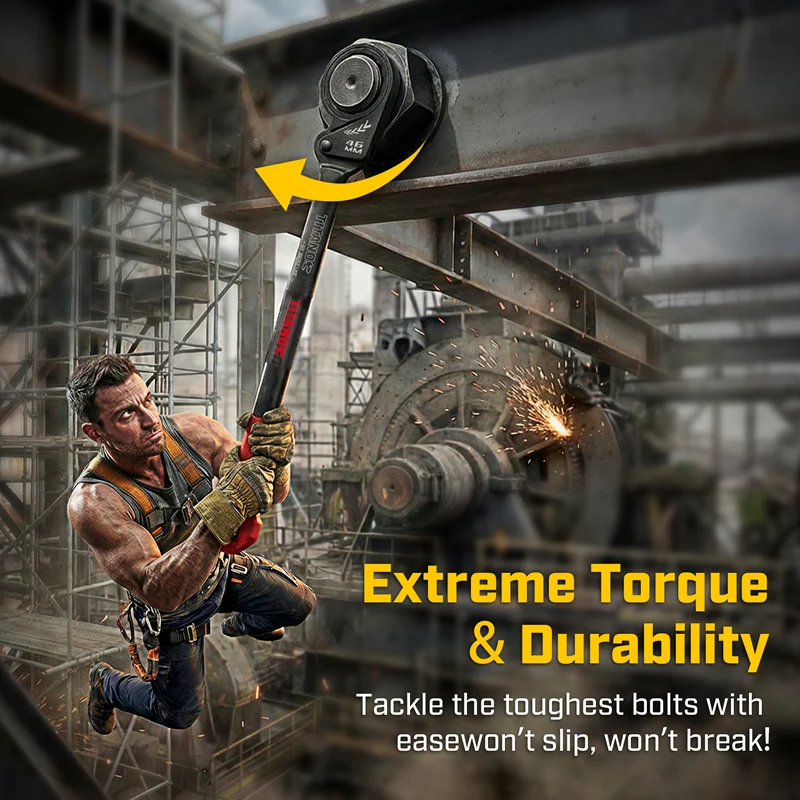
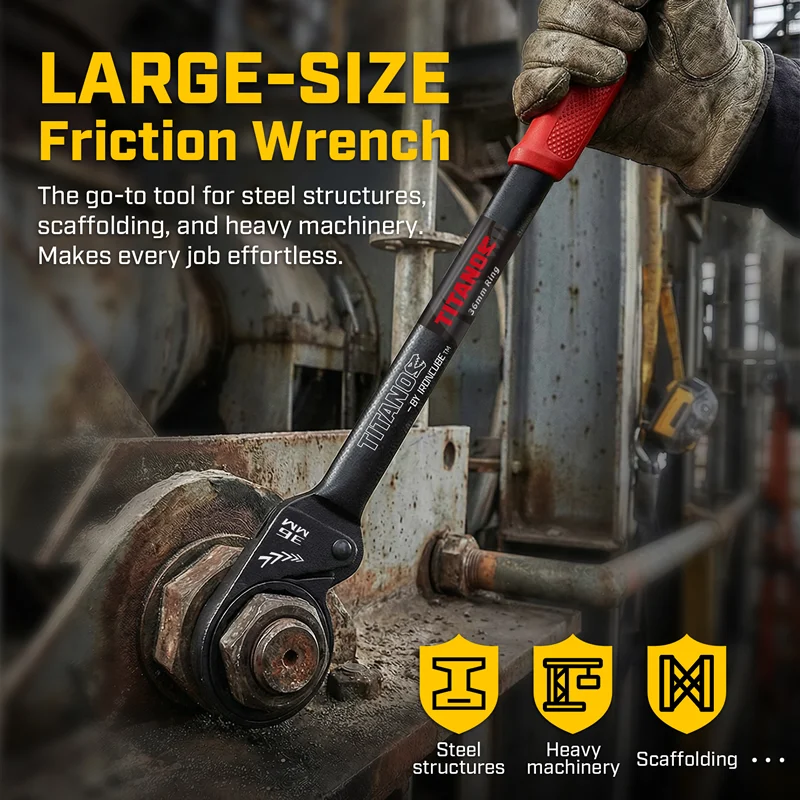
Diesel Mechanics: Working on heavy machinery requires the best heavy duty ratcheting wrench for diesel mechanics. These technicians deal with large fasteners that are often seized by heat cycles. A heavy-duty, long-handled wrench provides the necessary leverage.
Construction and Infrastructure: From bolting steel beams to maintaining cranes, the reliability of your tool is a safety issue.
Energy Sector: Wind turbine maintenance or solar farm array assembly requires precise torque application in environments that are anything but controlled.
Preventative Maintenance: Having the right large ratchet wrench on hand allows for quick inspections and adjustments, preventing catastrophic failures before they happen.
For those who want to see these tools in action, check out the Ironcube YouTube channel for demonstrations on how to properly handle these tools under load.
Where Extra Large Ratcheting Wrenches Deliver the Most Value
Three environments put extra large ratcheting wrenches through their hardest work.
Diesel and Heavy-Truck Repair
Turbochargers, exhaust manifolds, and drivetrain components all carry bolts in the 22–36mm range. The heavy-duty ratcheting wrench for diesel mechanics page covers the specific sizes diesel techs reach for daily.
Heavy Equipment Maintenance
Excavators, loaders, and cranes all use 36mm, 41mm, and 46mm hardware at pivot points and hydraulic couplings. The 36mm heavy-duty ratcheting wrench series and the broader large ratcheting wrench set cover this range.
Industrial and Structural Installation
Large flanges, pressure vessels, and steel-framed equipment rely on oversized fasteners. A dedicated extra large ratcheting wrenches for industrial use set earns its place on every maintenance cart in the plant. For more on the torque science behind these tools, see our guide on heavy-duty ratcheting wrenches, 30% force savings and 1000 N·m torque.
Summary
Choosing the right extra large ratcheting wrenches is about more than just getting the job done; it is about efficiency, safety, and long-term durability. By understanding the physics of leverage, the importance of high-quality materials, and the need for proper maintenance, you ensure that your tools work as hard as you do. Whether you are dealing with 36mm torque friction wrenches or standard large-format sets, remember that quality is an investment that pays for itself in reduced downtime and easier workdays. Visit Ironcube Works to browse our full collection and find the right gear for your professional needs.
FAQs
Q. Why do professional mechanics prefer extra-large ratcheting wrenches over fixed-head wrenches?
A. Professional mechanics choose extra large ratcheting wrenches because they significantly reduce labor time. The ratcheting mechanism allows for continuous turning without the need to lift and reset the wrench after every swing, which is essential for efficiency in confined spaces.
Q. Can I use an extension bar on my extra large ratcheting wrench?
A. While you might be tempted, we generally advise against using “cheater pipes” on heavy duty ratcheting wrenches. These tools are engineered for specific torque limits. Exceeding those limits with a cheater bar can cause internal failure or injury. If you need more torque, it is safer to use a properly rated breaker bar or a larger wrench.
Q. How do I know if I am buying a high-quality ratcheting wrench?
A. Look for the material specification. High-quality extra large ratcheting wrenches are forged from alloy steel, such as Chrome Vanadium. Check for a smooth, consistent clicking sound when the mechanism engages, and ensure the manufacturer provides clear specifications on their torque ratings.
Q. How often should I lubricate my wrench mechanism?
A. For heavy-duty tools used daily, we recommend a light lubrication of the pawl and gear mechanism once a month. This prevents premature wear and ensures that your extra large ratcheting wrenches continue to operate smoothly under high-stress conditions.
Q. What is the difference between a friction wrench and a standard ratcheting wrench?
A. A friction wrench is often designed for specific heavy-duty applications where high torque is required in tight, oily, or dirty environments. They often feature more robust internal components than standard light-duty ratchets, specifically to handle the “friction” and resistance encountered in industrial maintenance.