Understanding a wrench size chart is one of the most important skills in automotive repair, mechanical work, and DIY maintenance. Whether you are tightening a bolt on a car engine or assembling furniture, choosing the correct wrench size determines safety, precision, and efficiency.
A wrong size does not just slow you down. It can round off bolt heads, damage threads, or even cause mechanical failure. That is why professionals rely on a precise Wrench Size Chart when switching between SAE and metric systems.
This guide breaks everything down in a practical way. You will learn how SAE and metric systems relate, how to convert sizes accurately, and how to use a Wrench Size Chart like a professional mechanic in 2026.
If you are building your toolkit, you can explore durable options from IRONCUBE’s wrench collection, designed for both beginners and professionals.
What Is a Wrench Size Chart (Wrench Size Chart)?
A Wrench Size Chart is a conversion reference that helps match bolt and nut sizes between SAE (imperial) and metric systems. It shows which wrench fits which fastener.

For example:
- A 10mm bolt corresponds closely to 3/8 inch SAE
- A 13mm bolt is close to 1/2 inch SAE
- A 17mm bolt aligns near 11/16 inch SAE
These conversions are not always perfectly identical. Manufacturing tolerances and rounding differences exist. However, a Wrench Size Char gives the closest usable match.
According to engineering standards described in fastener measurement systems, SAE uses fractional inches while metric uses millimeters as defined under ISO standards for mechanical fasteners. (Wikipedia: Screw thread standards)
A properly used Wrench Size Char helps eliminate guesswork and reduces tool damage during mechanical work.
Why SAE and Metric Conversion Matters in Modern Repair Work
Modern vehicles and machinery often mix both systems. American vehicles traditionally use SAE sizes, while most modern global vehicles use metric fasteners.
This creates a real problem for DIY mechanics.
Without a Wrench Size Chart, users often:
- Try multiple wrenches on a single bolt
- Strip bolt heads
- Waste time searching for the correct tools
- Apply incorrect torque due to poor fit
Industry data shows that fastener-related issues are among the most common mechanical failures in maintenance environments. Even a small mismatch in wrench size can reduce grip force significantly, increasing slip risk.
A proper Wrench Size Chart eliminates these issues by giving a direct reference between systems.
For general maintenance workflows, pairing your wrench knowledge with a full toolkit like IRONCUBE’s best tools for car maintenance guide improves efficiency significantly.
Understanding SAE vs Metric Wrench Systems
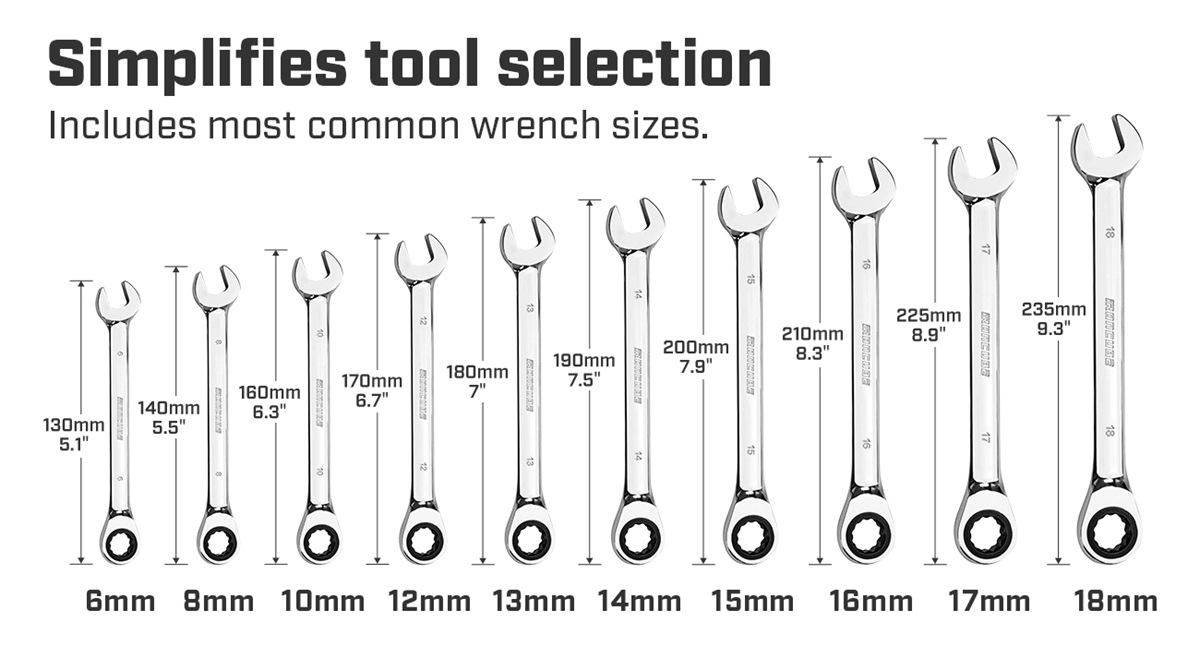
Before using a Wrench Size Chart, it is important to understand both systems.
SAE (Imperial System)
SAE stands for Society of Automotive Engineers. It uses fractional inches such as:
- 1/4”
- 3/8”
- 1/2”
- 9/16”
SAE is commonly used in:
- Older American vehicles
- Heavy machinery in the US
- Some industrial equipment
Metric System
Metric uses millimeters:
- 6mm
- 8mm
- 10mm
- 12mm
- 14mm
Metric is widely used in:
- Modern cars worldwide
- Electronics
- Industrial manufacturing
- European and Asian vehicles
A Wrench Size Chart becomes essential when switching between these systems during repairs.
For a deeper mechanical understanding of wrench types, refer to the general definition of a wrench.
Complete Wrench Size Chart (SAE to Metric Conversion)
Below is a practical conversion table used by mechanics worldwide. This is the core of any Wrench Size Chart reference system.
| SAE Size (inch) | Metric Size (mm) | Typical Use |
|---|---|---|
| 5/32” | 4 mm | Small electronics, trim |
| 3/16” | 5 mm | Interior fittings |
| 1/4” | 6 mm | Motorcycle parts |
| 9/32” | 7 mm | Small brackets |
| 5/16” | 8 mm | Body panels |
| 11/32” | 9 mm | Rare automotive use |
| 3/8” | 10 mm | Extremely common in cars |
| 7/16” | 11 mm | Engine components |
| 1/2” | 13 mm | Suspension, brackets |
| 9/16” | 14 mm | Engine mounts |
| 5/8” | 16 mm | Heavy fasteners |
| 11/16” | 17 mm | Wheels, chassis |
| 3/4” | 19 mm | Lug nuts |
| 13/16” | 21 mm | Trucks, SUVs |
| 7/8” | 22 mm | Heavy-duty bolts |
| 15/16” | 24 mm | Industrial machinery |
This Wrench Size Chart is widely used in automotive garages and mechanical workshops.
However, always verify fastener markings when available. Not all bolts strictly follow these conversions.
How to Measure Bolt and Nut Sizes Correctly
Using a Wrench Size Chart effectively requires proper measurement.
The correct method is simple:
First, measure across the flat sides of the bolt head. This is called “across flats” (AF). It determines wrench size.
Second, match the measurement with the closest value in your Wrench Size Chart.
Third, test-fit the wrench. A correct wrench should slide snugly without force.
Incorrect fitting usually happens when users:
- Guess sizes visually
- Use worn-out wrenches
- Mix SAE and metric tools incorrectly
Precision matters because even a 1mm mismatch can reduce grip efficiency.
Professional mechanics always confirm with calipers or gauge tools when accuracy is critical.
Common Mistakes When Using a Wrench Size Chart
A Wrench Size Chart is only effective when used correctly. Many beginners make predictable mistakes.
One major mistake is assuming SAE and metric are interchangeable. They are close, but not identical.
Another mistake is using adjustable wrenches for precise work. Adjustable tools often slip under torque.
A third mistake is forcing a slightly wrong size wrench. This damages both the tool and the fastener.
Finally, many users ignore wear on old fasteners. Rust and deformation can change real size slightly.
Using a Wrench Size Chart correctly prevents all of these issues when combined with proper technique.
Professional Mechanic Tips for Choosing the Right Wrench
Professionals do not rely only on memory. They use systems like a Wrench Size Chart combined with experience.
A key tip is to invest in a full metric and SAE set. Mixed sets reduce downtime.
Another tip is to prioritize six-point wrenches for heavy torque applications. They grip fasteners more securely than twelve-point designs.
Material quality also matters. Chrome vanadium steel is commonly used in high-quality wrench sets due to its balance of hardness and durability.
For long-term use, explore reliable IRONCUBE wrench tools designed for workshop durability.
Mechanics also recommend organizing tools according to a Wrench Size Chart layout for faster access.
SAE vs Metric: Which System Is Used Today?
Globally, metrics dominate modern manufacturing. Over 95% of new vehicles use metric fasteners.
However, SAE is still used in:
- Older US vehicles
- Aerospace components
- Specific industrial applications
This dual-system reality is why a Wrench Size Chart remains essential even in 2026.
Without it, technicians constantly switch between systems, increasing error risk.
Best Tools That Match Your Wrench Size Chart
A Wrench Size Chart becomes even more powerful when paired with the right tools.
A complete wrench set ensures coverage across all common sizes. IRONCUBE offers structured wrench collections for this purpose.
Screwdrivers also complement wrench work in mechanical assembly. You can explore screwdriver sets here.
For specialized work, brake line wrenches provide a precision grip on delicate fittings. Example:
IRONCUBE Brake Line Wrench Set
Tool selection becomes easier when guided by a proper Wrench Size Chart.
DIY Applications Using a Wrench Size Chart
A Wrench Size Chart is not only for mechanics. It is widely used in everyday DIY tasks.
In home repair, it helps assemble furniture, fix plumbing fittings, and adjust appliances.
In bicycle maintenance, it ensures correct torque on pedals, chains, and frame bolts.
If you are learning DIY maintenance, IRONCUBE’s car maintenance guide provides a structured starting point.
A Wrench Size Chart makes these tasks faster and safer.
FAQs
1. What is a Wrench Size Char used for?
A Wrench Size Chart is used to convert and match SAE and metric bolt sizes accurately for mechanical and DIY work.
2. Can I use SAE instead of metric wrench sizes?
A Wrench Size Chart shows close matches, but SAE and metric are not fully interchangeable. Always use the correct system when possible.
3. Why do 10mm bolts strip so easily?
A Wrench Size Chart shows that 10mm is widely used. High usage leads to wear, over-tightening, and frequent stripping issues.
4. Is metric better than SAE?
A Wrench Size Chart does not define “better.” Metric is more globally standardized, but SAE is still widely used in US-based systems.
5. How do professionals choose wrench sizes?
Professionals rely on a Wrench Size Chart, calipers, and experience to ensure an exact fit before applying torque.
Final Summary
A Wrench Size Chart is an essential reference tool for anyone working with mechanical systems, vehicles, or DIY repairs. It simplifies the conversion between SAE and metric systems and prevents costly mistakes like stripping bolts or using incorrect tools.
Whether you are a beginner or a professional, mastering a Wrench Size Chart improves accuracy, safety, and efficiency in every mechanical task.
Pairing this knowledge with high-quality tools from IRONCUBE ensures long-term reliability and professional-level results.