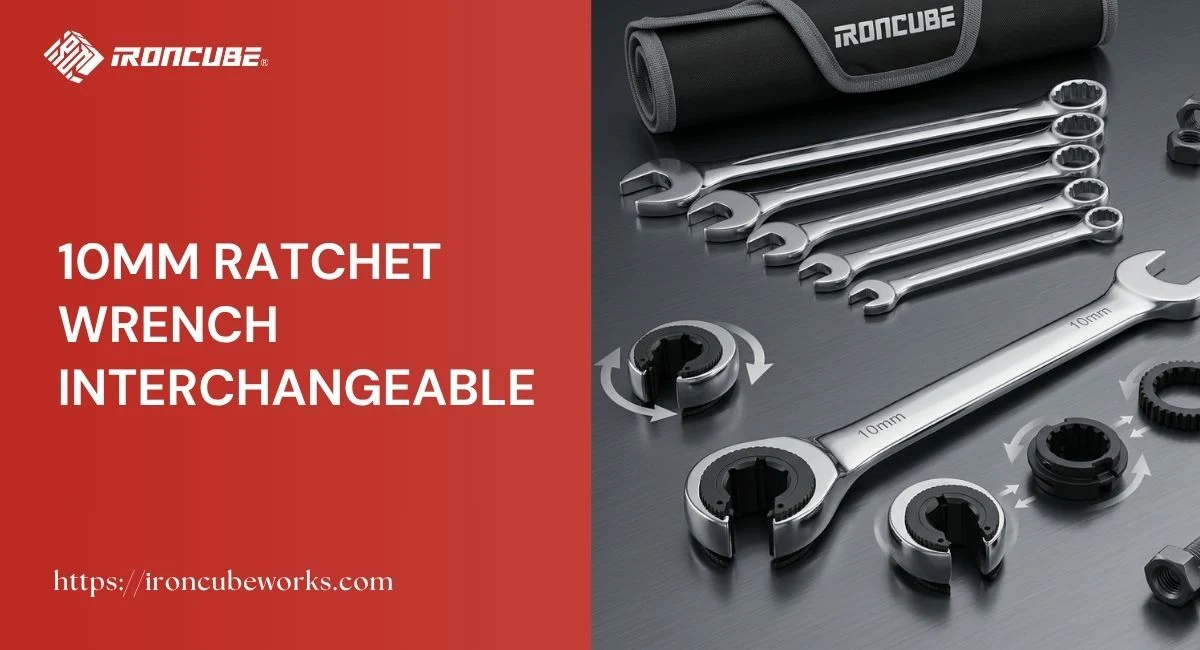
A missing 10mm Ratchet wrench can stop a repair faster than most people expect. The bolt is visible. The job looks simple. Yet the nearest SAE wrench feels either too tight or slightly loose.
That leads to a common question: Is a 10mm Ratchet wrench interchangeable with an SAE size?
The practical answer is no: a 10mm Ratchet wrench needs a true metric fit. A 3/8-inch wrench is the closest common SAE option, but it is not an exact match. A 3/8-inch opening equals 9.525mm, which makes it 0.475mm smaller than 10mm. That difference may sound minor. On a hex fastener, however, it can prevent full seating or encourage a poor grip. het wrench** placed on a 3/8-inch fastener creates the opposite problem. It is oversized by 0.475mm. Under load, that extra clearance can concentrate force near the fastener corners and increase the chance of slipping or rounding. plains the exact conversion, why the common shortcut is unreliable, and how to choose the right tool. It also covers ratchet design, fastener safety, conversion tables, and the relationship between small metric tools and heavy equipment wrench sizes.
Quick Answer: Is a 10mm Ratchet Wrench Interchangeable With SAE?
No SAE wrench is exactly interchangeable with a 10mm Ratchet wrench.
The nearest common SAE size is 3/8 inch. However, 3/8 inch converts to only 9.525mm. The U.S. National Institute of Standards and Technology states that one inch equals exactly 25.4 millimeters. Therefore, the calculation is straightforward:
0.375 × 25.4 = 9.525mm 0.475mm difference:
10.000mm − 9.525mm = 0.475mm
A 3/8-inch wrench is smaller than a nominal 10mm fastener. In most cases, it will not seat completely on a true 10mm hex. Forcing it can damage the wrench, the fastener, or your hand.
A 10mm Ratchet wrench may slide over a 3/8-inch fastener. Yet the fit will be loose. The Canadian Centre for Occupational Health and Safety advises users to select the correct wrench type and size because both metric and SAE fasteners are common. Correct sizing helps prevent equipment damage and injuries caused by wrench slippage. Ratchet wrench**, the workshop rule is simple: close is not the same as interchangeable.
Exact 10mm-to-SAE Conversion
Because one inch equals exactly 25.4mm, a metric dimension can be converted into inches by dividing it by 25.4:
10 ÷ 25.4 = 0.3937008 inch
Therefore, 10mm equals approximately 0.3937 inch.
There is no common SAE wrench marked 0.3937 inch. The closest familiar fractions sit on either side of that value.
| Candidate SAE size | Exact metric value | Difference from 10mm | Practical result |
|---|---|---|---|
| 3/8 inch | 9.525mm | 0.475mm smaller | Usually too small for a 10mm fastener |
| 25/64 inch | 9.9219mm | 0.0781mm smaller | Mathematically close, but uncommon and still undersized |
| 13/32 inch | 10.3188mm | 0.3188mm larger | May go over the fastener, but can be loose |
| 7/16 inch | 11.1125mm | 1.1125mm larger | Far too loose for safe substitution |
The table reveals an important distinction. 25/64 inch is the nearest listed fraction mathematically, but it is smaller than 10mm and rarely included in ordinary wrench sets. 13/32 inch is the nearest option that is larger than 10mm, but it is also uncommon and leaves unwanted clearance.
For most users, 3/8 inch remains the answer they see in conversion charts because it is the nearest widely available SAE size. Still, the correct working tool remains a genuine 10mm Ratchet wrench.
Why 3/8 Inch Is Close but Not Equal
The 0.475mm gap represents 4.75% of a 10mm nominal width. That percentage is not trivial when torque transfers through a small hex head.
Wrench standards exist because the nominal size alone does not tell the whole story. ISO 691 specifies tolerances for wrench and socket openings used with metric-width fasteners. ASME B107.100 provides dimensional, performance, and safety requirements for flat wrenches, including combination wrenches. These standards treat metric and inch tools as controlled dimensions, not casual approximations. 10mm Ratchet wrench* and its fastener both have controlled tolerances. Dirt, paint, plating, rust, wear, and damaged corners make substitution less predictable and can prevent full-depth contact.
Are 25/64 or 13/32 Inch Better Substitutes?
Not in normal workshop practice.
A 25/64-inch wrench equals about 9.9219mm. That is only 0.0781mm below 10mm. However, “slightly smaller” still means it may not fit over a nominal 10mm fastener. It is also an uncommon wrench size.
A 13/32-inch wrench equals about 10.3188mm. It can clear a 10mm fastener more easily. Yet the 0.3188mm surplus creates play. That play becomes more serious when the fastener is tight, corroded, shallow, or already damaged.
An unusual fractional wrench is a poor substitute. A proper 10mm Ratchet wrench offers better seating, identification, and control.
Why the Ratcheting Mechanism Does Not Change Wrench Size
Some users assume a ratcheting box end can adapt better than a fixed wrench. It cannot.
The ratchet mechanism changes how the handle resets. It does not change the across-flats opening that grips the fastener.
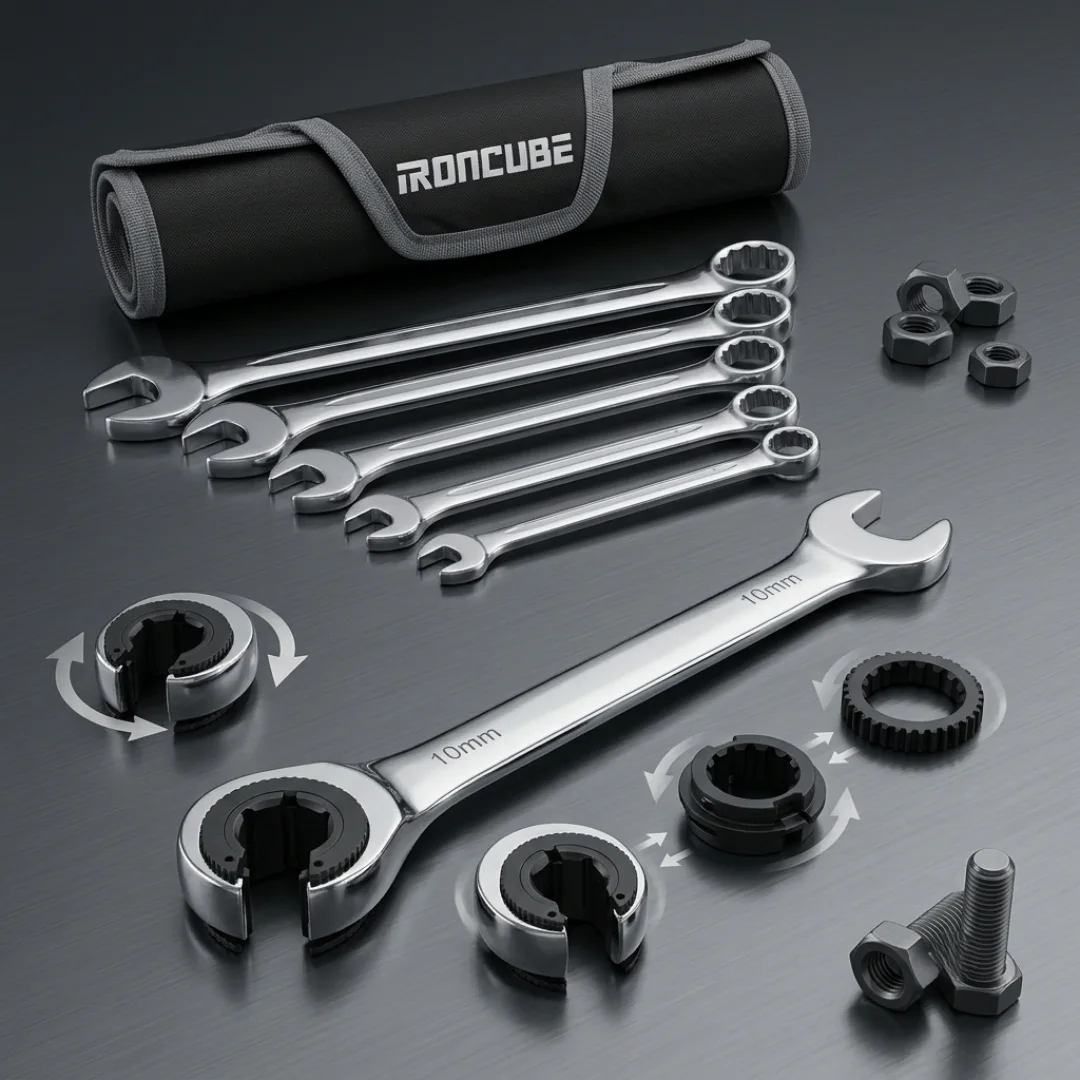
Inside a typical ratcheting wrench, a toothed gear and pawl let the handle move backward without turning the fastener. When the user pulls in the drive direction, the pawl locks against the gear and transfers torque. This saves time because the wrench does not need to be lifted after every short stroke. tchet divides a complete 360-degree circle into 72 positions. The theoretical swing interval is 5 degrees because 360 ÷ 72 = 5. GEARWRENCH lists a 10mm 72-tooth ratcheting combination wrench that needs a 5-degree movement, compared with 30 degrees for a standard wrench. 0-piece metric ratcheting wrench set](https://ironcubeworks.com/product/ironcube-10pcs-new-type-metric-ratcheting-wrench-set-with-rolling-pouch/) also lists a 72-tooth mechanism and a 5-degree working arc. The set includes 6mm, 8mm, 10mm, 12mm, 13mm, 14mm, 15mm, 16mm, 17mm, and 18mm sizes.
Its specifications identify chrome-vanadium steel, a mirror-polished finish, and a storage pouch. Ratchet wrench** features improve speed and access. They do not make a metric head interchangeable with an SAE fastener.
What Happens When the Wrench Does Not Fit Correctly?
Using the wrong size can create several problems at once.
First, the tool may contact only the fastener corners. Those corners offer less material than the broad flats. As torque rises, local pressure rises too. The corners begin to deform, and the wrench starts slipping. complete fit can tilt the wrench. The user then pulls at an angle rather than keeping the load square to the fastener. That makes the grip less stable.
Third, slippage can create a sudden release. The hand may strike a bracket, panel, frame, or nearby edge. OSHA prohibits the use of wrenches whose jaws are sprung enough to allow slippage. Although that rule addresses damaged tools, the same hazard explains why secure engagement matters. unded fastener turns a quick repair into extraction work. You may need locking pliers, a bolt extractor, heat, penetrating oil, cutting tools, or a replacement component.
Professional tool makers design around this problem. Proto states that a six-point box end increases wrench-to-fastener contact area and helps prevent rounding. Its socket designs also emphasize tight tolerances and load placement away from vulnerable corners. not that every small mismatch instantly destroys a bolt. The lesson is that mismatch reduces your safety margin. High torque, corrosion, worn corners, and awkward access reduce it further.
Metric-to-SAE Wrench Comparison Table
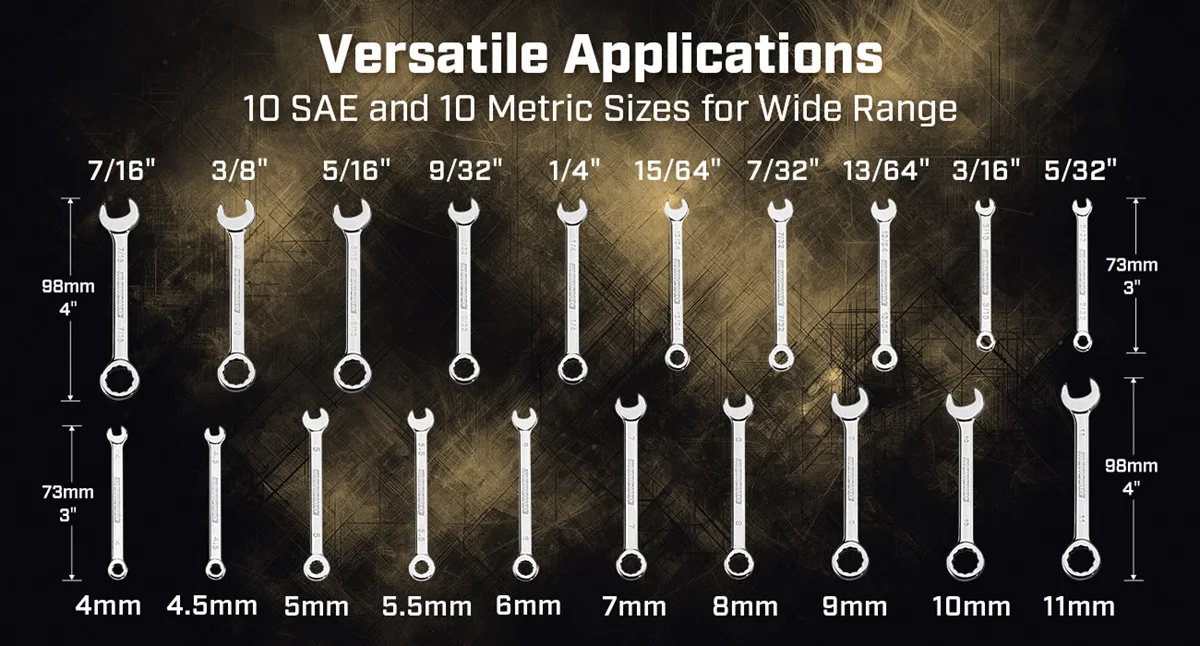
The following chart compares common metric sizes with nearby SAE fractions. It is useful for identification and planning. It is not permission to substitute automatically.
| Metric size | Nearby SAE size | SAE value in millimeters | Absolute difference |
| 8mm | 5/16 inch | 7.9375mm | 0.0625mm |
| 9mm | 11/32 inch | 8.7313mm | 0.2688mm |
| 10mm | 3/8 inch | 9.5250mm | 0.4750mm |
| 11mm | 7/16 inch | 11.1125mm | 0.1125mm |
| 12mm | 15/32 inch | 11.9063mm | 0.0938mm |
| 13mm | 1/2 inch | 12.7000mm | 0.3000mm |
| 14mm | 9/16 inch | 14.2875mm | 0.2875mm |
| 15mm | 19/32 inch | 15.0813mm | 0.0813mm |
| 16mm | 5/8 inch | 15.8750mm | 0.1250mm |
| 17mm | 11/16 inch | 17.4625mm | 0.4625mm |
| 18mm | 23/32 inch | 18.2563mm | 0.2563mm |
| 19mm | 3/4 inch | 19.0500mm | 0.0500mm |
Notice that some pairs are very close. For example, 19mm and 3/4 inch differ by only 0.05mm. The 10mm and 3/8-inch pair differs by almost ten times as much.
Even a close numerical pair may not be approved for a specific repair. Manufacturer procedures, fastener condition, required torque, tool geometry, and warranty rules still matter.
For a general introduction to wrench types, terminology, and history, see the Wikipedia overview of wrenches. For product-specific selection, browse the IRONCUBE wrench catalog.
How to Identify the Correct Wrench Size
The best method is direct verification, not guesswork.
Start by cleaning the bolt head or nut. Remove dirt, heavy grease, loose rust, and paint buildup. A contaminated surface can make the correct wrench feel too small.
Next, inspect the markings on the machine, fastener, service manual, or parts diagram. Equipment designed around metric standards usually specifies metric hardware. U.S. customary machinery may use SAE hardware. Mixed assemblies are also common after repairs or component replacements.
Then test the wrench by hand. A correct tool should slide fully onto the fastener without hammering. It should sit squarely and show minimal side-to-side movement.
Do not judge fit by whether the wrench can turn the fastener once. Judge whether it seats fully, contacts correctly, and remains stable under the expected load.
A caliper gives the clearest measurement. Measure the distance across two opposite flats of the hex head. A reading near 10mm indicates a metric 10mm fastener. A reading near 9.525mm indicates 3/8 inch.
Be careful with corroded or rounded heads. Their measured dimensions may be smaller than the original nominal size. In that case, an extractor socket or specialized gripping tool may be safer than downsizing a normal wrench.
How to Choose a Reliable 10mm Ratchet Wrench
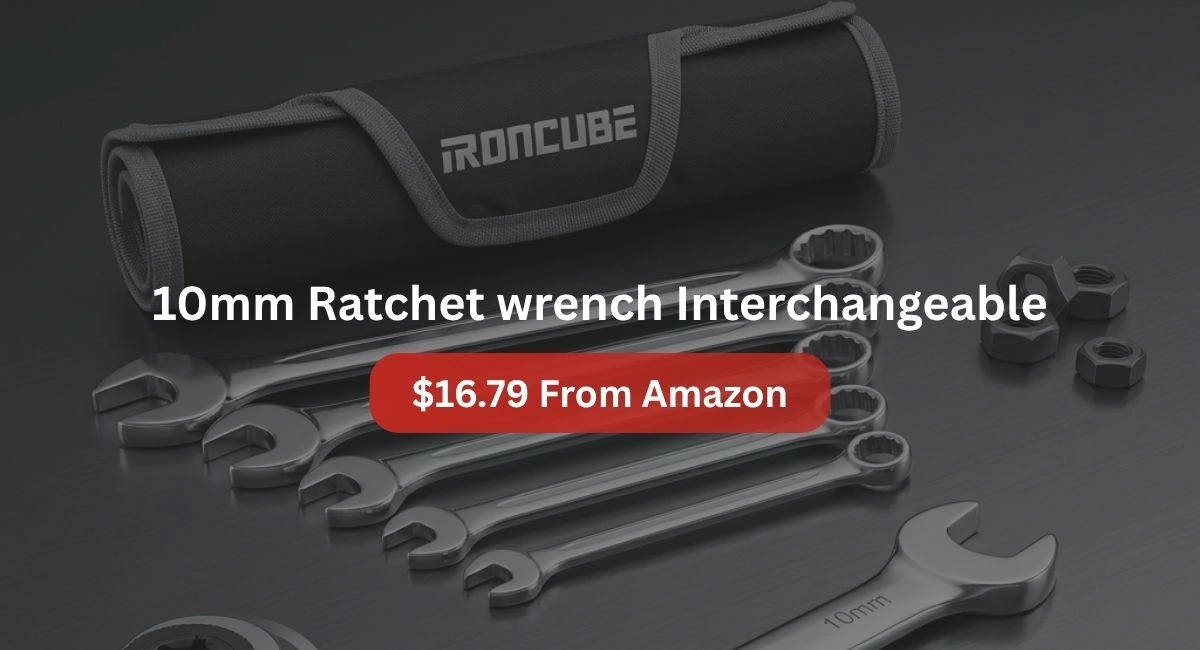
Correct 10mm Ratchet wrench sizing comes first. The mechanism and construction determine how well it works afterward.
A good 10mm Ratchet wrench should seat cleanly, reset smoothly, and resist unwanted flex. It should also provide enough access for the intended job.
Ratchet Tooth Count and Swing Arc
Tooth count affects how far the handle must move before the ratchet engages the next position.
A 72-tooth mechanism gives a nominal 5-degree step. That is valuable near hoses, brackets, firewalls, engine components, frames, cabinets, or machine guards. The handle can keep working even when a conventional wrench lacks enough swing space. sms may offer smaller arcs. However, tooth count alone does not prove strength or durability. Head design, pawl engagement, steel quality, heat treatment, lubrication, and manufacturing control also matter.
For everyday metric work, the IRONCUBE 10-piece metric ratcheting wrench set offers a practical size range around the frequently used 10mm position.
Users can also explore the broader IRONCUBE Works home page for related hand tools.
Six-Point Versus Twelve-Point Contact
A six-point box end matches the six flats of a standard hex fastener. It generally provides broad contact and strong resistance to rounding, especially under high load.
A twelve-point box end offers twice as many engagement positions. That improves access because the wrench can be placed at more angles. It can work well when the tool fits precisely and the fastener remains in good condition.
Neither design fixes a size mismatch. A loose twelve-point 10mm Ratchet wrench on a 3/8-inch fastener remains loose. A 3/8-inch six-point wrench still remains smaller than a nominal 10mm head.
When torque is high or the fastener is damaged, prioritize full seating and broad contact. Use a six-point socket when the repair procedure allows it.
Steel, Finish, Handle, and Storage
Chrome-vanadium steel is common in the cited IRONCUBE wrench products, paired with mirror-polished or black-oxide finishes for service durability and corrosion resistance. also matters. A longer handle creates more torque from the same hand force. However, excessive leverage can overload a small fastener or ratchet mechanism. Follow the equipment manufacturer’s torque procedure, especially during final tightening. 10mm Ratchet wrench is practical, not cosmetic. A labeled pouch or rack exposes missing sizes and improves organization.
Where 10mm Tools Fit Within Heavy Equipment Wrench Sizes
The secondary phrase supplied for this article was “eavy equipment wrench sizes.” The correct SEO phrase is heavy equipment wrench sizes.
A 10mm tool belongs at the small end of a maintenance kit. It may serve covers, clamps, brackets, electrical connections, guards, and accessory hardware. It is not a substitute for the large spanners used on structural joints, hydraulic assemblies, scaffolding, or major machinery fasteners.
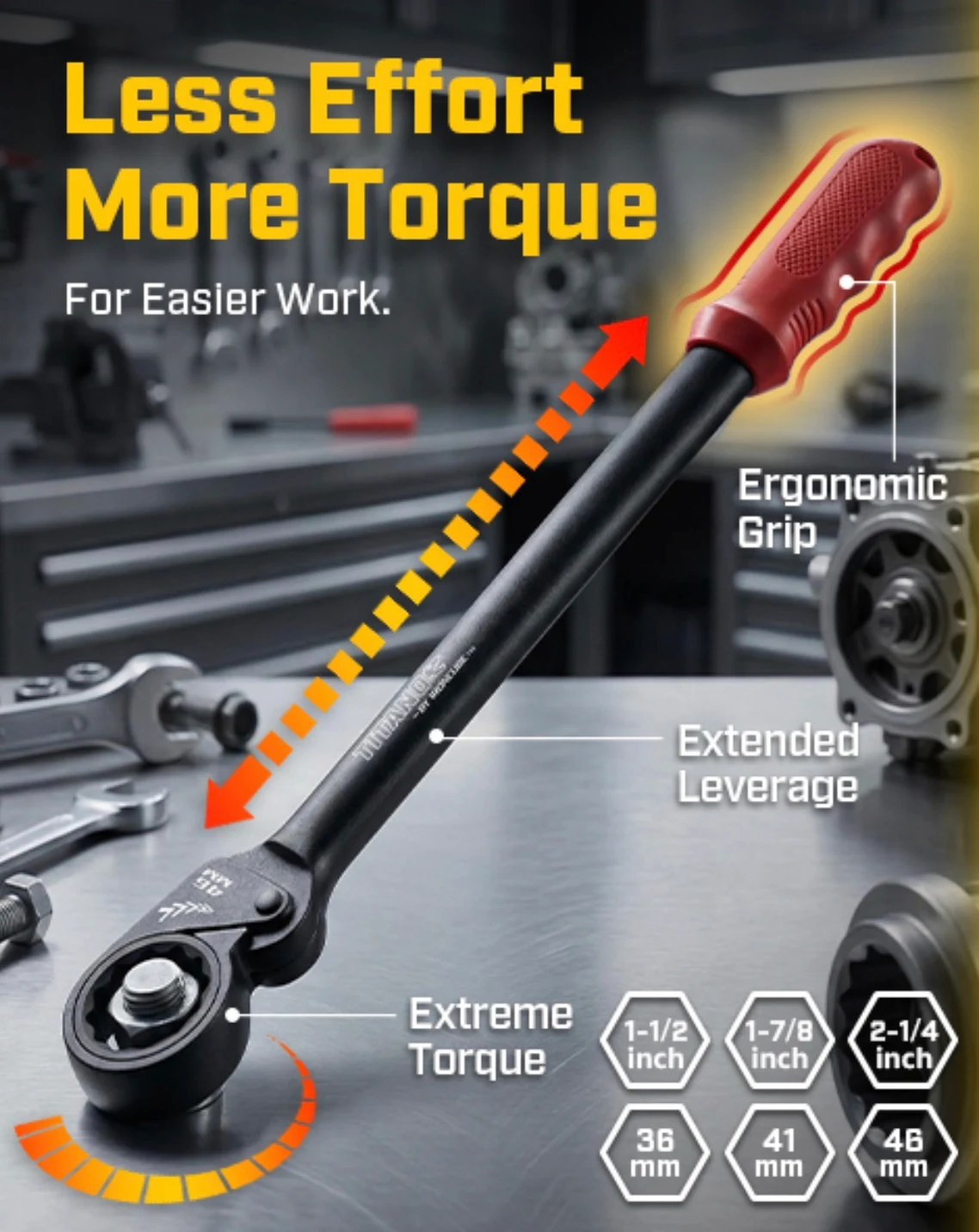
IRONCUBE’s extra-large heavy-duty ratcheting wrench range lists models from 36mm through 2-1/4 inches, with handle lengths from 510mm to 660mm.
The page also separates metric models such as 36mm, 41mm, and 46mm from inch models such as 1-1/2, 1-7/8, and 2-1/4 inches. ion reinforces the main point of this guide. Metric and SAE tools can look similar, but professional ranges keep the dimensions separate.
For metric industrial work, the 36mm high-torque friction wrench uses a metric 36mm box end and an extra-long handle.
For inch-based oversized fasteners, the 1-7/8-inch jumbo friction wrench uses a dedicated SAE opening. The products are not presented as interchangeable, even though 1-7/8 inches is often rounded to about 48mm in general descriptions. ipline should apply at 10mm. Select the stated system and size rather than the nearest label from another system.
Recommended IRONCUBE Wrench and Tool Resources
A useful tool library should guide readers from small service work to industrial fastening without mixing their purposes.
For compact metric repairs, begin with the IRONCUBE 10-piece metric ratcheting wrench set. The dedicated 10mm Ratchet wrench in that set removes the need for an unreliable SAE substitute.
For larger projects, compare the jumbo ratchet wrench guide, the extra-large heavy-duty ratcheting wrench range, and the friction wrench set buying guide for 2026.
Structural crews may also benefit from the field guide to friction wrench sets for structural steel and bridges.
Buyers comparing force-delivery tools with calibrated instruments should read friction wrench versus torque wrench and the explanation of how a torque friction wrench can reduce required hand effort.
The latter correctly explains that a friction wrench delivers turning force but does not replace a calibrated click-type torque wrench for specified final torque. eams can review how to find quality wholesale jumbo wrench sets or contact IRONCUBE about factory and volume requirements.
Individual buyers can view the IRONCUBE jumbo friction ratcheting wrench on Amazon.
For related fastening work, browse the IRONCUBE screwdriver category and best magnetic screwdriver sets.
For tubing jobs, see the IRONCUBE brake line wrench set on Amazon.
Video learners can also visit the IRONCUBE Tools YouTube channel for product demonstrations and practical tool content.
FAQ
Is a 10mm ratchet wrench the same as a 3/8-inch wrench?
No. A 10mm ratchet wrench opens to 10mm, while a 3/8-inch wrench measures 9.525mm. The 0.475mm difference is small on paper but critical in practice. That gap prevents a clean grip and rounds fastener corners under torque, so the two are not true equivalents despite the common myth.
What SAE size is closest to 10mm?
The closest common fraction is 3/8 inch, but it runs 0.475mm undersized. A 25/64-inch size is nearer at 9.922mm, and 13/32 inch sits just above at 10.319mm, yet both are uncommon. In reality no inch size matches cleanly, which is why a dedicated 10mm ratchet wrench is the reliable choice.
Can I use a 3/8-inch wrench on a 10mm bolt in a pinch?
Only for hand-tight, low-torque situations, and even then reluctantly. A 3/8-inch wrench is slightly too small to seat properly on a 10mm head. The moment real force is needed, the poor fit slips and rounds the corners. A proper 10mm ratchet wrench avoids that risk on any fastener that actually resists.
Why is the 10mm always the one I lose?
Because you use it constantly. The 10mm fits M6 bolt heads found across engines, brackets, and panels, making it the most-reached-for size in most metric work. More use means more time out of the tray and more chances to misplace it. Owning a spare 10mm ratchet wrench in a rolling pouch is the practical fix.
How many teeth should a 10mm ratchet wrench have?
For general work, 72 teeth is the sweet spot, giving a 5-degree swing arc with strong durability. If you often work in cramped engine bays, a 90-tooth model with a 4-degree arc helps. A quality 10mm ratchet wrench pairs a fine tooth count with hardened steel so the teeth do not strip under load.
Do I need metric tools if I only work on American vehicles?
Almost certainly yes. Nearly every US vehicle built since 1992 uses metric fasteners, including domestic brands. Only older trucks, lawn equipment, and some appliances still rely on SAE hardware. For anything modern, a 10mm ratchet wrench and a full metric set are essential rather than optional.
Summary
So, is a 10mm ratchet wrench interchangeable with an SAE size? The honest answer is no. The nearest fraction, 3/8 inch, falls 0.475mm short, and that gap is exactly what strips fastener heads under torque. The confusion mostly comes from 3/8 inch also being a socket drive size, which has nothing to do with the bolt. Because modern vehicles run almost entirely on metric hardware, and because the 10mm fits the ever-present M6 bolt, there is no good substitute. Buy the correct metric tool, keep a spare in the roll, and you will never round a bolt reaching for an inch wrench that almost fits. For a full metric range built for real work, explore IRONCUBE Works and its wrench collection, or get in touch for sizing help.