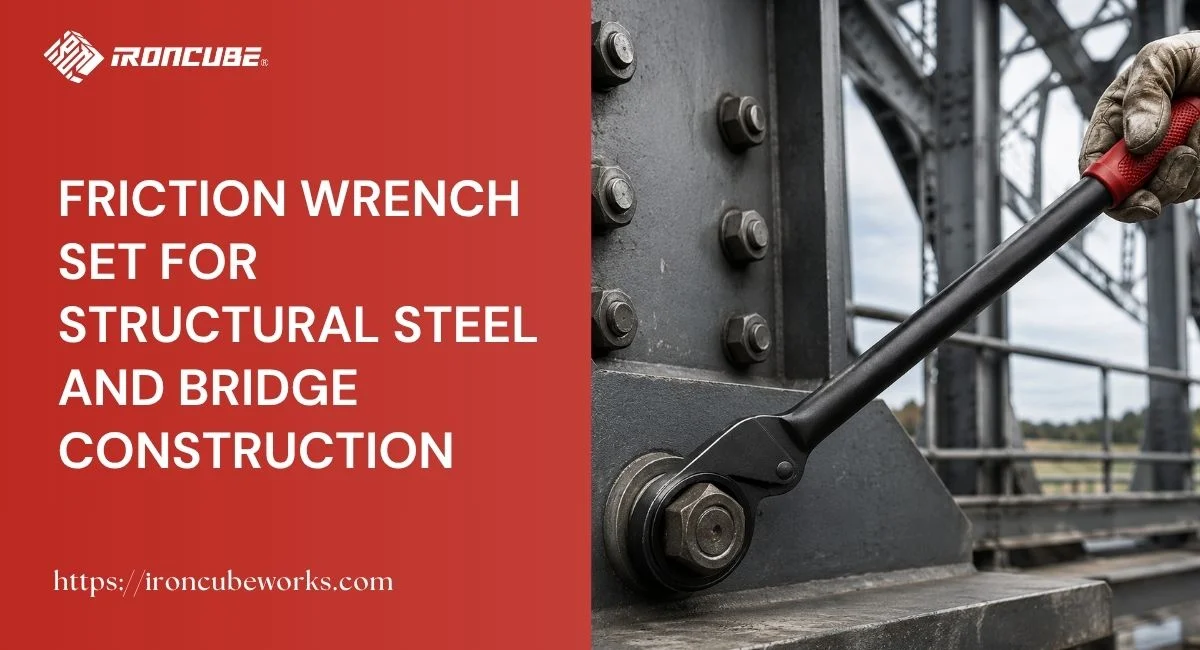
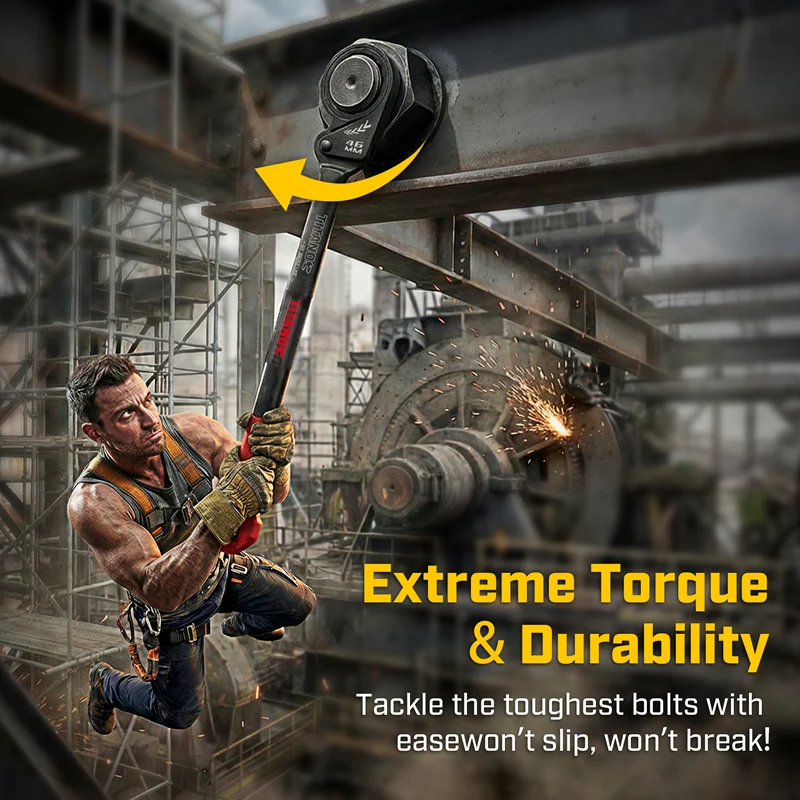
There’s a moment on every steel erection job that separates the pros from everyone else. It’s the moment a 1-1/8″ A325 bolt won’t budge, the impact wrench is out of range, and the guy on the beam has to reach for something that will actually deliver leverage. That something, more often than not, is a jumbo ratcheting spanner. Which brings us to why the best friction wrench set for structural steel and bridge construction isn’t a “nice to have” — it’s the tool that keeps ironworkers moving when the powered options fail.
This field guide is written for the people who actually build things: ironworkers, bridge crews, riggers, structural engineers overseeing bolted connections, and superintendents building out crew tool inventories. It covers what the best friction wrench set looks like for structural steel work, which sizes match the ASTM F3125 (formerly A325 and A490) fastener population you’ll encounter on real jobs, how to handle high torque without hurting yourself, and how to keep the tools in service between jobs.
Structural bolting is not casual work. The 2024 Bureau of Labor Statistics reported ironworkers as one of the higher-injury occupations in construction, with strain injuries and struck-by incidents leading the list. A properly chosen best friction wrench set isn’t just about productivity. It’s about not tearing a rotator cuff on the third day of erection, and not sending a wrench across the deck when a jaw slips under load.
Below, we break down the technical realities of using friction wrenches on ASTM F3125 structural bolts, why torque compliance is more complicated than most crews assume, and what actually belongs in a field-grade best friction wrench set for 2026 and beyond.
Friction Wrench Set Role in Structural Steel Work
Structural steel connections are one of the most standards-heavy environments in construction. Every bolted joint is governed by a specification, an inspection method, and a paper trail. The role of the best friction wrench set in that ecosystem is very specific — and often misunderstood.
Tension Control Bolt Requirements
Modern structural connections in North America use four accepted installation methods, all defined in the Research Council on Structural Connections (RCSC) Specification for Structural Joints Using High-Strength Bolts. The methods are turn-of-nut, calibrated wrench, direct tension indicators (DTI), and twist-off tension-control (TC) bolts.
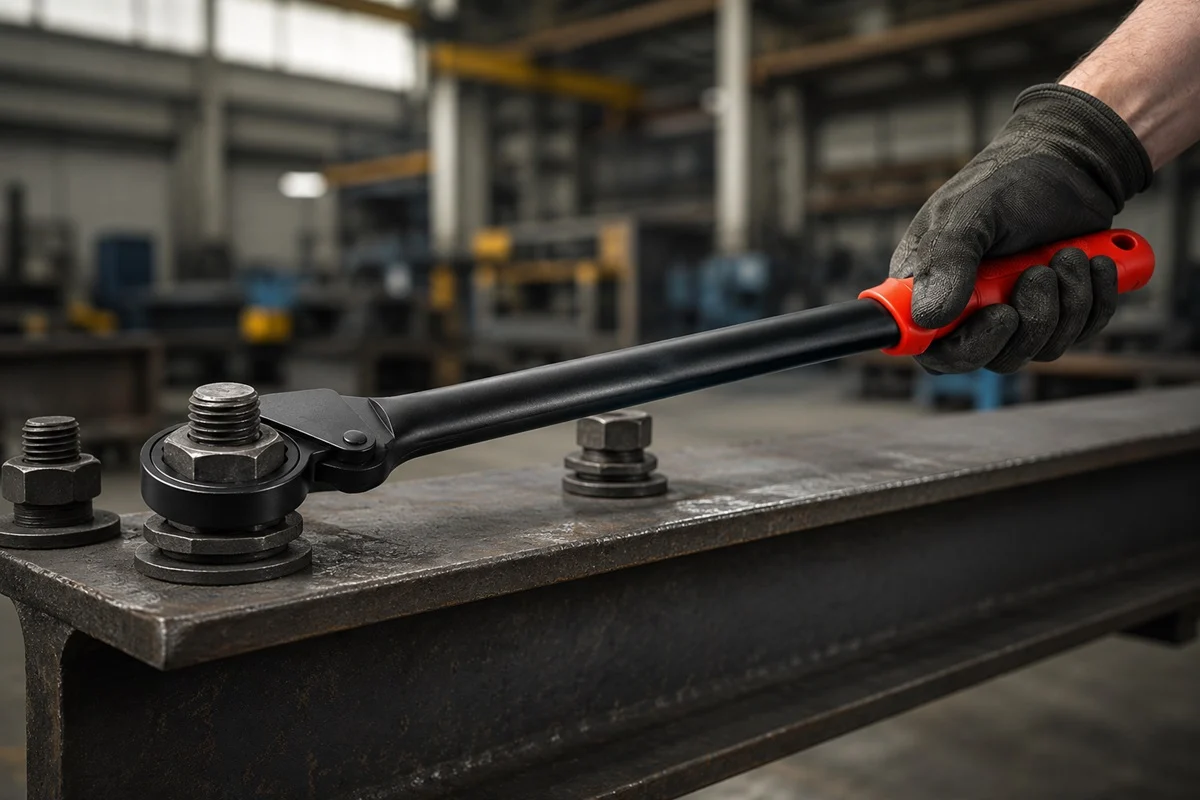
Here’s what most people miss: none of these methods rely on a hand-held friction wrench for final pretension. Final tensioning is done with shear wrenches on TC bolts, with impact or hydraulic wrenches under calibrated procedures, or by direct rotation counting after snug-tight condition. The best friction wrench set on a steel erection job isn’t there to hit final torque. It’s there to handle everything before and after — snugging, disassembly, re-work, and the constant one-off bolts that don’t fit the automated workflow.
That’s still an enormous portion of the work. On a typical multi-story building erection, ironworkers may handle thousands of bolts per day, and a meaningful share of them still get manual attention. When the impact tool won’t fit between two beams, when a bolt has to come off a temporary fit-up, when a nut is seized from weather exposure — that’s when the best friction wrench set earns its place in the tool belt.
OSHA and ASTM Torque Compliance
There’s a common misconception on job sites that OSHA sets torque values for structural bolts. It doesn’t. 29 CFR 1926 Subpart R — OSHA’s steel erection standard — regulates fall protection, decking, column stability, and site safety practices, but it defers to industry standards for actual bolt installation procedures. That means the enforceable specifications come from AISC 360, the AISC Code of Standard Practice, and the RCSC Specification.
The most important fact for anyone using the best friction wrench set in this context: ASTM A325 and A490 were officially withdrawn in 2016 and consolidated into ASTM F3125, which now covers both grades (120 KSI for former A325, 150 KSI for former A490) plus the twist-off variants F1852 and F2280. Old drawings and old crews still say “A325” and “A490,” and the industry generally accepts that shorthand, but the governing spec today is F3125.
The RCSC spec explicitly notes that torque alone is not a reliable measure of bolt pretension — variation of ±30% to ±40% from the same applied torque is normal because thread friction, surface condition, and lubrication all affect how much clamping force actually develops. This is why the calibrated wrench method requires job-site calibration on a Skidmore-Wilhelm tension calibrator before each shift. A best friction wrench set in this environment is a workhorse tool, not a measurement instrument. If you’re new to that distinction, our detailed friction wrench vs. torque wrench guide breaks it down.
For a broader introduction to wrench families and terminology, Wikipedia’s wrench overview is a decent starting point.
Sizes Every Steel Erector Should Carry
A best friction wrench set for structural steel work needs to match the real fastener population on North American job sites. That means understanding which wrench sizes actually correspond to A325 and A490 heavy hex bolts.
A325 and A490 Bolt Sizing
Heavy hex bolts have larger head dimensions than standard hex bolts of the same diameter. That’s a critical fact for wrench selection. A 1″ standard hex bolt takes a 1-1/2″ wrench, but a 1″ heavy hex structural bolt takes a 1-5/8″ wrench across flats because the head is intentionally oversized to distribute clamping load.
Here’s the heavy hex bolt-to-wrench conversion for ASTM F3125 (A325/A490) sizes, per ASME B18.2.6:
| Bolt Diameter | Wrench Size (Across Flats) | Approx. Metric Equivalent |
|---|---|---|
| 1/2″ | 7/8″ | 22mm |
| 5/8″ | 1-1/16″ | 27mm |
| 3/4″ | 1-1/4″ | 32mm |
| 7/8″ | 1-7/16″ | 36mm |
| 1″ | 1-5/8″ | 41mm |
| 1-1/8″ | 1-13/16″ | 46mm |
| 1-1/4″ | 2″ | 50mm |
| 1-3/8″ | 2-3/16″ | 55mm |
| 1-1/2″ | 2-3/8″ | 60mm |
Note how the wrench sizes cluster in the 1-1/4″ to 2-3/8″ range for the bolts most commonly used in structural work. A best friction wrench set engineered specifically for steel erection needs to hit those sizes — not the “sort of close” alternatives you’ll find in a general jumbo wrench kit.
Common Site Wrench Sizes
If you polled fifty ironworkers on which single wrench size they reach for most, the answers would cluster around 1-1/4″, 1-7/16″, 1-5/8″, and 1-13/16″ — the sizes for 3/4″, 7/8″, 1″, and 1-1/8″ A325/A490 bolts. These four sizes cover the vast majority of building connections and a large share of bridge work.
Bridge construction leans slightly larger. The 1-13/16″, 2″, and 2-3/8″ range dominates plate girder splices, floor beam connections, and large gusset assemblies. That’s why the 2-1/4″ friction wrench and the 1-1/2″ heavy-duty ratcheting spanner are among the most-requested individual sizes for bridge crews.
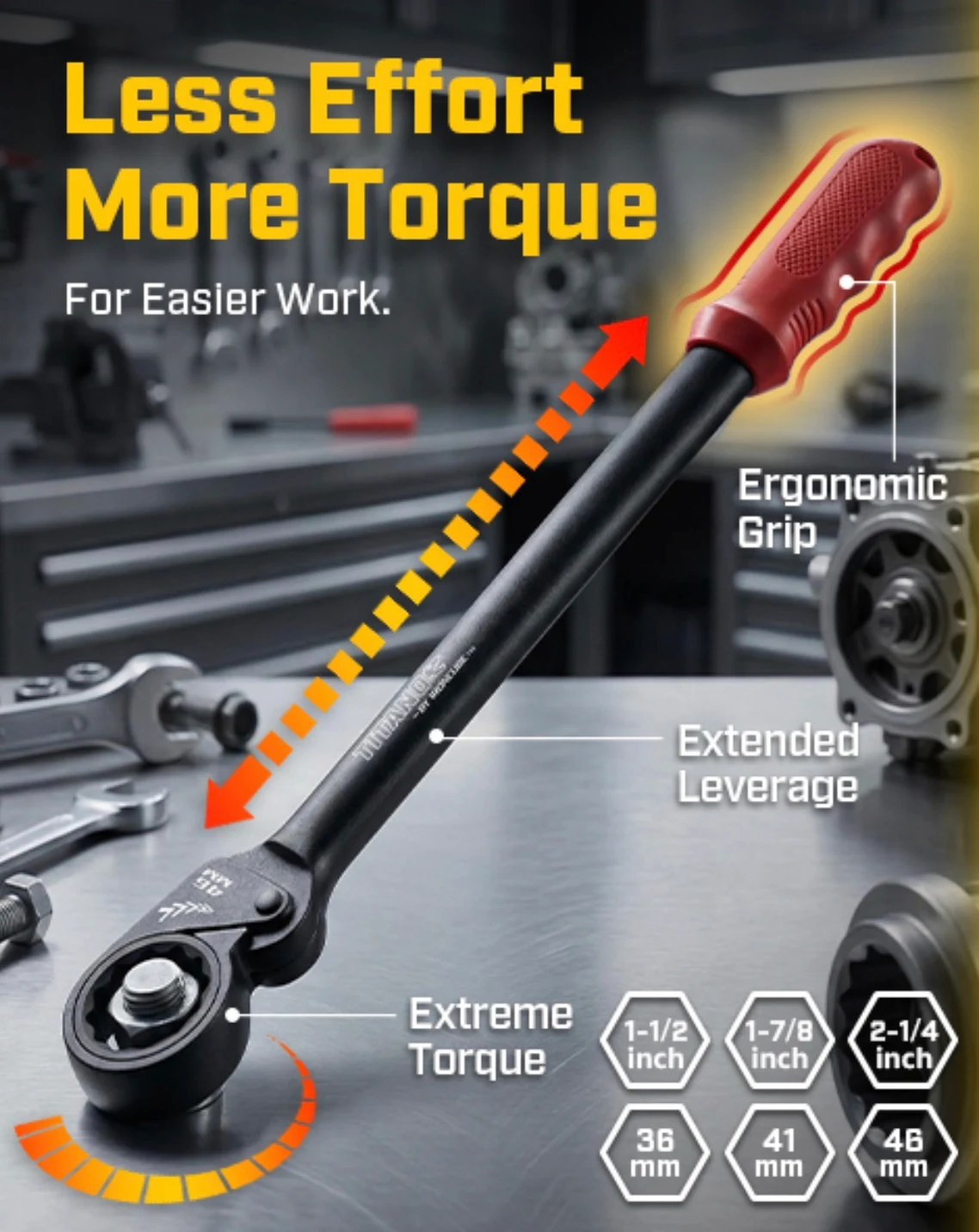
For metric sites — increasingly common on international infrastructure projects — the 41mm jumbo ratchet spanner covers 1″ heavy hex equivalent, and the 46mm friction wrench set covers 1-1/8″ heavy hex. If you want the deeper breakdown of size selection logic across metric and SAE, our friction wrench set buying guide 2026 covers it exhaustively.
A truly complete best friction wrench set for a mixed structural crew includes both SAE and metric jumbo sizes. Browse the full IRONCUBE® wrench catalog or the extra-large heavy-duty ratcheting wrench range to see what’s currently stocked.
Handling High Torque Safely
The torque required to seat and break loose structural bolts is genuinely significant. This is where the difference between a professional and a hobbyist becomes a safety issue.
Reference torque values for structural bolts (from published RCSC-referenced data for uncoated A325 bolts, informational use only):
| Bolt Diameter | Approx. Suggested Tightening Torque (A325) | Approx. Suggested Tightening Torque (A490) |
|---|---|---|
| 3/4″ | 355 ft-lb | 435 ft-lb |
| 7/8″ | 570 ft-lb | 715 ft-lb |
| 1″ | 850 ft-lb | 1,070 ft-lb |
| 1-1/8″ | 1,060 ft-lb | 1,500 ft-lb |
| 1-1/4″ | 1,495 ft-lb | 2,125 ft-lb |
| 1-3/8″ | 1,960 ft-lb | 2,780 ft-lb |
| 1-1/2″ | 2,600 ft-lb | 3,700 ft-lb |
Those numbers are not casual. A 1-1/4″ A490 bolt at 2,125 ft-lb is 2,880 N·m of torque — well beyond what any hand-operated torque wrench can deliver. This is exactly why the best friction wrench set matters: it’s the tool that safely transmits force in that range without requiring hydraulic support for routine work.
Important caveat: these are reference values only. Per the RCSC Specification, torque is not an approved standalone pretensioning method for slip-critical connections — you need turn-of-nut, DTI, TC bolts, or the calibrated wrench method. The values above matter for understanding the mechanical loads your best friction wrench set will actually see.
Body Position and Leverage
The single biggest cause of ironworker shoulder injuries when using jumbo wrenches is bad body position. Working overhead, twisting sideways, or pulling with locked knees puts the entire load through the rotator cuff and lumbar spine.
The rule of thumb from experienced steel crews: keep the pull path aligned with your body’s centerline, keep your feet planted shoulder-width apart, and use your legs and hips, not your arms and back. When possible, pull downward or horizontally with the wrench positioned so the arc of the swing sweeps through your natural range of motion.
For very high-torque situations — think 1-3/8″ and 1-1/2″ bolts — a best friction wrench set with a properly sized handle length becomes essential. The physics is simple: torque equals force times distance. A 24-inch handle at 100 pounds of pull gives you 200 ft-lb. A 36-inch handle at the same pull gives you 300 ft-lb. Longer handles let you generate high torque with less muscular effort and lower injury risk.
Two-Person Torque Routine
When breaking loose severely corroded structural bolts — a common situation on repair and retrofit work on older bridges — a two-person torque routine is often the safest approach. One person stabilizes the wrench head on the nut. The other applies pull force through the handle.
This method distributes the load across two people, prevents the wrench from cocking off the nut face (which is how jaws round off and slip), and dramatically reduces the chance of a sudden release when the bolt finally breaks free. A properly designed best friction wrench set has enough handle length and jaw geometry to make this two-person approach practical.
Never use a cheater bar on a hand wrench unless the manufacturer explicitly rates the tool for that use. Most don’t. Adding pipe extensions to a wrench not designed for it can bend the handle, crack the head, or send fragments flying if the tool fails under overload.
Bridge Construction and Rigging Uses
Bridge construction has its own set of challenges that make the best friction wrench set particularly valuable. Confined spaces, weathered fasteners, heavy machinery hookups, and safety-critical connections that must be inspectable after installation.
Heavy Machinery Hookups
Bridge deck erection uses cranes, gantries, launching noses, and skidding equipment — all of which have large-diameter pin connections, wire rope terminations, and structural attachment points that need frequent make-and-break. The best friction wrench set on a bridge crew typically lives in the crane operator’s toolkit or the rigger’s foreman box for exactly this reason.
Typical wrench sizes for heavy rigging on bridge projects sit in the 1-1/2″ to 2-1/2″ range, corresponding to 1″ through 1-1/2″ pins and structural attachment bolts. This is why the 1-1/2″ heavy-duty friction wrench and the 2-1/4″ version are common on bridge sites.
You can also source jumbo friction ratcheting wrenches through the IRONCUBE® Amazon storefront, including the B0FSQX6YFM Jumbo Friction Ratcheting Wrench and the B0FSPV1T9D companion size for procurement teams that prefer that channel.
Cable Clamp Fastener Work
Suspension bridges, cable-stayed bridges, and stay-cable retrofits all involve cable clamps with large-diameter through-bolts. These fasteners run from 1″ up to 2″ or larger and must be torqued to specifications set by the cable-system engineer — usually well outside the range of any conventional hand tool.
Even when final tensioning is done hydraulically, the setup and adjustment work is manual. A best friction wrench set covering the 1-5/8″, 1-13/16″, 2″, and 2-3/8″ range handles the routine work of cable clamp maintenance, saddle inspection, and stay-anchor adjustments. Bridge maintenance crews doing routine inspection often carry this exact tool set for on-the-spot re-torque and diagnostic work.
Maintenance Between Jobs
A best friction wrench set used hard on structural work won’t stay in field-ready condition without regular maintenance. Job-site conditions — rain, grinding dust, weld spatter, concrete slurry, corrosion — all attack the internal ratcheting mechanism.
Cleaning Grit from the Ratchet Head
The eccentric friction mechanism at the head of a Parmelee-style ratchet spanner is the heart of the tool. It’s also the part most vulnerable to grit contamination. When abrasive dust gets between the friction plate and the internal cam surface, the tool starts to slip under load — which on a structural bolt at 1,500 ft-lb of resistance is a legitimate safety hazard.
Clean the head after every job. Solvent-flush with a light degreaser or a dedicated tool cleaner, work the mechanism through its full range while flushing, and re-lubricate with a light machine oil or a purpose-formulated ratchet grease. Avoid heavy greases that can trap grit inside the mechanism. Our detailed friction wrench maintenance guide walks through the specific cleaning procedure for jumbo ratcheting spanners.
For video walk-throughs and hands-on demos, the IRONCUBE® YouTube channel posts regular maintenance content.
Rust and Corrosion Checks
Structural steel job sites are wet, cold, humid, or all three. Wrenches left in gang boxes overnight without wipe-down will develop surface corrosion within days. Corrosion on the jaw faces reduces grip on nuts. Corrosion on the internal mechanism can freeze the ratchet action entirely.
The routine is straightforward: wipe down every wrench with a light oil rag at the end of each shift, store in the case (not loose in a toolbox), and do a quarterly deep inspection of the internal mechanism. If a wrench starts feeling gritty or stiff, don’t wait — clean it before it fails on the beam.
A best friction wrench set stored properly and maintained on schedule should last 10 to 20 years in real service. A neglected one can be junk in 18 months.
Rounding Out the Structural Steel Toolkit
A serious steel erection kit isn’t just wrenches. It’s a matched set of jumbo ratcheting spanners, spud wrenches, drift pins, ratchet handles, and reliable screwdrivers for the accessory work. The IRONCUBE® screwdriver range is engineered for the same heavy-duty ethos as the wrench lineup, and our overview of the best magnetic screwdriver sets is a useful reference for that side of the kit.
For crews that also handle vehicle maintenance on service trucks and equipment, our guide to the best tools for car maintenance covers the smaller-scale tools that round out a mobile shop.
The full IRONCUBE® catalog is browsable from the homepage, and for procurement inquiries — bulk orders, custom-branded sets, wholesale pricing — the contact page is the direct line to the sales team.
Frequently Asked Questions
What torque do structural bolts need?
Torque values for structural bolts vary significantly by diameter and grade. For reference, an A325 bolt in the 1″ diameter range typically requires around 850 ft-lb for target pretension, while a 1-1/2″ A490 bolt runs closer to 3,700 ft-lb. That said, RCSC and AISC do not recognize torque as a standalone reliable measure of bolt pretension — the ±30% to ±40% variability in the torque-tension relationship is why the four accepted installation methods are turn-of-nut, calibrated wrench (with daily Skidmore-Wilhelm verification), direct tension indicators, and twist-off bolts. A best friction wrench set for structural work handles snug-tight and pre-tensioning work, but final verification always uses one of the four RCSC methods.
Are friction wrenches ANSI certified?
Friction wrenches themselves don’t fall under a specific ANSI/ASME performance standard the way sockets and combination wrenches do. However, most reputable manufacturers build friction wrenches to comparable specifications — chrome-molybdenum or chrome-vanadium alloy steel, heat treated to a Rockwell hardness range of 38–55 HRC (the same range ASME B107.100 requires for flat wrenches), and forged for consistent grain structure. When evaluating a best friction wrench set for structural work, ask the manufacturer specifically what alloy is used, what the target hardness range is, and what the rated maximum torque is. Reputable brands publish all three.
Can you use a friction wrench with a cheater bar?
Only if the manufacturer explicitly rates the wrench for cheater-bar use — and most don’t. Using a pipe extension on a hand wrench not designed for that duty is one of the top causes of tool failure and hospital-visit injuries on steel erection sites. The overload can bend the handle, crack the head casting, or shatter the internal ratchet mechanism. If you’re finding yourself reaching for a cheater bar regularly with your best friction wrench set, that’s a signal you need a longer-handled wrench or a hydraulic tool for that specific application, not more leverage on the wrong tool.
What’s the difference between a friction wrench and a spud wrench?
A spud wrench is a fixed-jaw open-end wrench with a tapered handle designed for aligning bolt holes during steel erection. It doesn’t ratchet. A friction wrench is a jumbo ratcheting spanner that uses an internal friction mechanism to grip and turn a nut, then releases when the handle is reversed — letting you re-position without lifting the wrench off the nut. Serious ironworkers carry both. The spud wrench aligns and snugs; the best friction wrench set handles the run-down, break-loose, and disassembly work that would take three times as long with a fixed spanner.
Are A325 and A490 still the correct bolt designations?
Technically no, but practically yes. In 2016, ASTM withdrew A325 and A490 as separate specifications and consolidated them into ASTM F3125, which now covers both grades — 120 KSI (formerly A325) and 150 KSI (formerly A490) — plus the twist-off tension-control variants F1852 and F2280. The industry still widely uses “A325” and “A490” as shorthand, and bolt heads are still marked with those designations. When ordering wrenches for a structural job, you’ll see both the old and new terminology — a best friction wrench set sized to the wrench chart above works for both.
Is a friction wrench safe for use on galvanized structural bolts?
Yes, with one important note. Hot-dip galvanized A325 bolts have significantly higher thread friction than plain finish bolts, which raises the K-factor (nut factor) from about 0.20 to 0.25 or higher. That means it takes noticeably more torque to reach the same pretension on a galvanized bolt versus a plain one. The wrench itself doesn’t care — a properly built best friction wrench set handles the mechanical load either way. What changes is the calibration on the tension side, and RCSC requires job-site verification tests for galvanized structural bolts. Note: A490 bolts cannot be galvanized due to hydrogen embrittlement risk in the higher-strength steel.
Final Summary
The best friction wrench set for structural steel and bridge construction isn’t a marketing category — it’s a specific piece of professional equipment sized to the ASTM F3125 (A325/A490) fastener population, built from properly heat-treated alloy steel, and long enough in the handle to safely transmit the torque these connections require. It works alongside impact tools, hydraulic wrenches, and torque-measurement equipment, not as a replacement for any of them.
For working ironworkers and bridge crews, the sizes that matter most are 1-1/4″, 1-7/16″, 1-5/8″, 1-13/16″, 2″, and 2-3/8″, plus the metric equivalents for international projects. Add proper maintenance — clean the ratchet head, inspect for corrosion, store in a case — and a well-chosen best friction wrench set will outlast the project it was bought for.
The IRONCUBE® jumbo friction ratcheting wrench lineup was designed specifically for this environment: forged chrome-molybdenum construction, controlled heat treatment, published torque ratings, and coverage of the full SAE and metric size range that structural work demands. For technical questions, custom sizing, or wholesale procurement, the IRONCUBE® contact page is the direct route.