Walk into any professional workshop and you’ll spot two very different tools sitting side by side: a torque wrench with its digital display or clicker mechanism, and a friction wrench — that heavy, slim-profile ratcheting spanner built for nuts the size of a soda can. Both tighten fasteners. That’s about where the similarities end.
The debate around friction wrench vs torque wrench confuses a lot of buyers, especially those working on heavy machinery, structural steel, or industrial pipework. One is a measuring instrument. The other is a force multiplier. Using the wrong tool can strip threads, damage joints, or leave you fighting a nut that refuses to move.
Here’s the twist most people miss. When you apply torque to a bolt, only about 10% of that force actually stretches the bolt to create clamping pressure. The rest — roughly 90% — is lost to friction under the nut face and along the threads. So a “torque wrench” isn’t really measuring how tight your joint is. It’s measuring the friction you’re fighting, plus a small slice that ends up as preload.
That physics quirk is central to understanding the friction wrench vs torque wrench conversation. In this guide, we’ll break down how each tool works, when each shines, their honest pros and cons, and how to choose between them for your next job. Whether you’re a mechanic, a structural fitter, or a maintenance engineer, you’ll leave with a clear framework for picking the right wrench.
What Is a Torque Wrench?
A torque wrench is a precision instrument that measures or limits the rotational force applied to a fastener. Torque is expressed in newton-metres (Nm), foot-pounds (ft-lb), or inch-pounds (in-lb), depending on your region.
There are four common styles you’ll encounter.
Click-type torque wrenches are the most popular. Turn the handle, set your target torque, and the internal cam-and-clutch mechanism produces an audible “click” once you reach the setting. Beyond that click, the wrench slips slightly to prevent over-tightening.
Beam torque wrenches are the oldest design — a simple flexible bar with a scale. You watch the pointer as you pull, and stop at the reading you want. No moving parts, no calibration drift, but easy to misread.
Digital torque wrenches use strain gauges and a digital readout. They log torque values, alarm at target, and often support Bluetooth for record-keeping. Aerospace, motorsport, and audited manufacturing environments favor them.
Dial torque wrenches display torque on an analog dial. Common in labs and quality control, less common on the shop floor.
Professional click-type torque wrenches are calibrated to the ISO 6789 international standard, which specifies accuracy tolerances of ±4% for the higher-grade hand-operated torque tools in the upper 80% of their range. That’s the industry benchmark. Cheaper wrenches sold at big-box stores often carry ±10% tolerances and no traceable calibration certificate.
What Is a Friction Wrench?
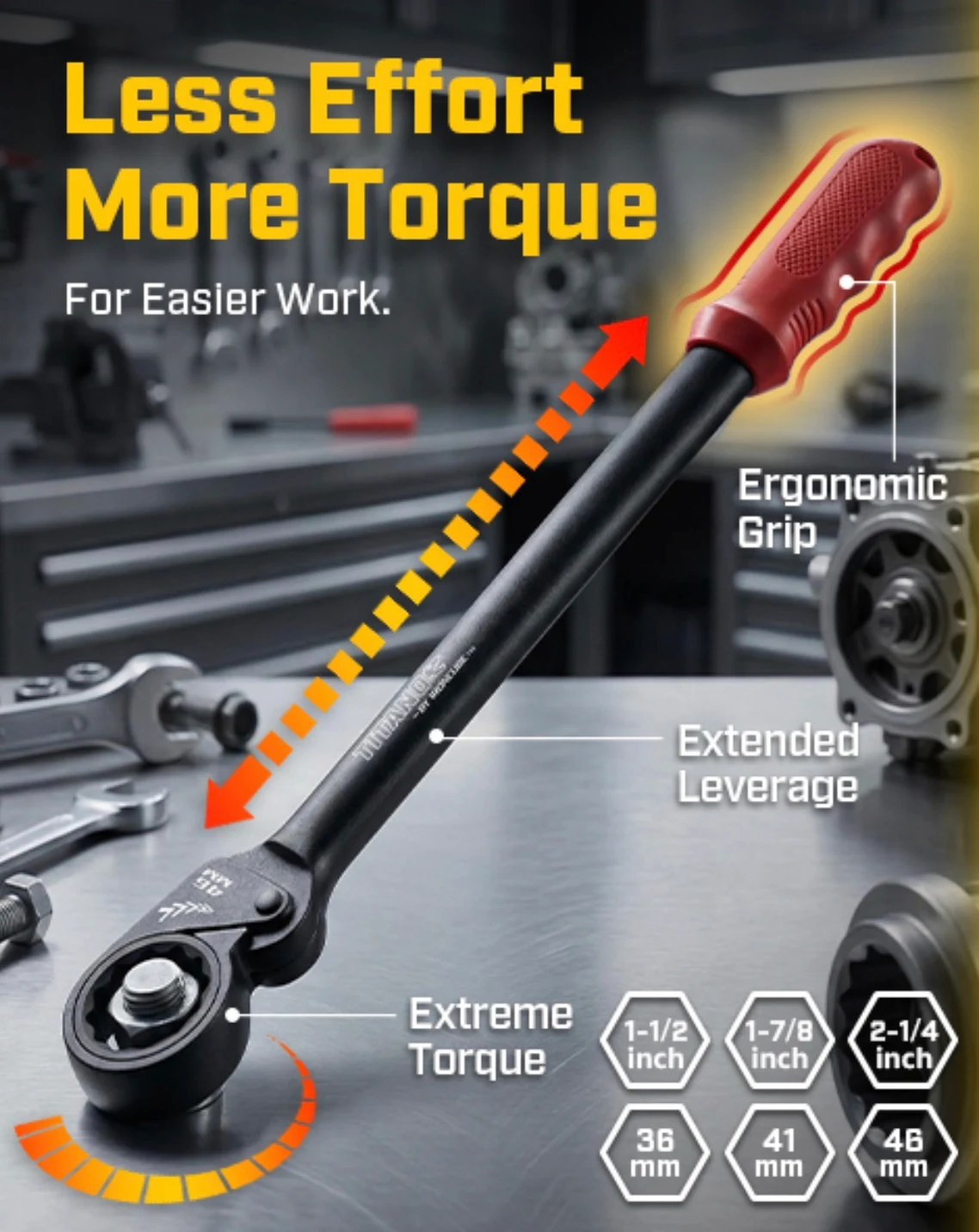
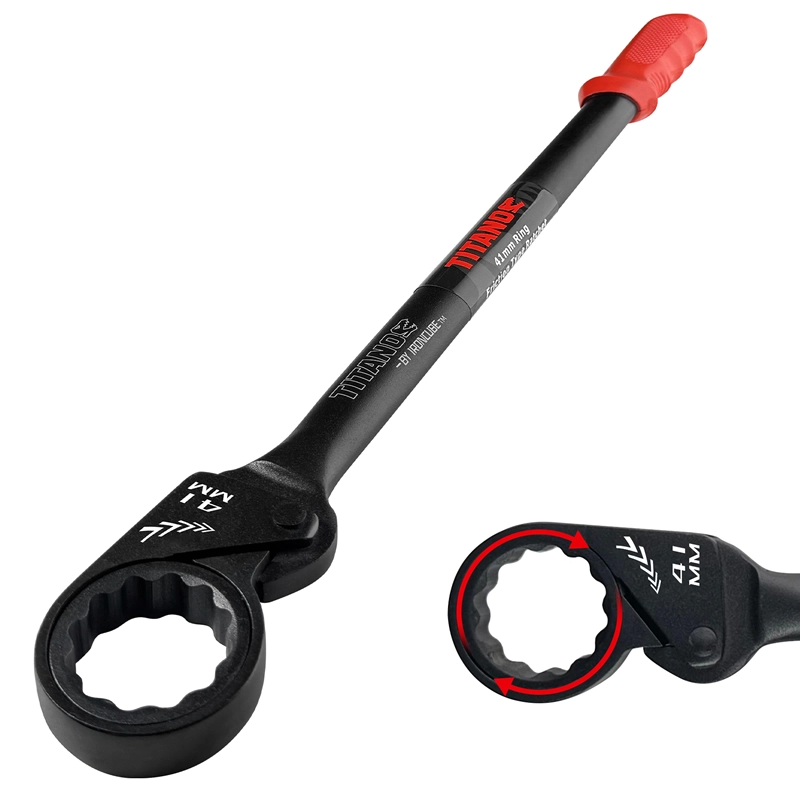
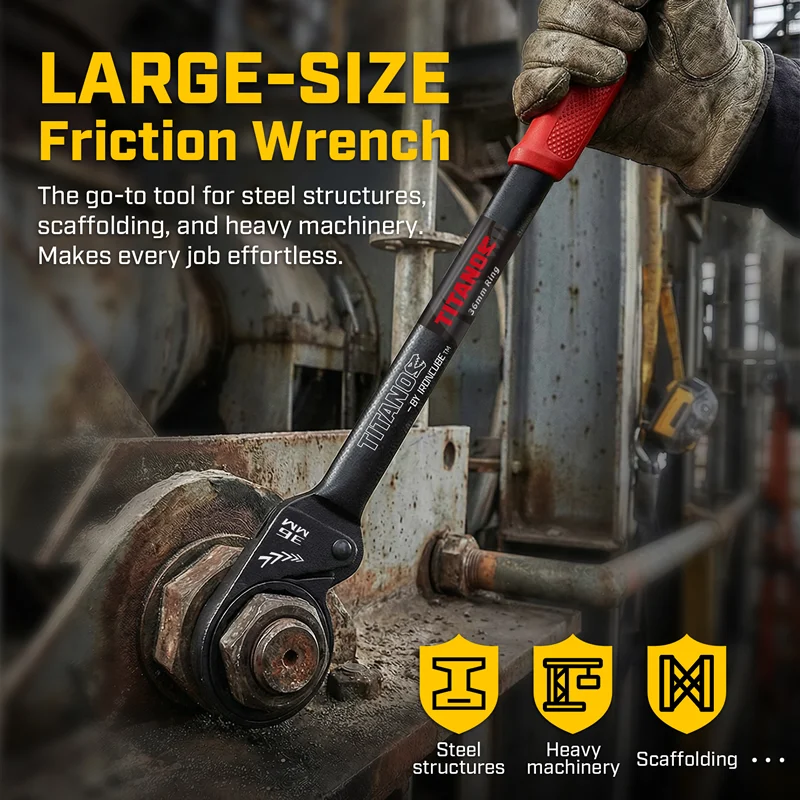
A friction wrench — sometimes called a Parmelee-style ratcheting spanner, a jumbo ratchet spanner, or simply a friction ratchet — is a hand tool designed for turning very large nuts and bolts in space-restricted areas. The IRONCUBE® friction wrench lineup covers 1-1/2″, 1-13/16″, 2-1/4″, 41mm, 46mm, and other jumbo sizes typically found on structural, industrial, and heavy equipment fasteners.
Unlike a socket-based ratchet or a click wrench, a friction wrench uses an eccentric friction plate or roller inside a slim, open-jaw head. When you push the handle in the tightening direction, the eccentric wedges against a flat of the nut and grips through friction. Pull the handle back, and the plate releases — letting you re-position without lifting the wrench off the nut.
That mechanism is why the tool earned the name. It doesn’t rely on a machined gear-and-pawl system like a standard ratchet. It relies on a controlled friction interface, delivering ratcheting action in a body thin enough to slide into places where a socket and breaker bar simply won’t fit.
Critically, a friction wrench does not measure torque. It’s a torque-delivery tool, not a torque-measurement tool. Its purpose is to transmit high force into a large nut in a confined space, with a design that lets you work fast without repositioning between strokes.
You’ll find these wrenches in service kits for wind turbines, oil and gas installations, structural steel erection, marine engineering, mining equipment, and rail infrastructure. They’re rugged, forged from chrome-molybdenum alloy steel, and priced accessibly compared to specialty hydraulic tensioners or oversized torque multipliers. Browse the full friction wrench and ratcheting spanner catalog to see the size options that dominate this category.
Friction Wrench vs Torque Wrench: The Core Mechanical Difference
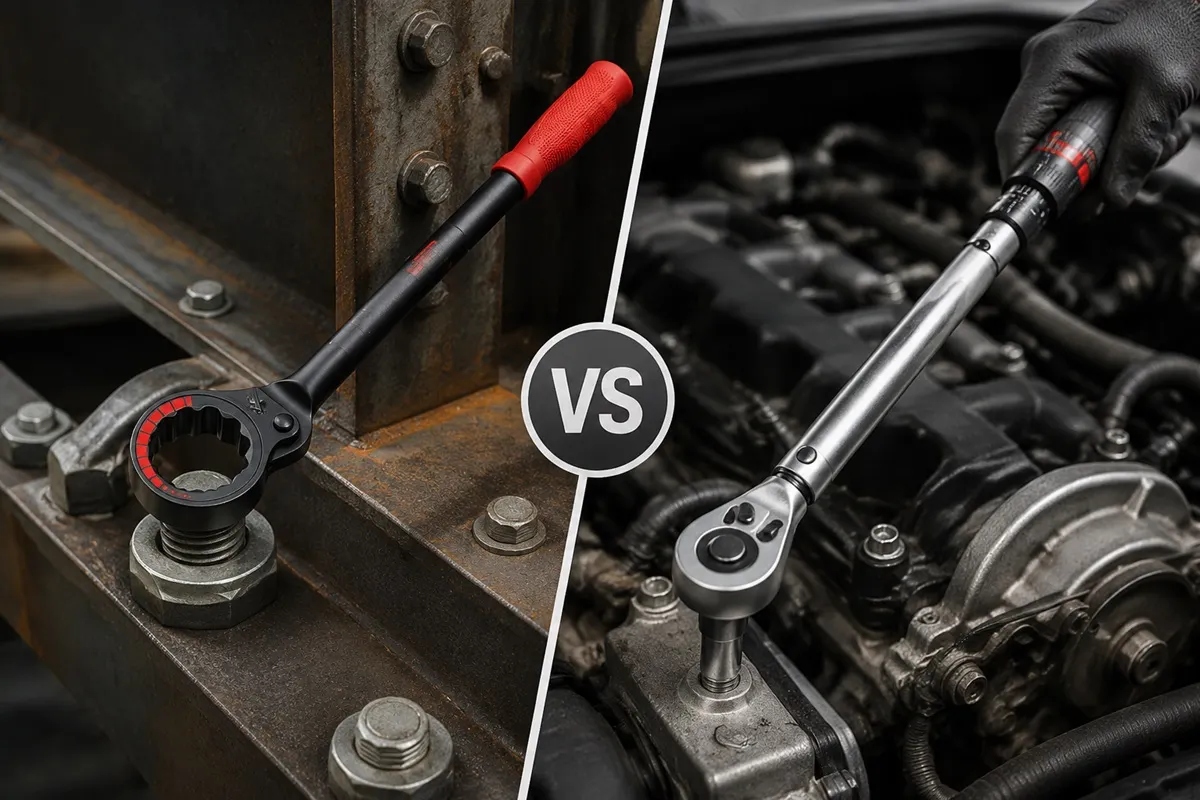
The friction wrench vs. torque wrench distinction comes down to one thing: measurement.
A torque wrench is a measuring device that happens to turn a fastener. A friction wrench is a fastener-turning device with zero measurement capability. That single difference cascades into every other decision you’ll make about which tool belongs in your kit.
There’s a deeper technical layer here that engineers care about. When you tighten a bolted joint, the applied torque distributes roughly like this, based on widely referenced fastener engineering data:
~10% goes into stretching the bolt — this is the actual clamping preload, the useful work.
~40% is lost to thread friction between the male and female threads.
~50% is lost to under-head friction between the nut face and the joint surface.
That distribution — often called the 10-40-50 rule — is why bolted joint experts point out that a torque wrench is, in a very real sense, a friction-reading device. You’re not measuring bolt tension. You’re measuring the combined resistance of thread and bearing-face friction, and hoping the K-factor (also called the nut factor) is what the spec assumed.
The industry-standard formula is:
T = K × D × F
Where T is applied torque, D is nominal bolt diameter, F is target preload, and K is the nut factor. K is typically 0.20 for dry, as-received fasteners and around 0.15 for well-lubricated ones. Change the lubrication, the plating, or the surface condition, and your preload can swing by 30% or more even when the torque reading is identical.
A friction wrench sidesteps this measurement question entirely. It just turns nuts. What system controls the preload — turn-of-nut, tension-indicating washers, hydraulic tensioning, or an inspector with a calibrated verification torque wrench — sits outside the tool itself.
Use Cases: When Each Tool Wins
Deciding between the two comes down to what job you’re doing, how big the fastener is, and how tightly the specification controls preload.
When a Torque Wrench Is the Right Call
Torque wrenches dominate anywhere the specification is written in Nm or ft-lb and there’s a documented QA process behind the assembly.
Engine and drivetrain work. Cylinder heads, main bearing caps, con-rods, and flywheel bolts have tight torque specs. A digital or click-type torque wrench is non-negotiable.
Automotive wheel lugs. Whether you’re on aluminum wheels or steel, the torque spec matters for safety. A torque wrench prevents warped brake rotors from over-tightening and wheel-off events from under-tightening. Our guide to the best tools for car maintenance covers where torque wrenches fit in a home mechanic’s kit.
Aerospace and aviation. Every fastener has a paper trail. Calibrated digital torque wrenches with data logging are standard.
Machinery assembly. Gearboxes, hydraulic manifolds, pump housings — anything where a leak or misalignment costs real money.
Small to medium fasteners. Most hand-operated torque wrenches top out around 300 ft-lb (about 400 Nm), which covers fasteners up to roughly 3/4″ or M20. Above that, you’re moving into torque multiplier territory.
When a Friction Wrench Is the Right Call
Friction wrenches take over the moment you’re dealing with heavy-duty fasteners, tight spaces, or high-volume tightening where precision matters less than throughput.
Structural steel erection. Column splices, moment connections, and base plates use large bolts — often 1″, 1-1/8″, or larger. Ironworkers reach for jumbo ratcheting spanners to run nuts down before the final tension is applied by a shear-wrench, tension-control bolt system, or turn-of-nut method.
Pipeline flanges and pressure vessels. Large-diameter flanges have 30-mm to 60-mm studs. A slim-profile friction wrench slides between adjacent flanges and works fast. Our extra-large heavy-duty ratcheting wrenches are engineered for exactly this environment.
Marine and offshore. Salt-crusted nuts on ship deck fittings, oil rig equipment, and dredging hardware require raw grip and turning power in cramped conditions.
Wind turbine service. Tower flange bolts, gearbox mounts, and yaw ring fasteners are enormous. Field technicians favor friction wrenches for setup and disassembly, then verify final preload with hydraulic tensioners.
Rail infrastructure. Rail joint bolts, catenary hardware, and switch components use large fasteners in tight geometry.
Heavy equipment and mining. Bucket teeth, track links, and structural pins on excavators demand size 41mm, 46mm, and larger. A 46mm friction wrench set or a 41mm jumbo ratchet spanner covers most of the fastener sizes you’ll see on this equipment.
If you’re specifically dealing with heavy-duty fasteners in the 1-1/2″ and above range, a friction wrench is almost always the more practical choice. Have a look at the 1-1/2″ friction wrench for large nuts and the 2-1/4″ model for the two most requested sizes.
Side-by-Side Comparison Table
| Feature | Torque Wrench | Friction Wrench |
|---|---|---|
| Primary function | Measures applied torque | Transmits torque via friction grip |
| Accuracy | ±4% for professional grades (ISO 6789) | Not applicable — no measurement |
| Typical fastener range | Up to ~3/4″ / M20 for hand tools | 1-1/2″, 1-13/16″, 2-1/4″, 41mm, 46mm, and larger |
| Head profile | Socket-based, bulky | Slim open-jaw, ideal for tight spaces |
| Ratchet mechanism | Fine-tooth gear pawl | Eccentric friction plate |
| Calibration | Annual recalibration standard | Not required |
| Data logging | Available on digital models | None |
| Best for | Precision preload control | Large-nut tightening in confined spaces |
| Cost of ownership | Purchase + annual calibration | One-time purchase |
Pros and Cons: The Honest View
Torque Wrench — Advantages
Traceable accuracy, standardized calibration, records for audits, prevent catastrophic over-tightening, wide availability of sizes and drive types, essential for critical safety fasteners.
Torque Wrench — Limitations
It measures torque, not preload. Lubrication changes preload dramatically. Calibration drifts and requires annual verification. Click mechanisms wear out. Hand-operated models cap out around 400 Nm — beyond that, you need multipliers, hydraulic wrenches, or tensioners. Expensive when you factor in calibration costs over the tool’s life.
Friction Wrench — Advantages
Delivers serious turning power on large nuts. Slim head geometry fits where sockets can’t. No calibration needed, no batteries, no electronics. Forged from tough alloy steel — the IRONCUBE® friction wrench line uses chrome-molybdenum for durability under high load. Handles rough field conditions. Faster than swapping sockets on large fasteners. Excellent value for the size class.
Friction Wrench — Limitations
No torque measurement means it can’t be used as the primary control for critical joints. Requires clean, undamaged nut flats to grip properly. Doesn’t work well on badly rounded or heavily corroded nuts. Not appropriate for small fasteners where a standard ratchet or torque wrench is faster.
The Hidden Truth About Torque Control
Here’s something the friction wrench vs torque wrench debate rarely surfaces. Even with a properly calibrated torque wrench, preload scatter of ±25% to ±30% is normal in dry, as-received bolted joints. That’s not a flaw in the wrench. It’s the physics of friction variability.
The Research Council on Structural Connections (RCSC), which publishes the specification governing high-strength bolts in North American steel construction, recognizes this. Their specification treats torque control as an installation method, but final acceptance for pretensioned joints typically requires turn-of-nut, twist-off bolts, direct-tension-indicating washers, or the calibrated wrench method with rigorous daily verification.
That’s the industry’s polite way of saying: torque alone isn’t good enough for the most demanding joints. Which is exactly why friction wrenches — tools that don’t pretend to measure preload — remain the workhorse for running large-nut assemblies, with a separate verification step handling the accuracy question.
For a broader definition of the wrench family — including origins of the various ratcheting designs — the Wikipedia entry on wrenches is a solid reference.
How to Choose Between a Friction Wrench and a Torque Wrench
Ask three questions and the choice usually makes itself.
1. How big is the fastener? Under 3/4″ or M20, torque wrenches are practical and often required. Above 1-1/8″, a friction wrench (or a hydraulic tool) is almost always the working tool.
2. Is a precise preload specified? If your assembly drawing calls out a torque value in Nm or ft-lb, use a calibrated torque wrench for the final pass. If the spec is “snug tight” or “turn of nut” or a hydraulic tension setpoint, a friction wrench handles the mechanical labor and the specified control method handles the accuracy.
3. What’s the working space? Standard sockets need vertical clearance. Slim-profile friction wrenches slide between flanges, into gearboxes, and along bracketry where a bulky drive tool won’t reach.
Many professionals carry both. A torque wrench for the small stuff and the audited joints, and a friction wrench for the big-nut work that torque wrenches can’t physically address. If you’re building out a professional kit, browse the IRONCUBE® wrench catalog and the screwdriver range — both are engineered for the same heavy-duty, field-service ethos.
You can also see the IRONCUBE® jumbo friction ratcheting wrenches on Amazon: the Jumbo Friction Ratcheting Wrench B0FSQX6YFM and the companion size model B0FSPV1T9D, or explore the full IRONCUBE® Amazon storefront.
For upkeep guidance to keep either tool performing, our friction wrench maintenance guide walks through cleaning, lubrication points, and inspection checkpoints. And if you’re rounding out a mechanic’s toolkit, the best magnetic screwdriver sets pair nicely with the wrench lineup. For product demos and hands-on walkthroughs, the IRONCUBE® YouTube channel posts regular content.
Frequently Asked Questions
Is a friction wrench the same as a torque wrench?
No. This is the core confusion in the friction wrench vs torque wrench conversation. A torque wrench is a measuring instrument — it tells you when a specific rotational force has been reached. A friction wrench is a ratcheting spanner that uses friction to grip and turn large nuts, with no torque measurement built in. They serve different purposes and typically live in different parts of a professional toolkit.
Can I use a friction wrench instead of a torque wrench on my car?
For final torqueing of critical fasteners like wheel lugs, head bolts, or suspension components, no — you need a calibrated torque wrench. The friction wrench vs torque wrench decision on a passenger car almost always favors the torque wrench because passenger-vehicle fasteners fall within its size range and have documented torque specs. Friction wrenches shine on the very large fasteners typically found on trucks, heavy equipment, and industrial machinery, not on cars.
Why do professionals prefer a friction wrench for heavy-duty fasteners?
Three reasons make the friction wrench vs torque wrench trade-off favor friction wrenches for heavy-duty fasteners above roughly 1-1/8″. First, hand-operated torque wrenches don’t reliably cover that size range. Second, friction wrench heads are slim enough to fit tight geometry around large flanges and structural connections. Third, most critical large-diameter joints use turn-of-nut or hydraulic tensioning for final preload control, meaning torque measurement isn’t the mechanism running the nut anyway.
How accurate is a torque wrench compared to a friction wrench?
A friction wrench isn’t rated for accuracy because it doesn’t measure anything. A professional torque wrench calibrated to ISO 6789 is accurate to about ±4% of the applied torque for the higher-accuracy grades. Important caveat — that’s ±4% of torque, not of bolt preload. Preload scatter is typically ±25% to ±30% even with a perfectly calibrated wrench because of friction variability at the thread and bearing surfaces. The friction wrench vs torque wrench accuracy comparison is really apples-to-oranges: one measures torque with precision, the other doesn’t try to measure anything.
What industries rely on friction wrenches?
Structural steel erection, oil and gas, wind energy, mining, marine and offshore, rail infrastructure, and heavy equipment maintenance. The common thread across these industries is large fasteners — often 1-1/2″ and above — that need to be run down efficiently in confined field conditions. In every one of these sectors, the friction wrench vs torque wrench conversation lands the same way: friction wrenches handle the mechanical work, and a separate control method handles the preload verification.
Do I need to calibrate a friction wrench?
No. Because a friction wrench doesn’t measure torque, there’s nothing to calibrate. Basic maintenance — cleaning, inspection for jaw wear, and periodic lubrication of the ratcheting mechanism — is all that’s needed. This is one practical reason the friction wrench vs torque wrench cost comparison often favors the friction wrench for high-use field applications: no annual calibration fee, no downtime for calibration turnaround.
Final Summary
The friction wrench vs torque wrench decision comes down to what job you’re doing. A torque wrench is a measurement instrument that delivers precise, calibrated torque control on small to medium fasteners. A friction wrench is a rugged, ratcheting spanner engineered to move very large nuts in confined spaces where precision isn’t the priority — throughput and turning power are.
Neither tool replaces the other. Serious mechanics, ironworkers, and maintenance engineers carry both. The right question isn’t which tool wins the friction wrench vs torque wrench debate. The right question is: what’s the fastener size, what’s the specified control method, and what’s the working space? Answer those three, and the tool selection becomes obvious.
If you’re building or expanding a professional-grade toolkit, explore the full IRONCUBE® tool lineup, and reach out through the contact page for guidance on the right friction wrench sizes for your application.