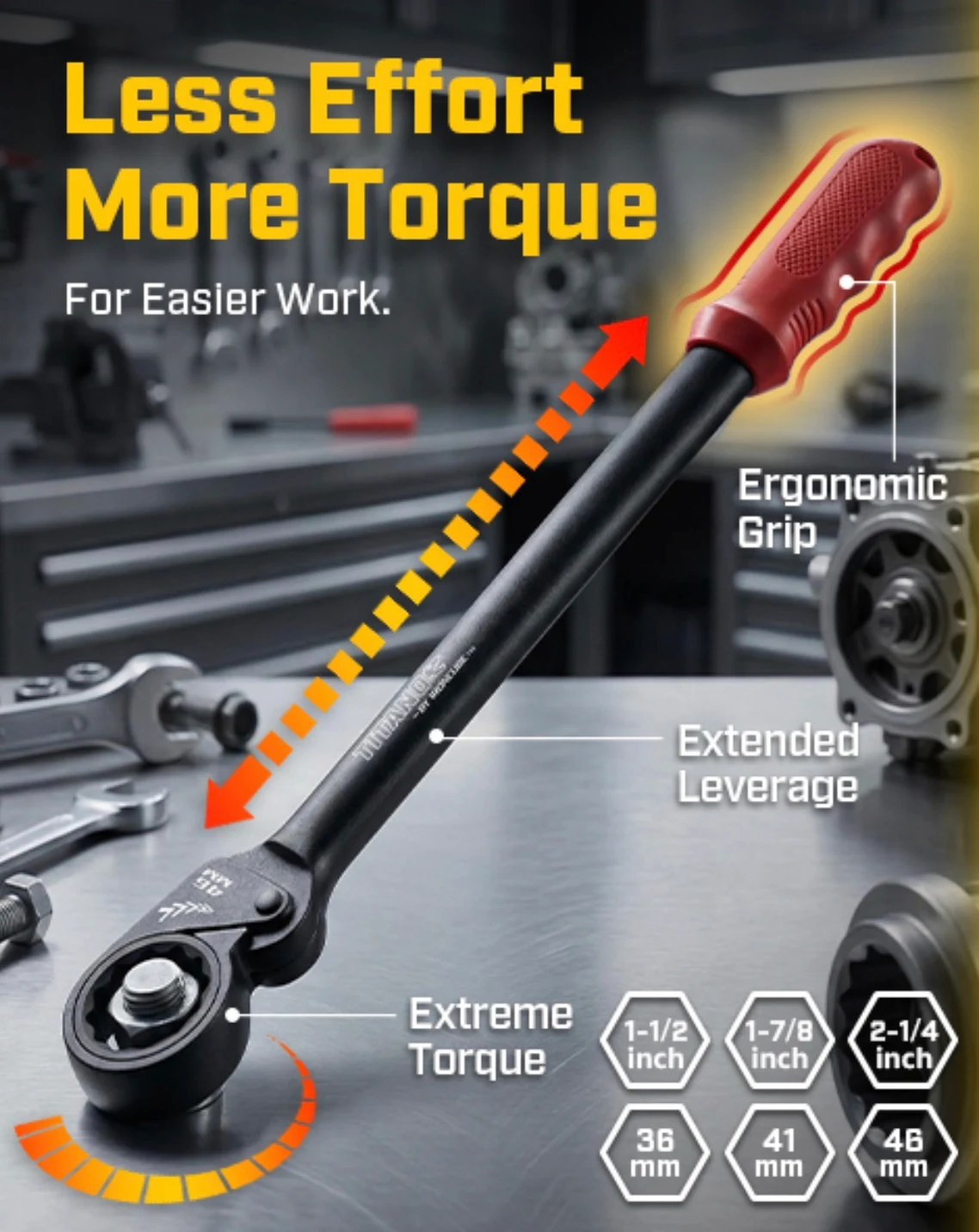
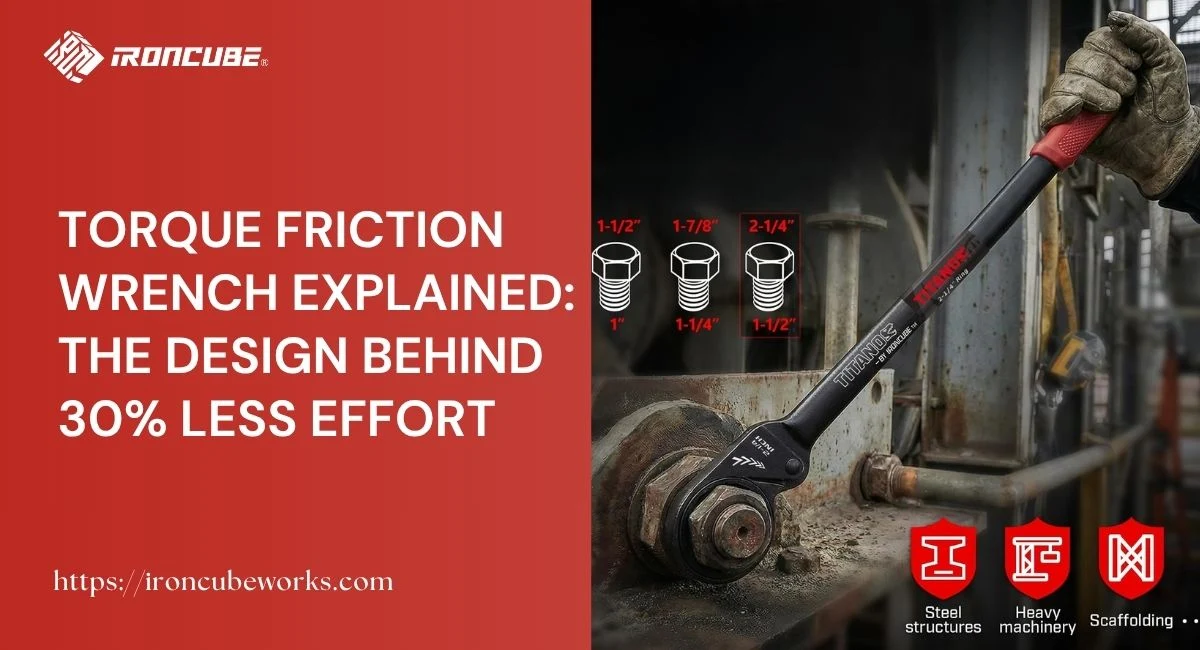
A Torque Friction Wrench looks simple at first. It has a long handle, a strong ratcheting head, and a large box-end profile for heavy fasteners. But the design solves a real industrial problem: large nuts need serious turning force, and workers need a tool that can deliver that force without wasting energy on awkward repositioning.
That is where the “30% less effort” idea comes from.
It should not be treated as a universal laboratory guarantee for every user, every bolt, or every jobsite. The honest explanation is better. A longer effective handle, a strong friction-ratchet mechanism, and better hand contact can reduce the force a worker feels when compared with shorter or less efficient tools. Torque is force multiplied by lever distance, so a longer working radius can reduce the hand force needed to reach the same torque. The basic relationship is widely accepted in mechanics: torque equals applied force times lever arm distance when the force is perpendicular to the lever.
For heavy-duty users, that matters. A Torque Friction Wrench is not just another spanner. It is a high-torque wrench built for structural steel, bridge work, large plant maintenance, heavy machinery nuts, and field assembly where space, speed, and durability matter.
For buyers comparing options, the IRONCUBE wrench category is a practical starting point. You can also browse the main IRONCUBE tools website for related hand tools and industrial fastening solutions.
What Is a Torque Friction Wrench?
A Torque Friction Wrench is a heavy-duty ratchet wrench designed to apply high turning force to large nuts and bolts. It uses a friction-style ratcheting action rather than a delicate click-torque measuring mechanism. The goal is not laboratory torque measurement. The goal is strong, repeatable, efficient fastening and loosening in tough work environments.
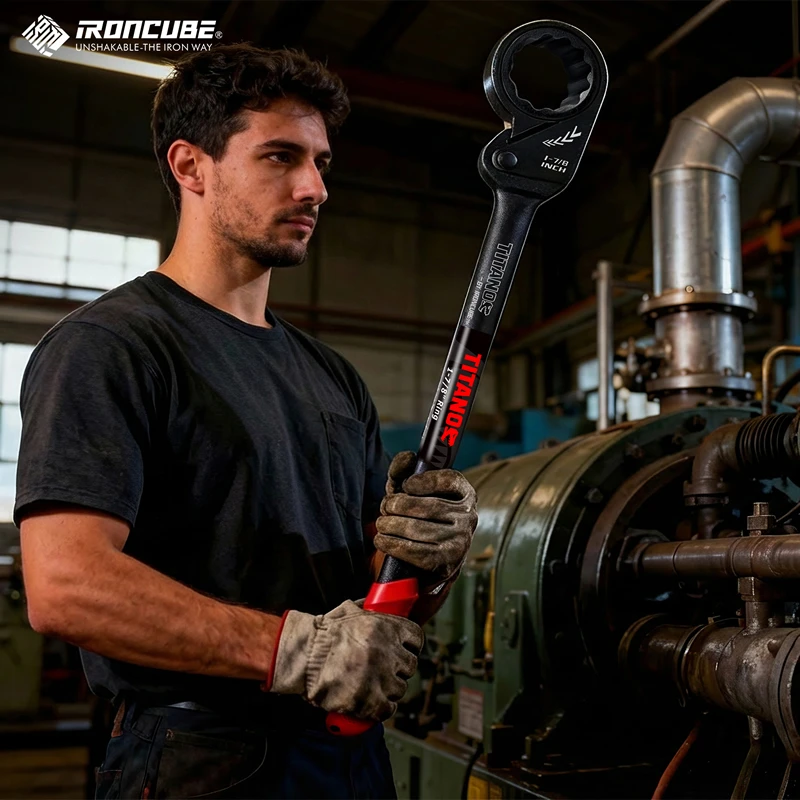
A standard wrench provides grip and mechanical advantage for applying torque to rotary fasteners such as nuts and bolts. That basic definition has not changed much over time. What changed is the engineering around access, leverage, ratcheting, handle comfort, and load capacity.
In practical terms, a Torque Friction Wrench sits between a regular spanner and a precision torque wrench. It gives more speed than a fixed box wrench. It gives more strength than a light-duty ratchet. And it often survives rougher handling than a click-type industrial torque wrench.
For large-size fastening work, check examples such as the IRONCUBE 1-1/2 inch heavy-duty ratcheting spanner, the IRONCUBE 1-7/8 inch friction wrench, and the IRONCUBE 2-1/4 inch friction wrench.
Definition and short history
The wrench has always been about leverage. Early spanners were simple tools for turning square or hex-shaped fasteners. Over time, industry demanded better access and less wasted motion. Box-end wrenches improved contact. Ratcheting wrenches reduced repositioning. Heavy-duty friction wrenches added strength for larger nuts.
A Torque Friction Wrench follows that same evolution. It keeps the mechanical advantage of a long spanner but adds ratcheting convenience. This makes it useful in places where a full swing is impossible.
Think of steel frames, pipe flanges, plant equipment, mining machinery, large agricultural machines, and bridge joints. In those environments, a normal wrench can feel slow. A light ratchet can feel weak. A heavy-duty ratchet wrench gives the worker a better balance of speed and force.
How it differs from a click-type torque wrench
A click-type torque wrench is a measuring tool. You set a torque value, apply force, and stop when the wrench clicks. That makes it useful when a manufacturer requires a specific torque value.
A Torque Friction Wrench is different. It is mainly a force-delivery tool. It helps the user tighten or loosen large fasteners efficiently, but it does not normally “click” at a preset torque value.
That difference matters. ISO 6789-2:2017 covers calibration methods and uncertainty calculation for hand torque tools, including indicating and setting torque tools. ASME B107.300 also defines performance and safety requirements for manually operated torque instruments used to control fastener tightness.
So, do not confuse the tools. A click torque wrench is for controlled final tightening. A Torque Friction Wrench is for high-load turning, run-down, loosening, and heavy assembly support.
For a deeper comparison, read Friction Wrench vs Torque Wrench.
How the Friction Ratchet Design Works
The design is built around three things: tooth engagement, load transfer, and usable leverage.
When a worker pulls the handle, force travels through the handle into the head. The ratchet mechanism allows rotation in one direction while slipping or resetting in the other direction. This means the user does not need to remove and reposition the tool after every short movement.
That saves time. It also saves energy.
In tight areas, the saving can feel significant. A worker may only have 15 or 20 degrees of swing. With a fixed box wrench, that worker may need to lift, reposition, re-seat, pull, and repeat. With a friction ratchet design, the hand can keep working in a smaller arc.
That is one reason a Torque Friction Wrench feels easier during repetitive work.
Pawl and gear mechanics in plain language
A typical ratchet uses a pawl and gear system. The gear has teeth. The pawl locks against those teeth in the drive direction. When the handle moves backward, the pawl slides over the teeth and resets.
A friction-style ratchet mechanism is designed for tough load transfer. The user feels a firm engagement rather than a delicate measuring release. This is why the tool suits large nuts better than fine calibration work.
The head design also matters. A large box-end shape spreads contact across the fastener faces. This can reduce rounding risk compared with poor-fitting open-end tools. It also gives better control when the user applies high force.
For larger fasteners, see the 41mm jumbo ratchet spanner for large nuts and the guide on 46mm friction wrench sets for heavy machinery nuts.
Why friction handles bigger loads than clockwork ratchets
Light ratchets are built for convenience. Heavy friction wrenches are built for load. That is the difference.
Small clockwork-style ratchets often have compact internal parts. They are excellent for automotive, maintenance, and general workshop tasks. But large industrial fasteners demand more contact area, thicker heads, stronger handles, and a mechanism that can tolerate higher shock loads.
A Torque Friction Wrench is closer to a structural tool than a delicate instrument. It does not need a fine spring to signal a torque value. It needs a strong path for force.
This also affects lifespan. A measuring torque wrench can drift out of calibration. A friction wrench does not provide calibrated measurement in the first place, so its care priorities are different. You focus on wear, cleanliness, lubrication, tooth condition, and head fit.
For maintenance guidance, use IRONCUBE’s friction wrench maintenance guide.
The Design Behind 30% Less Effort
The cleanest way to understand “30% less effort” is through leverage.
Imagine a worker needs 700 N·m of torque.
With a 0.70 m effective handle, the required hand force is about 1,000 N.
With a 1.00 m effective handle, the required hand force drops to about 700 N.
That is a 30% reduction in hand force for the same target torque. The torque did not become smaller. The tool made the work easier by increasing the effective lever distance.
| Required torque | Effective handle length | Approx. hand force needed |
|---|---|---|
| 700 N·m | 0.70 m | 1,000 N |
| 700 N·m | 0.85 m | 824 N |
| 700 N·m | 1.00 m | 700 N |
This is not marketing magic. It is basic mechanics.
The second part is ergonomics. OSHA advises using tool handles long enough to span the full hand because this spreads contact force across the palm and fingers. That is why handle shape matters on a high-torque wrench. A thin handle can create hand pressure. A better handle spreads the load.
The third part is ratcheting efficiency. A Torque Friction Wrench reduces wasted movement. The user keeps the tool seated and works through repeated short strokes. On real jobs, that can feel like less effort because the body does fewer non-productive movements.
Torque Ranges You Can Reach
The torque range of a wrench depends on size, material, handle length, head design, and manufacturer rating. You should always follow the product specification for the exact model.
Still, industrial users often think in broad ranges.
A smaller hand torque tool may work in lower ranges. A large friction wrench can support heavy run-down and loosening tasks where the fastener size is much larger.
Norbar’s torque tool FAQ notes that, for best accuracy and repeatability with torque tools, the target torque often falls between 20% and 80% of the tool’s rated capacity. That guidance is most relevant to measuring torque tools, but the selection logic still helps: avoid choosing a tool that is too small for the job.
Standard torque friction wrenches: 300–600 N·m
A standard Torque Friction Wrench can suit medium-heavy industrial work. This includes plant maintenance, large equipment service, pipe support brackets, and oversized workshop fasteners.
In this range, speed matters as much as force. Workers may need to tighten many fasteners during one shift. A ratcheting design helps because it reduces repeated lifting and resetting.
For buyers building a kit, the Friction Wrench Set Buying Guide 2026 explains how to compare sizes, materials, and jobsite needs.
Heavy-duty models: 600–1000 N·m and beyond
Larger models can support much higher torque applications, especially when paired with long handles and large fastener sizes. These tools are common around steel construction, heavy vehicles, industrial plants, and equipment foundations.
At this level, tool selection becomes serious. A poor fit can damage the nut. A weak ratchet can fail. A short handle can make the worker use unsafe body force.
For heavy applications, review extra-large heavy-duty ratcheting wrenches and jumbo ratchet wrenches for heavy-duty work.
If you buy in bulk, the guide on quality wholesale jumbo wrench sets can help with sourcing decisions.
Best Uses for a Torque Friction Wrench
A Torque Friction Wrench works best when the main job is turning large fasteners under high resistance. It is not the first choice for delicate electronics, small machine screws, or final calibrated tightening.
It is a practical tool for rougher, heavier work.
Structural bolt tensioning
Structural steel work often involves high-strength bolts, controlled procedures, and inspection requirements. This is where accuracy matters. AISC warns that torque is not a valid measure for pretensioned installation unless it is calibrated. It also notes that old standard torque tables produced installed tension variation as high as plus or minus 40% because thread condition changed the result.
That is a critical point.
A Torque Friction Wrench can help during snugging, run-down, positioning, and general assembly. But final pretensioning must follow the project specification. If calibrated wrench tightening is used, AISC says torque must be calibrated daily for the specific bolt lot, diameter, and condition.
For structural work, read the guide on best friction wrench sets for structural steel and bridge construction.
Wind turbine assembly
Wind turbines contain thousands of bolts. One industry source notes that wind turbines typically contain more than 6,000 bolts and that inspection of larger critical bolts is required at regular intervals.
That explains why high-torque tools matter in wind work. Fasteners may sit in towers, hubs, nacelles, base flanges, and access-restricted areas. Workers need tools that can handle load without slowing the job.
A Torque Friction Wrench can support assembly, inspection access, and maintenance tasks where a strong manual tool is useful. For final controlled tightening, teams may use calibrated torque tools, hydraulic tools, or tensioning systems depending on the engineering specification.
Bridge and heavy plant work
Bridge maintenance and heavy plant work often involve corrosion, large fasteners, weather exposure, and awkward access. A normal wrench may not give enough leverage. A compact ratchet may not survive.
This is where a heavy-duty ratchet wrench gives value. It keeps the head seated. It lets the user work in short arcs. It provides the strength needed for stubborn nuts.
In these jobs, the Torque Friction Wrench is not just a convenience tool. It can reduce fatigue across a full shift.
Torque Friction Wrench vs Click Torque Wrench
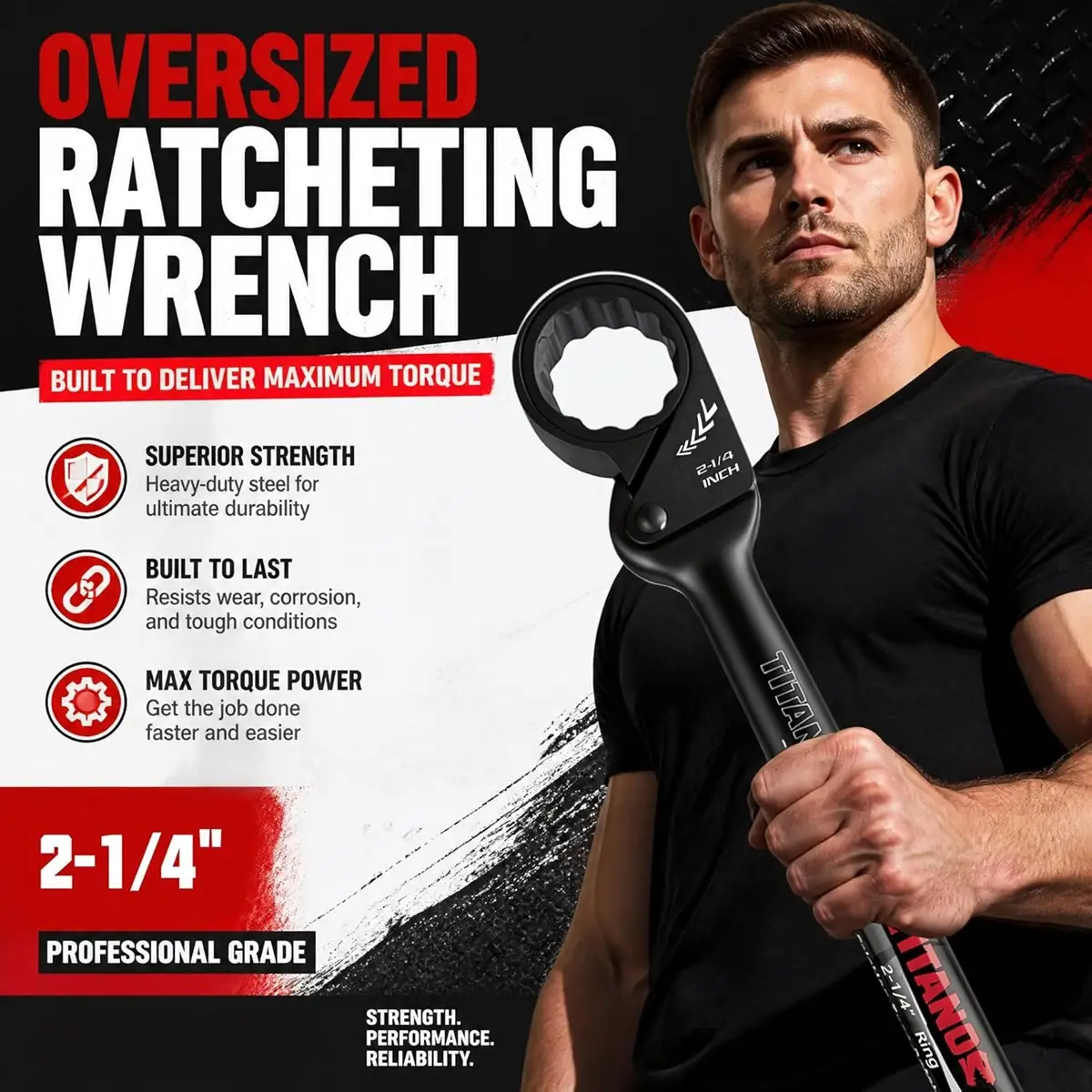
The choice depends on the job.
A Torque Friction Wrench is best when the task requires strength, speed, and durability. A click torque wrench is best when the task requires a known final torque.
Neither tool replaces the other.
Precision comparison
A click torque wrench is a calibrated measuring tool. It is designed to signal when a set torque is reached. ISO 6789-2:2017 describes calibration methods and uncertainty requirements for hand torque tools.
A Torque Friction Wrench does not usually provide that signal. It gives mechanical advantage and ratcheting action. If the final joint requires a precise torque value, use a calibrated torque wrench after run-down.
This is especially important for safety-critical work.
Cost and lifespan differences
A click-type industrial torque wrench includes measuring parts. Those parts can wear, drift, and require calibration. That is normal.
A friction wrench has fewer precision-measuring components. This can make it more rugged for rough field use. It may also lower ownership complexity when the job does not require calibrated final torque.
However, rugged does not mean careless. The head, teeth, pawl, handle, and fastener contact faces still need inspection.
When each one wins
Use a Torque Friction Wrench when you need to loosen large nuts, run down heavy fasteners, work in limited swing areas, or reduce repetitive repositioning.
Use a click torque wrench when the final specification says “tighten to X N·m” or “X ft-lb.”
Use both when the job needs speed and accuracy. First use the friction wrench for heavy run-down. Then finish with the calibrated tool.
For related tools, you can also explore IRONCUBE screwdrivers and best magnetic screwdriver sets for smaller fastening work.
How to Care for a Torque Friction Wrench
A Torque Friction Wrench is built for heavy work, but it still needs basic care. Dirt, rust, metal dust, and poor storage shorten tool life.
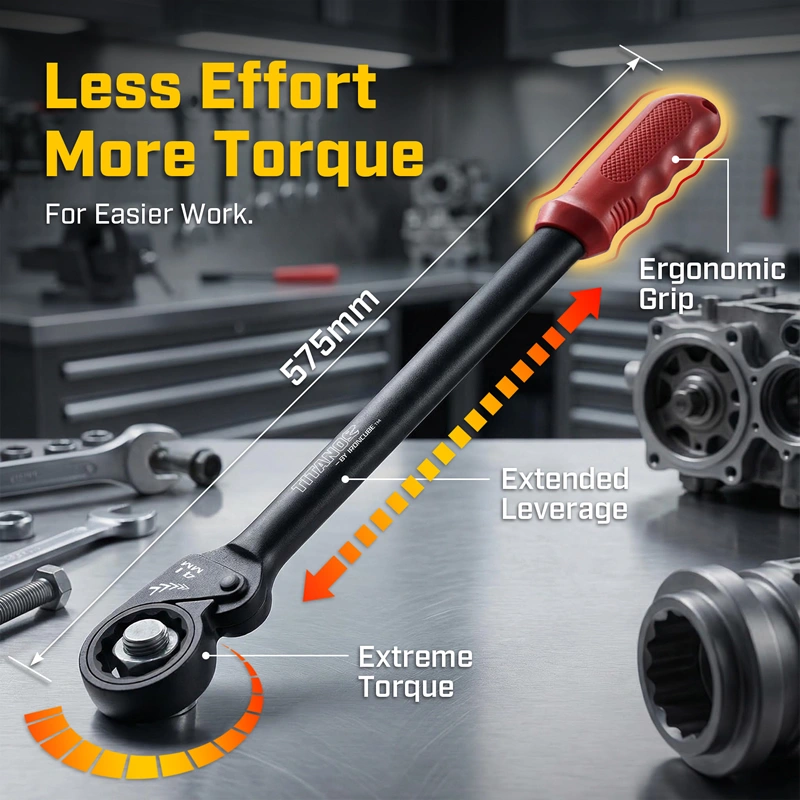
Maintenance is simple. Do it consistently.
Cleaning after each shift
After each shift, wipe the handle and head. Remove grit from the ratchet area. Check for stuck debris between the teeth.
If the tool was used around mud, concrete dust, salt air, or oil, clean it more carefully. Contamination can affect engagement and accelerate wear.
Do not leave the wrench wet. Dry it before storage.
Lubrication points to know
Lubrication reduces wear inside the ratchet mechanism. Use the manufacturer’s recommended lubricant. Avoid over-lubricating because extra grease can hold abrasive dirt.
The contact surfaces inside the head matter most. If the pawl feels rough or the ratchet skips, stop using the tool and inspect it.
The bolt tightening process itself is also strongly affected by friction. PCB’s torque-tension white paper explains that input torque includes thread friction, pitch torque, and underhead torque. It also notes that controlling friction coefficients helps produce more consistent clamp load values.
That is why clean fasteners matter as much as clean tools.
Safe storage practices
Store the Torque Friction Wrench in a dry place. Keep it away from heavy impact. Do not throw it into a toolbox where the head can strike other steel tools.
If the wrench has a reversible mechanism, leave it in a neutral safe position when possible. If it has a long handle, avoid bending loads during transport.
For crews, assign sizes clearly. Mixing similar large-size tools can cause wrong-fit usage. That leads to rounded nuts and damaged heads.
Buying Guide: Choosing the Right Torque Friction Wrench
Start with fastener size. Then consider access, torque demand, handle length, and working environment.
For large nut work, size fit is non-negotiable. A slightly loose wrench can damage the nut under high force. For 46mm jobs, compare the 46mm friction wrench set and the detailed guide on 46mm friction wrench sets for heavy machinery nuts.
Next, consider handle length. Longer handles reduce hand force, but they need more working room. Shorter handles fit tighter spaces, but they require more force.
Then check the head profile. A heavy-duty box-end ratchet head usually gives better fastener contact than an open-end wrench under heavy load.
Finally, think about buying format. Single tools work for one repeated size. Sets work better for maintenance teams handling varied equipment.
IRONCUBE products are also available through the IRONCUBE Amazon store. Product examples include this IRONCUBE Jumbo Friction Ratcheting Wrench on Amazon and another IRONCUBE jumbo friction wrench listing.
For product questions, bulk inquiries, or fitment guidance, use the IRONCUBE contact page.
You can also follow practical tool content on the IRONCUBE YouTube channel.
FAQs
Do torque-friction wrenches need calibration?
A Torque Friction Wrench usually does not need calibration in the same way a click-type torque wrench does, because it does not measure or signal a preset torque value. However, if a jobsite procedure uses torque as part of a controlled bolting method, the actual measuring tool or calibrated wrench process must follow the required standard. For structural bolt pretensioning, AISC states that torque is invalid unless calibrated for the installation condition.
How much torque is a friction wrench rated for?
A Torque Friction Wrench rating depends on the exact model, size, handle length, material, and head design. Medium-heavy tools may support work in the 300–600 N·m range, while larger heavy-duty models can support higher-force applications. Always check the manufacturer’s rating before use. Do not assume every large wrench can handle the same load.
Can I preset a torque friction wrench?
A Torque Friction Wrench normally cannot be preset like a click torque wrench. It is designed to deliver force, not to stop at a selected torque value. If your assembly requires final tightening to a specific value, use the friction wrench for run-down and then finish with a calibrated torque wrench.
Is a torque friction wrench better than a torque wrench?
A Torque Friction Wrench is better for heavy loosening, fast run-down, limited swing areas, and rugged industrial work. A torque wrench is better for final measured tightening. The best choice depends on the job. For many industrial tasks, the strongest workflow uses both tools.
What size torque friction wrench should I buy?
A Torque Friction Wrench should match the nut size exactly and suit the working space. Choose a longer handle when you need more leverage. Choose a compact model when access is limited. If your team handles multiple machines, a set may be more practical than a single size.
Final Summary
A Torque Friction Wrench is a practical high-torque wrench for large fasteners, heavy-duty maintenance, structural work, bridge jobs, machinery repair, and industrial assembly. Its advantage comes from leverage, strong ratchet engagement, better hand contact, and reduced repositioning.
The “30% less effort” idea is most credible when explained through physics. A longer effective handle can reduce the hand force needed for the same torque. A stronger ratchet design also reduces wasted motion during repetitive work.
Use this tool for strength and speed. Use a calibrated torque wrench when the final torque value must be controlled. When selected correctly, maintained properly, and used in the right stage of fastening, a Torque Friction Wrench can make large-nut work faster, safer, and less tiring.