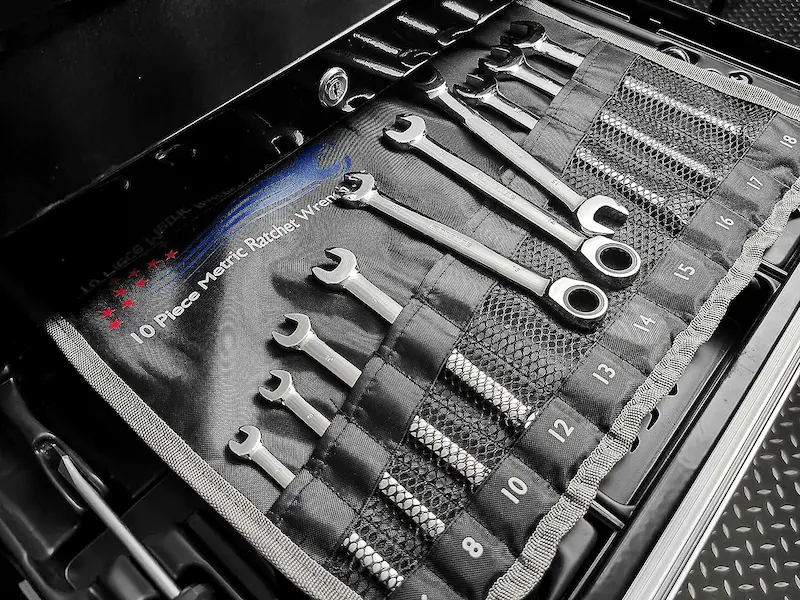
Open a compact metric wrench set and you may notice something odd. It includes 17 mm and 19 mm, yet the 18 mm slot is missing. That gap leads many buyers to assume the size is unnecessary.
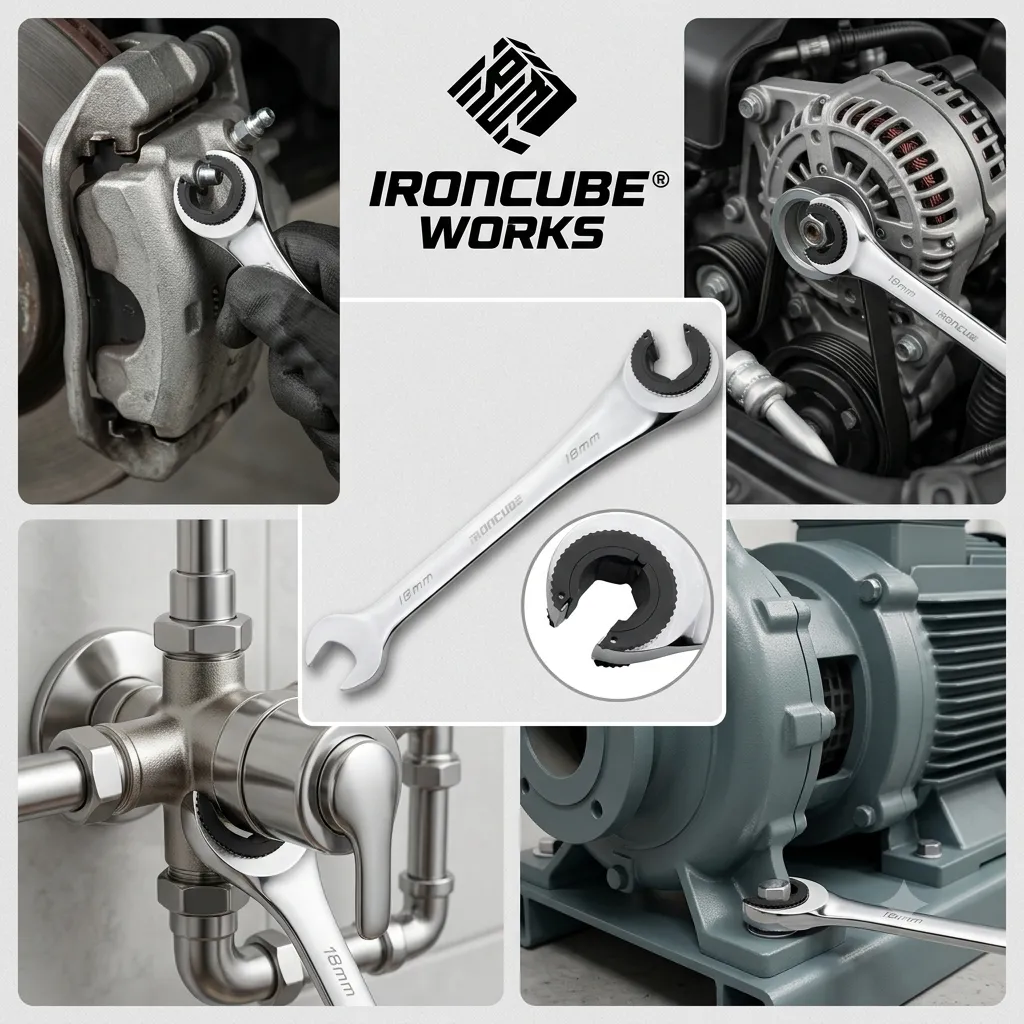
In real workshops, that assumption can stop a repair. 18mm Wrench Uses include modern M12 fasteners, automotive suspension hardware, machinery brackets, tube fittings, brake-line connections, and selected hydraulic or refrigeration components. The exact application depends on the manufacturer, but the size itself is legitimate.
An 18 mm wrench also solves a problem that nearby tools cannot solve safely. A 17 mm wrench will not fit a true 18 mm hex. A 19 mm wrench has excessive clearance and may damage the corners. An SAE tool that merely looks close creates the same risk.
Understanding 18mm Wrench Uses prevents tool substitutions that can damage expensive fasteners. This guide explains where an 18 mm wrench appears, why some sets omit it, and which wrench style suits each job. It also covers line wrenches, ratcheting wrenches, sockets, measurement, safe technique, and metric-to-SAE comparisons.
For broader tool options, visit the IRONCUBE® WORKS home page or browse the complete wrench category.
Why 18mm Wrench Uses Matter More Than the Number Suggests
A wrench size describes the distance across two opposite flat surfaces on a hexagonal nut or bolt head. Mechanics call this dimension the width across flats.
It does not describe the bolt’s thread diameter. Therefore, an 18 mm wrench does not normally fit an M18 bolt. A conventional M18 hex fastener needs a much larger tool.
The International Organization for Standardization page for ISO 272 identifies the standard as the specification for widths across flats on hexagonal fasteners. ISO says the 1982 edition was reviewed and confirmed in 2023, although a replacement draft is under development.
The Bureau of Indian Standards adoption of ISO 4014 records a clear change: M10 and M12 widths moved from 17 mm and 19 mm to 16 mm and 18 mm. It also states that the older dimensions were no longer permitted after December 31, 1994.
However, alternative head patterns, specialty nuts, legacy hardware, and manufacturer-specific designs can still differ.
Therefore, measure the hex rather than trusting the thread label.
18mm Wrench Uses on Modern M12 Fasteners
One of the most important 18mm Wrench Uses involves modern M12 hex bolts and nuts. You may find them in machinery frames, mounting brackets, automotive assemblies, industrial guards, pumps, and fabricated equipment.
An M12 fastener has a nominal thread diameter of 12 mm. Its head is wider because it needs enough material to transmit tightening force and support the joint.
Not every M12 bolt uses an 18 mm head. Older DIN-style hardware and some replacement components may use 19 mm. A repaired machine can contain original 18 mm hardware and later 19 mm replacements in the same assembly.
Before applying force, remove paint, rust, oil, or road grime. Then test the wrench by hand. It should seat fully with minimal movement.
Common Automotive 18mm Wrench Uses
Modern vehicles provide many possible 18mm Wrench Uses, especially around high-load chassis assemblies. Exact locations vary by make, model, and year, so the service manual remains the final authority.
Possible applications include suspension mounting bolts, shocks, struts, control arms, sway-bar brackets, steering parts, engine mounts, transmission mounts, subframes, and crossmembers.
Aftermarket parts may use different head dimensions from the factory component. A replacement ball joint, tie-rod end, damper, or bracket can introduce an 18 mm fastener where another size appeared originally.
For general metric work, the IRONCUBE 10-piece metric ratcheting wrench set includes 18 mm among its listed sizes. The product page also lists a 72-tooth ratcheting box end and a five-degree working arc.
Suspension and Chassis Hardware
Suspension work combines high force, corrosion, limited clearance, and awkward access. Those conditions magnify the effect of poor wrench fit.
A loose 19 mm wrench can rotate before its jaws contact an 18 mm fastener. That movement shifts pressure toward the corners instead of the broad flats. Once those corners deform, removal becomes much harder.
Use a six-point socket when the fastener is accessible from above. Choose a box-end or ratcheting wrench when surrounding components block a socket.
Follow the manufacturer’s replacement and torque instructions because requirements vary by vehicle and joint.
Engine and Transmission Mounts
Mounting hardware carries engine movement, driveline reaction, and road vibration. An 18 mm head may appear on brackets, crossmembers, or through-bolts.
Support the engine or transmission correctly before removing a mount. The correct wrench does not make an unsupported assembly safe.
18mm Wrench Uses on Brake, Fuel, and Hydraulic Lines
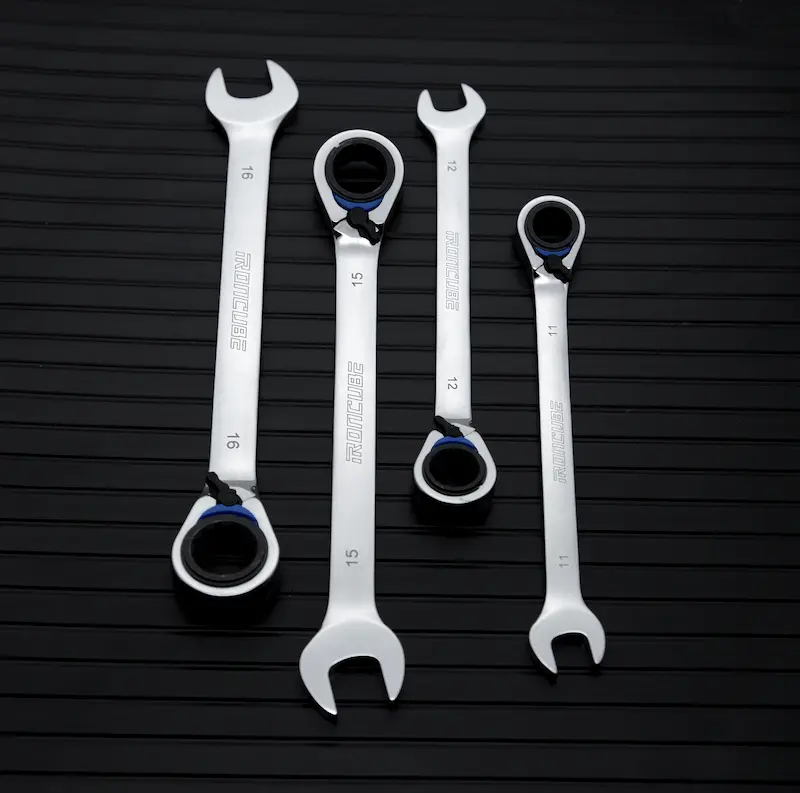
Some sensitive 18mm Wrench Uses involve fittings connected to rigid or flexible lines. These fittings may carry brake fluid, fuel, hydraulic oil, refrigerant, or compressed air.
A normal box wrench cannot pass over the tube. An open-end wrench can reach the nut, but it supports less of the hex. That reduced contact increases the chance of rounding a tight or corroded fitting.
A flare nut wrench solves the access problem. Its slot passes around the line, while the surrounding head grips more of the nut.
HAZET describes its 16 × 18 mm open double-box wrench as suitable for tube connections, union nuts, and male pipe fittings. The page identifies a 15-degree slotted jaw and DIN 3118 construction.
FACOM’s dedicated 18 mm flare-nut wrench opens around a pipe and closes on the nut. The manufacturer lists automotive, trucking, compressor, refrigeration, public-works, sanitation, and aeronautical piping among its applications.
For a dedicated option, see the IRONCUBE 18 mm brake-line wrench.
Why a Line Wrench Protects the Fitting
A line wrench is also called a flare nut wrench or brake-line wrench. It combines side access with near-box-end support.
The slot lets the tool pass over the tube. The head then contacts more sides than a basic open-end wrench. That extra support matters on plated steel, brass, aluminum, and other relatively soft fittings.
The Wikipedia overview of wrench types offers a useful visual comparison of flare nut, open-end, box-end, socket, and adjustable designs. Actual limits should still come from the tool and equipment manufacturers.
Safe Technique for Fluid-Line Fittings
First, identify the system and release pressure through the manufacturer’s procedure. A line can remain dangerous after a machine or engine stops.
Clean the fitting, slide the wrench over the line, and seat its head fully. Keep the tool square to the nut.
Many connections have two hexes. Hold the fixed union, hose end, valve, or component body with a second wrench. Turn only the specified nut so the tube does not twist.
Apply smooth pressure. Do not jerk the handle or add an improvised extension. If the fitting stays locked, stop and reassess the direction, corrosion, threads, and support point.
Industrial and Equipment 18mm Wrench Uses
Industrial maintenance creates another broad category of 18mm Wrench Uses. Modern metric machinery often uses 18 mm heads on M12 fasteners.
Typical locations include motor mounts, pump bases, conveyor brackets, safety guards, compressor frames, access panels, and bearing supports. Hydraulic and pneumatic systems can also include 18 mm union nuts.
Agricultural and construction machines often mix ISO hardware, older DIN dimensions, manufacturer-specific fittings, and replacement parts. A no-skip collection reduces substitutions and saves time during field service.
For larger fasteners, read the guide to extra-large heavy-duty ratcheting wrenches and the explanation of how a torque-friction wrench can reduce effort.
18mm vs 17mm vs 19mm: Why Exact Fit Matters
The difference looks small. In practice, one millimeter can decide whether the wrench grips the flats or damages the corners.
| Wrench size | Difference from 18 mm | Fit on an 18 mm hex | Recommendation |
|---|---|---|---|
| 17 mm | 1 mm smaller | Normally will not fit | Use only on 17 mm hardware |
| 18 mm | Exact nominal size | Correct fit | Recommended |
| 19 mm | 1 mm larger | Loose | Do not substitute |
| 11/16 inch | 0.5375 mm smaller | Usually will not fit | Not reliable |
| 23/32 inch | 0.25625 mm larger | May fit loosely | Still not ideal |
| 3/4 inch | 1.05 mm larger | Excessively loose | Do not use |
The correct wrench includes small manufacturing clearance so it can slide over a nominal 18 mm head. That designed clearance is different from adding a full millimeter with a 19 mm wrench.
Tool wear creates extra clearance too. OSHA’s hand-tool rule says workers should not use wrenches whose jaws have sprung enough to permit slippage.
Is 18mm the Same as an SAE Wrench Size?
No exact common SAE size equals 18 mm.
The National Institute of Standards and Technology length guide states that one international inch equals exactly 25.4 mm. Therefore, 18 mm equals approximately 0.70866 inch.
Eleven-sixteenths equals 17.4625 mm. Three-quarters equals 19.05 mm. The less-common 23/32-inch size equals 18.25625 mm.
Although 23/32 inch is mathematically closest, it remains larger. It may feel acceptable under light force, but it is not the correct choice for corroded, soft, or safety-critical hardware.
A central lesson from 18mm Wrench Uses is that “close” does not mean “interchangeable.”
Which Tool Fits Different 18mm Wrench Uses?
Different 18mm Wrench Uses require different head designs. No single wrench works best everywhere.
| Tool style | Best application | Main advantage | Main limitation |
| Open-end wrench | Accessible hardware | Fast side entry | Limited contact |
| Combination wrench | General nuts and bolts | Open and box ends | Box end cannot cross tubing |
| Ratcheting wrench | Tight swing spaces | Minimal repositioning | Not ideal for every high-force release |
| Six-point socket | High-force accessible bolts | Strong engagement | Needs overhead clearance |
| Flare nut wrench | Tube and line fittings | More support around the nut | Specialized use |
| Crowfoot wrench | Restricted fittings or torque access | Works with a drive tool | May change effective torque |
| Adjustable wrench | Backup work | Covers several sizes | More clearance and setup error |
Use a six-point socket for an ordinary bolt when access allows. Select a combination or ratcheting wrench around brackets. Choose a flare nut wrench when a tube passes through the nut.
Measuring Before Trying 18mm Wrench Uses
Accurate 18mm Wrench Uses begin with measurement. Use calipers across two opposing flats. Do not measure corner to corner because the diagonal distance is larger.
Remove paint, rust scale, and burrs first. If the reading is close to 18 mm, test a clean, unworn wrench.
The tool should seat fully without hammering. It should show little rotational movement.
Never force a 17 mm wrench onto the head. Likewise, do not choose a 19 mm wrench merely because it slides on easily.
Loosening and Tightening an 18mm Fastener
Start by exposing the full hex. Use a six-point socket when possible and keep it straight.
Apply force smoothly. If corrosion holds the joint, use an appropriate penetrating product and protect nearby rubber, painted, hot, electrical, and friction surfaces.
Pull rather than push when practical. Pulling gives better balance if the fastener releases suddenly.
Do not place a pipe over a standard wrench unless the manufacturer approves extension use. Extra leverage can spread the jaws or overload the fastener.
Many 18mm Wrench Uses involve preliminary tightening rather than final torque. A standard or ratcheting wrench does not measure applied torque.
Use the specified torque value, sequence, lubrication condition, and replacement rules. A crowfoot can change the effective lever length and the applied torque. Follow the torque-tool manufacturer’s correction method instead of guessing.
For larger jobs, review the IRONCUBE 36 mm torque-friction wrench and the comparison of a friction wrench versus a torque wrench. They serve different fastener classes and do not replace an 18 mm tool.
Why Some Metric Sets Skip 18mm
Manufacturers design compact sets around price, package size, and expected demand. They may omit sizes that buyers use less often.
Legacy patterns also matter. Older M12 hardware commonly used 19 mm heads, while later standards adopted 18 mm. Existing tool-set habits did not change immediately.
Some kits rely on near-overlap between metric and SAE sizes. That saves space but can encourage loose substitutions.
A homeowner may rarely need 18 mm. A vehicle technician, machinery mechanic, fabricator, or hydraulic specialist may use it often. For mixed work, a no-skip set reduces downtime.
Buying for Practical 18mm Wrench Uses
Start with the systems you service.
Occasional bracket work may require only an 18 mm combination wrench. Automotive chassis jobs often justify a six-point socket and long wrench. Restricted bays benefit from a ratcheting design.
Brake, fuel, hydraulic, and refrigeration lines require a line wrench when the fitting measures 18 mm. Check the head profile, slot width, jaw thickness, material, finish, and working angle.
The IRONCUBE wrench collection covers general, ratcheting, specialty, and heavy-duty work. Its 10-piece metric ratcheting wrench set includes 18 mm for ordinary fasteners.
For line fittings, consider the IRONCUBE 18 mm brake-line wrench.
Care and Common Mistakes
Reliable 18mm Wrench Uses depend on an unworn, correctly sized tool. Clean tools after each job. Brake fluid, fuel, hydraulic oil, road salt, dirt, and moisture can damage finishes or create slippery handling.
Inspect the jaws, box profile, and ratcheting mechanism. Retire a tool with cracks, visible spreading, severe wear, or excessive movement on a known-size fastener.
Store tools by size in a rack, pouch, or labeled drawer. Good organization prevents a 19 mm wrench from reaching an 18 mm fastener by mistake.
The biggest error is treating a loose 19 mm wrench as acceptable. Other mistakes include assuming every M12 bolt uses the same head, using an open end on a seized tube nut, failing to counter-hold a fitting, and confusing a turning wrench with a calibrated torque tool.
For demonstrations and workshop content, visit the IRONCUBE tools YouTube channel.
Related IRONCUBE Resources
Work beyond normal 18mm Wrench Uses may require specialist tools. Explore the 1-7/8-inch friction wrench, the 2026 friction wrench set buying guide, and the guide to the best friction wrench set for structural steel and bridge work.
Fleet and wholesale buyers can review how to find quality wholesale jumbo wrench sets and jumbo ratchet wrenches for heavy-duty work. IRONCUBE also lists a jumbo friction ratcheting wrench on Amazon.
For smaller assembly tools, browse the screwdriver category and the guide to the best magnetic screwdriver sets. Send sizing or wholesale questions through the IRONCUBE contact page.
Frequently Asked Questions About 18mm Wrench Uses
What is an 18 mm wrench commonly used for?
18mm Wrench Uses commonly include modern M12 hex hardware, vehicle suspension parts, engine or transmission mounts, machinery brackets, and selected brake, hydraulic, fuel, or refrigeration fittings. Always verify the actual hex because manufacturers and standards vary.
What size bolt takes an 18 mm wrench?
Many current M12 regular hex bolts and nuts take an 18 mm wrench, but 18mm Wrench Uses are not limited to M12 threads. Reduced heads, flange designs, legacy standards, and replacement parts can use different dimensions.
What SAE wrench is closest to 18 mm?
The closest fractional size is 23/32 inch at 18.25625 mm, although it remains larger. For dependable 18mm Wrench Uses, choose a true metric wrench rather than a loose SAE substitute.
Can I use a 19 mm wrench on an 18 mm bolt?
No. A 19 mm wrench adds one millimeter of nominal clearance and can load the corners instead of the flats. Correct 18mm Wrench Uses require an exact tool, especially on tight, corroded, soft, or safety-critical hardware.
Why do wrench sets skip 18 mm?
Some compact kits omit less-requested sizes to reduce price and package size. Older fastener patterns also made 19 mm more familiar for M12 hardware. Modern 18mm Wrench Uses justify buying a no-skip set or adding the size separately.
Do I need an 18 mm flare nut wrench?
You need one when a measured tube fitting has an 18 mm external hex. In those 18mm Wrench Uses, a flare nut wrench supports more of the fitting than a basic open end while its slot passes around the line.
Final Summary
18mm Wrench Uses are broader than many compact tool sets suggest. The size appears on modern M12 hardware, vehicle chassis components, machinery, mounting brackets, and selected line fittings.
Neither 17 mm nor 19 mm is a safe substitute. No common SAE wrench provides an exact match either.
Use a socket or box end for ordinary high-load fasteners, a ratcheting wrench for restricted movement, and a flare nut wrench for tube fittings.
Measure first, seat the tool fully, support connected parts, and follow the specified torque procedure. Those habits protect the fastener, tool, and surrounding assembly.