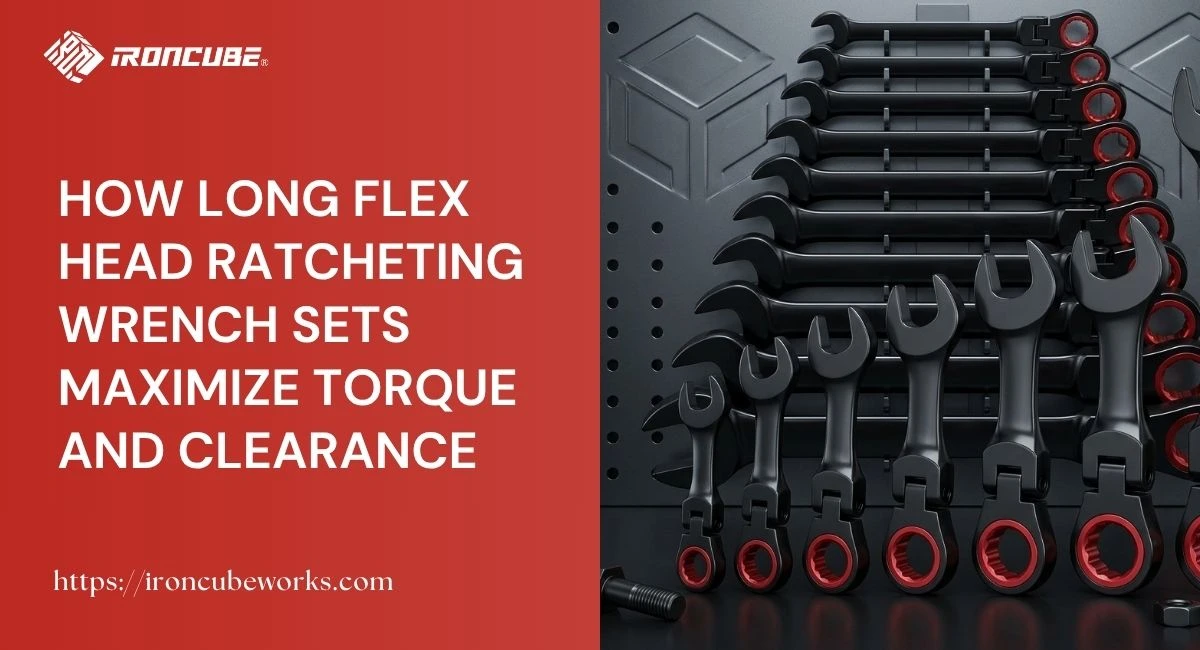
A stubborn fastener rarely sits in a convenient location. It may hide behind an alternator, beneath a hydraulic line, or beside a frame rail. Even when the nut is visible, a standard wrench may not have enough room to swing. That is where Flex Head Ratcheting Wrench Sets earn their place in a professional toolbox.
The best designs solve two problems at once. A longer handle increases mechanical advantage, so the user can create more turning force with less hand effort. A pivoting ratchet head changes the approach angle and keeps the wrench moving around nearby parts.
There is still an important limit. A long flex-head wrench can increase usable leverage, but it does not become a breaker bar or calibrated torque wrench. The tool must match the fastener, expected load, and manufacturer rating.
This guide explains how Flex Head Ratcheting Wrench Sets improve torque, clearance, speed, and control. A useful low-competition long-tail keyword is “extra long flex head ratcheting wrench sets for tight spaces.”
What Are Flex Head Ratcheting Wrench Sets?
A flex-head ratcheting wrench combines an open end with a ratcheting box end that pivots around a joint. Depending on the model, the head may move through an arc of up to 180 degrees. This movement lets the user approach a fastener from above, below, or around an obstruction.
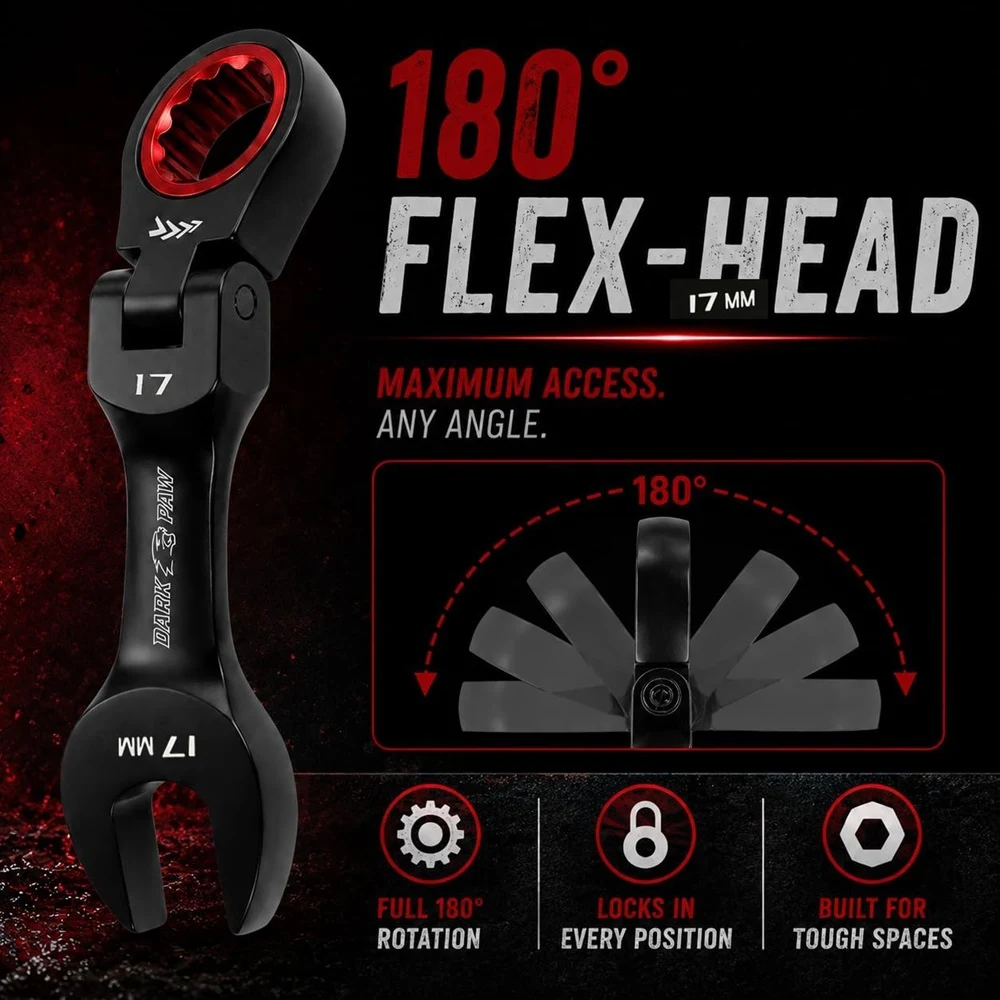
The ratcheting mechanism performs another job. It allows the handle to reset without lifting the box end from the fastener. As a result, the mechanic can work through repeated short strokes instead of removing and repositioning the wrench after every turn.
The IRONCUBE 12-piece flexible-head ratcheting wrench set illustrates this design. Its product specification lists metric sizes from 8 mm through 19 mm, a 180-degree rotating ring end, and a 72-tooth mechanism requiring a 5-degree movement.
That combination matters because clearance has two dimensions. First, the tool needs enough space around the fastener head. Second, the handle needs enough room to travel. Flex Head Ratcheting Wrench Sets reduce both restrictions by changing the head angle and minimizing the swing arc.
Readers who need a broader view can begin with the IRONCUBE wrench collection or review the basic history and types of wrenches.
How Longer Flex Head Ratcheting Wrench Sets Increase Torque
Torque is the turning effect created when force acts at a distance from a pivot. NASA’s explanation of torque and lever arms expresses the basic perpendicular relationship as:
Torque = Force × Lever-Arm Length
Handle length therefore changes the amount of hand force required. A longer wrench does not create free energy. Instead, it gives the user a larger lever arm. NASA defines torque as force multiplied by the perpendicular distance from the pivot.
Consider a simplified example. Suppose a fastener needs 120 N·m of turning torque.
| Effective handle length | Approximate hand force required |
|---|---|
| 0.20 m | 600 N |
| 0.30 m | 400 N |
| 0.40 m | 300 N |
| 0.50 m | 240 N |
Doubling the effective handle length from 0.20 m to 0.40 m halves the theoretical hand force. Real workshop conditions introduce losses from grip angle, body position, friction, and head geometry. Still, the underlying relationship remains valid.
This is the first major advantage of long Flex Head Ratcheting Wrench Sets. They can help a technician reach the necessary turning force without pulling as aggressively on a short handle.
Handle Angle Still Controls Usable Torque
The full handle length only contributes when force acts close to perpendicular to the wrench. Pulling along the handle creates very little useful torque. Pulling at a poor angle also reduces the effective lever arm.
A flexible head helps because it lets the user reposition the handle while keeping the box end seated. In many cramped jobs, that improved body position matters as much as the extra length.
For example, a straight wrench may force the mechanic to pull upward with a bent wrist. A flex head can move the handle away from a hose or bracket, allowing a safer sideways pull. The tool then produces more usable torque from the same effort.
Longer Does Not Mean Unlimited
Every wrench has a load limit. The handle, flex joint, pawl, gear, and box end must transfer the applied force safely. Adding a pipe extension can overload those parts and may cause sudden failure.
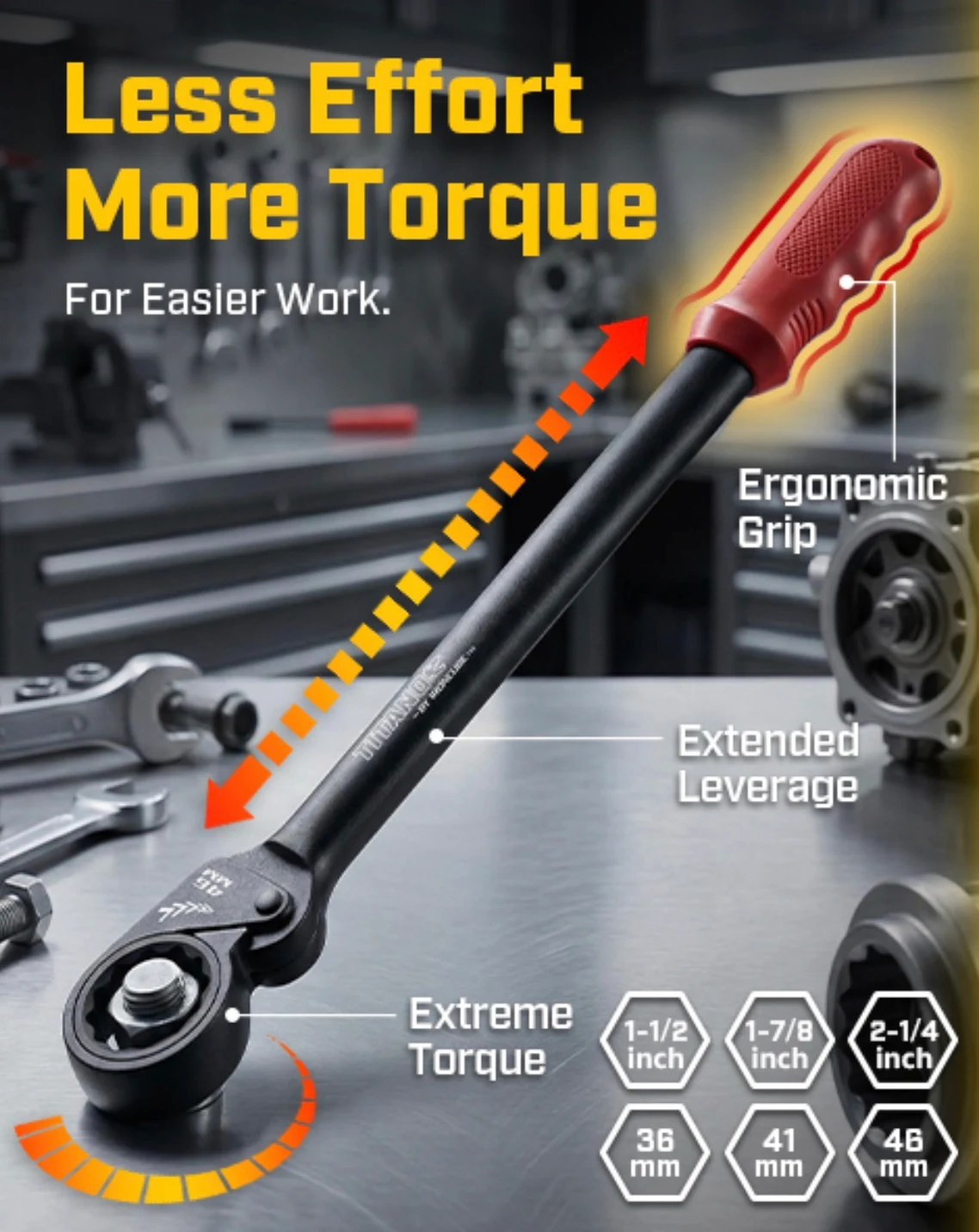
For very large industrial fasteners, use a purpose-built tool instead. IRONCUBE lists extra-large heavy-duty ratcheting wrenches with 510–660 mm handles and specified torque outputs for sizes from 36 mm to 2-1/4 inches. Those ratings belong to those particular products, not to every flex-head wrench.
How Flex Heads Maximize Clearance
A long handle improves leverage, but length alone can make access worse. The handle may strike a firewall, chassis rail, engine cover, or adjacent bolt. The pivoting head solves that conflict.
With Flex Head Ratcheting Wrench Sets, the box end can remain aligned with the nut while the handle moves into a clearer path. This is valuable around automotive engines, motorcycles, agricultural machines, conveyors, pumps, and hydraulic assemblies.
The head also helps when the fastener sits on a recessed plane. A fixed wrench may contact the surrounding casting before the box end reaches the nut. Tilting the head can create the required offset without adding a bulky socket and extension.
Clearance Comes From Head Angle and Head Profile
Two wrenches can both pivot 180 degrees yet behave differently. A thick ratchet head may not fit between a nut and a nearby wall. A slimmer head may enter the gap but offer a lower load rating. The joint housing can also become the widest part of the tool.
Buyers should therefore check more than the advertised pivot angle. Measure the available side clearance, overhead clearance, fastener depth, and handle travel.
A flex head is especially useful when a socket wrench is too tall. The box end surrounds the fastener without stacking a ratchet head and socket above it. This lower profile often makes Flex Head Ratcheting Wrench Sets the fastest manual option in narrow mechanical spaces.
Why Ratchet Tooth Count Changes Working Clearance
Tooth count determines the theoretical angle needed before a ratchet engages its next position. Divide 360 degrees by the number of gear teeth.
| Ratchet tooth count | Theoretical minimum swing arc |
| 36 teeth | 10 degrees |
| 48 teeth | 7.5 degrees |
| 72 teeth | 5 degrees |
| 90 teeth | 4 degrees |
| 120 teeth | 3 degrees |
A 72-tooth ratchet provides a theoretical 5-degree swing arc. IRONCUBE confirms that specification for its 12-piece metric set.
A smaller arc helps when the handle can travel only a few centimeters. Yet tooth count alone does not prove strength. Pawl design, engagement depth, steel quality, heat treatment, and manufacturing tolerance also matter.
Some fine-tooth mechanisms engage several teeth simultaneously. Others distribute force through different pawl arrangements. A 120-tooth wrench is not automatically stronger than a 72-tooth wrench.
For general maintenance, a quality 72-tooth mechanism offers a practical balance. Buyers can compare the IRONCUBE 72-tooth ratcheting combination wrench listing on Amazon with the company’s 10-piece metric ratcheting wrench set.
Flex Head Ratcheting Wrench Sets Compared With Other Tools
No single wrench design wins every job. The correct choice depends on access, load, speed, fastener condition, and whether final torque must be measured.
| Tool type | Main advantage | Main limitation | Best use |
| Long flex-head ratcheting wrench | Leverage plus adjustable access | Flex joint adds complexity | Confined maintenance and repetitive fastening |
| Fixed-head ratcheting wrench | Stable head and fast operation | Limited approach angle | Open areas with restricted swing |
| Standard combination wrench | Simple and durable | Requires repositioning | General tightening and initial loosening |
| Breaker bar | High leverage without a ratchet mechanism | Requires socket clearance | Breaking seized or heavily tightened fasteners |
| Friction wrench | High-load ratcheting for large nuts | Usually not a measuring tool | Heavy equipment, steelwork, and industrial assembly |
| Calibrated torque wrench | Controls final tightening torque | Not intended for careless breakout force | Specification-critical final tightening |
| Line wrench | Better contact around tube fittings | Specialized application | Brake, fuel, hydraulic, and air-conditioning lines |
This comparison reveals a key point. Flex Head Ratcheting Wrench Sets maximize convenience and usable leverage, not calibrated accuracy.
When a service manual specifies final torque, use the flex-head wrench for removal or initial run-down. Then finish with a suitable calibrated torque wrench.
The guide on friction wrench versus torque wrench explains the difference between force-delivery tools and measuring tools in more detail.
For standards context, buyers can also review the Hand Tools Institute’s index of ASME B107 hand-tool standards. The B107 series covers performance, dimensions, testing, and safety requirements for several hand-tool categories.
Do Flex Head Ratcheting Wrench Sets Really Save Time?
Yes, especially when the user has only a small swing arc. The ratcheting box end eliminates repeated lifting and reseating, while the flexible joint reduces body repositioning.
Across dozens of fasteners, those small savings compound. Flex Head Ratcheting Wrench Sets can also reduce dropped tools and accidental contact with nearby components.
However, speed still depends on fit. A loose box end can round a fastener, while a floppy joint can slow alignment. For frequent work, a locking or well-detented head may provide better control.
Selecting Flex Head Ratcheting Wrench Sets for Metric and SAE Work
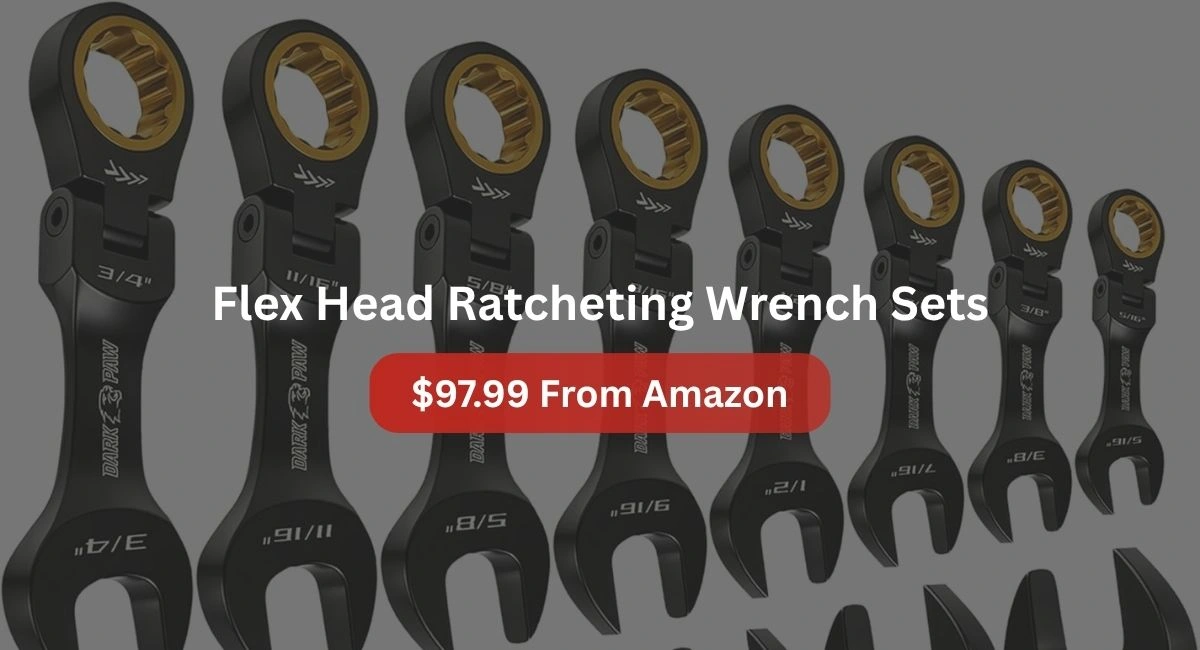
Start with the equipment, not the number of pieces in the package. Review the fastener sizes used on the machines you service, then choose a set with minimal gaps.
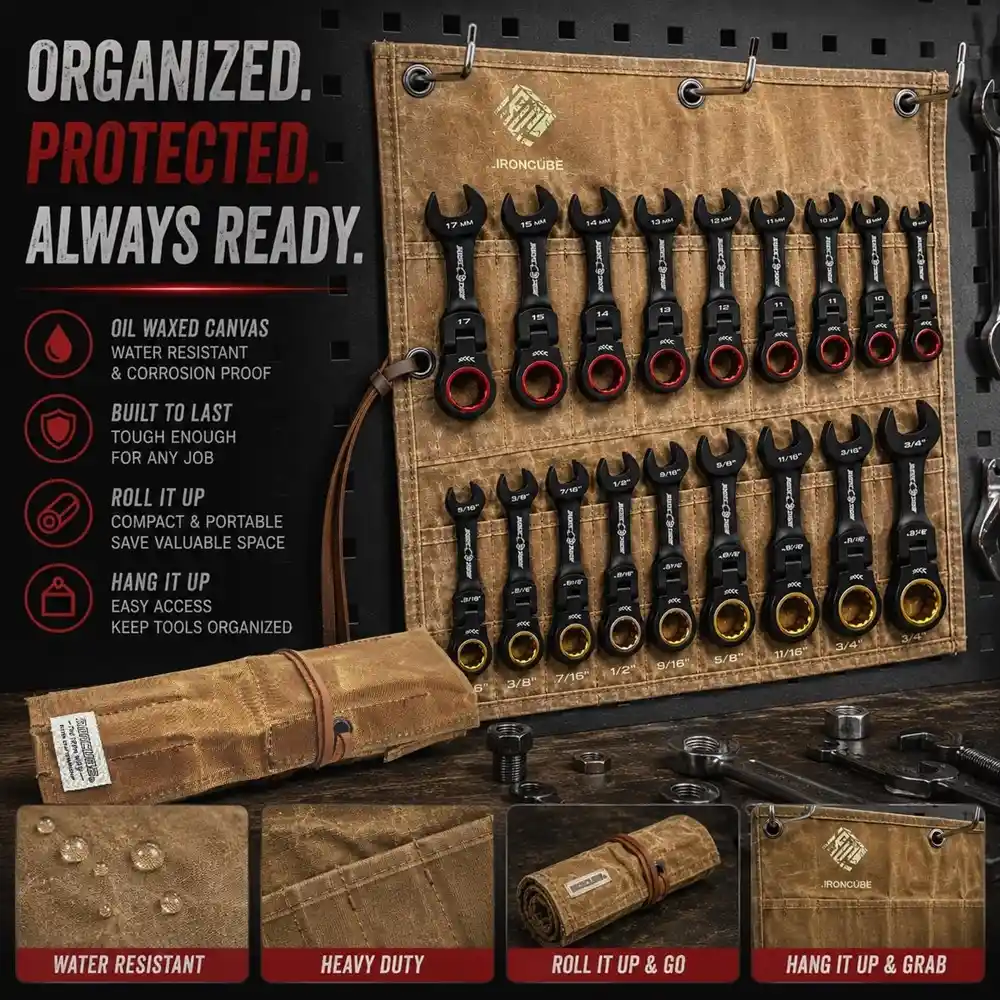
The 8–19 mm range covers many common automotive and general mechanical tasks. IRONCUBE’s 12-piece flexible set includes every whole millimeter from 8 mm through 19 mm. That continuous sequence reduces the chance of reaching for an incorrect near-size.
SAE users should build around the inch sizes found on their vehicles, machinery, farm equipment, or structural assemblies.
Never substitute a close metric size for an SAE fastener under high load. The small clearance difference can concentrate force on the corners and cause rounding.
A Practical Heavy Equipment Wrench Sizes Framework
The secondary phrase heavy equipment wrench sizes covers a wide range, so no universal set fits every machine. Equipment manuals and fastener markings remain the final authority.
Still, buyers can plan inventory in broad bands:
| Service level | Typical planning range | Common work |
| General maintenance | 8–19 mm and 1/4–3/4 in. | Covers, brackets, accessories, and light assemblies |
| Medium mechanical work | 20–32 mm and 13/16–1-1/4 in. | Pumps, mounts, driveline parts, and machine frames |
| Large industrial work | 36, 41, and 46 mm; 1-1/2, 1-7/8, and 2-1/4 in. | Structural connections, heavy machinery, and large flanges |
These are toolkit-planning categories, not universal torque recommendations. A 36 mm nut on one machine may have a completely different grade, thread pitch, lubrication condition, and tightening specification from a 36 mm nut elsewhere.
For large fasteners, review the 36 mm high-torque friction wrench, the 1-7/8-inch friction wrench, or the IRONCUBE jumbo friction wrench on Amazon.
These tools occupy a different category from compact automotive Flex Head Ratcheting Wrench Sets.
Where Flex Head Ratcheting Wrench Sets Work Best
Automotive and Powersports Repair
Modern engine bays and motorcycle frames leave little unused space. A flex head keeps the box end square while the handle clears wiring, shields, exhaust parts, and structural members.
Its low profile may also reach places where a socket and ratchet stack is too tall. This advantage becomes particularly useful around alternators, accessory brackets, engine mounts, battery trays, and under-dashboard components.
Agricultural and Construction Equipment
Guards, hydraulic hoses, and heavy frames often interfere with tool travel. Flex Head Ratcheting Wrench Sets work well on accessible maintenance fasteners, covers, brackets, and secondary assemblies.
Corroded or oversized nuts may require a stronger tool. In those cases, consult the jumbo ratchet wrench guide for heavy-duty work or compare extra-large heavy-duty ratcheting wrenches.
Industrial Maintenance
Pumps, motors, conveyors, compressors, and machine frames often place fasteners close to housings. The adjustable head can route the wrench handle around nearby guards and structural parts.
Where structural steel or bridge work demands heavier load capacity, review the friction wrench guide for structural steel and bridges.
Brake, Fuel, and Hydraulic Lines
A normal box end cannot pass over a connected tube. An open end fits around the tube, but it may provide limited contact with the fitting.
A line wrench wraps farther around the fitting. Therefore, Flex Head Ratcheting Wrench Sets are not always correct for tubing work. The IRONCUBE brake line wrench set on Amazon serves that specialized application.
How to Use Flex Head Ratcheting Wrench Sets Safely
Confirm the exact size, seat the box end fully, and keep it square to the fastener. Partial engagement increases the risk of slipping and rounding.
Set the flex angle before applying heavy force. Avoid allowing the joint to fold while loaded. A stable joint angle creates a more predictable force path.
Whenever possible, pull rather than push. Pulling often gives better balance and reduces the risk of falling forward when a fastener suddenly releases. Keep your knuckles away from sharp edges and nearby castings.
Inspect the tool for cracks, looseness, skipping teeth, corrosion, or distorted box ends. OSHA’s construction hand-tool standard states that employers must not permit unsafe hand tools. It also prohibits using wrenches with sprung jaws when slippage can occur.
Never strike a standard ratcheting wrench unless the manufacturer designed it for that purpose. Do not add a cheater pipe to Flex Head Ratcheting Wrench Sets. Choose a longer, properly rated tool instead.
When a Flex-Head Ratcheting Wrench Is the Wrong Tool
Flex Head Ratcheting Wrench Sets improve leverage and clearance, but they should not handle every fastening stage.
Use a breaker bar or purpose-built heavy wrench when a fastener is seized or needs extreme breakout torque. A breaker bar removes the fine ratcheting mechanism from the main load path.
Use a calibrated torque wrench when the final value is critical. Tightening by feel cannot reliably replace a specified torque procedure.
Choose an extractor or specialty socket for a badly rounded nut. Use a line wrench for connected tubing and hydraulic fittings.
If the required size exceeds the tool’s rating, consult the 2026 friction wrench set buying guide and the explanation of a torque friction wrench designed to reduce effort.
The flexible head is an access feature, not permission to exceed engineering limits.
Buying Checklist for Flex Head Ratcheting Wrench Sets
Evaluate more than piece count. Check the size range, missing sizes, metric or SAE format, tooth count, swing arc, flex range, head thickness, handle length, and surface finish.
Examine the joint as well. A locking mechanism gives predictable positioning. A detent-style joint may move faster, but it should still hold the selected angle during normal operation.
Material claims also need context. Chrome-vanadium steel is common, but the alloy name alone does not prove performance. Heat treatment, head geometry, tooth engagement, and quality control determine how a wrench behaves under load.
Storage matters more than it appears. A labeled roll pouch helps users identify missing sizes and prevents tools from striking one another. It also supports mobile repair and roadside work.
Review warranty terms, product support, and the stated application. Buyers can browse IRONCUBE WORKS, compare the complete wrench product category, or use the IRONCUBE contact page for product, wholesale, and fitment questions.
Bulk buyers can also read the guide to finding quality wholesale jumbo wrench sets.
Building a Complete Fastening Toolkit
Flex Head Ratcheting Wrench Sets should sit beside fixed wrenches, sockets, breaker bars, torque wrenches, and specialty tools.
For smaller fasteners, browse the IRONCUBE screwdriver collection and the guide to magnetic screwdriver sets.
For large nuts, compare jumbo ratchet wrenches for heavy-duty work with the IRONCUBE 1-7/8-inch friction wrench.
For demonstrations and workshop content, visit the IRONCUBE Tools YouTube channel.
The goal is not to own the largest possible number of tools. It is to create a logical progression from access and initial run-down to breakout and controlled final tightening.
Final Summary
Flex Head Ratcheting Wrench Sets maximize usable torque and clearance by combining three practical advantages: a longer lever arm, an adjustable approach angle, and a short ratcheting swing.
The longer handle can reduce hand force for the same turning torque. The flexible head routes the handle around nearby parts. Meanwhile, a fine-tooth ratchet keeps the wrench working where a standard tool cannot complete a full swing.
Tool selection must still remain disciplined. Use a breaker bar or heavy-duty friction wrench for severe breakout loads. Use a line wrench around tubing. Use a calibrated torque wrench for specification-critical final tightening.
Chosen correctly, Flex Head Ratcheting Wrench Sets make difficult access feel manageable. They improve speed without sacrificing fastener contact and give mechanics a more useful working angle when space and leverage are both limited.
FAQs
Are Flex-Head Ratcheting Wrenches Worth Buying?
Yes, Flex Head Ratcheting Wrench Sets are worth buying when you regularly work around obstacles or in low-clearance areas. They save the most time in automotive, motorcycle, machinery, and equipment maintenance. A fixed-head set may provide better control for open work, so many professionals keep both types.
Can Flex-Head Ratcheting Wrenches Handle High Torque?
Quality Flex Head Ratcheting Wrench Sets can handle substantial torque within their rated limits. Longer handles also reduce the hand force needed to reach a given torque. However, the flex joint and ratchet remain load-bearing components. Do not use a cheater pipe or assume the tool can replace a breaker bar.
What Is Better: A 72-Tooth or 90-Tooth Ratcheting Wrench?
A 72-tooth mechanism needs a theoretical 5-degree swing, while a 90-tooth mechanism needs approximately 4 degrees. Therefore, 90-tooth Flex Head Ratcheting Wrench Sets can operate in a slightly tighter arc. Tooth count alone does not determine strength, however. Pawl engagement, steel quality, and head design matter just as much.
Do Flex-Head Ratcheting Wrenches Replace Torque Wrenches?
No. Flex-Head Ratcheting Wrench Sets deliver turning force and improve access, but they usually do not measure final torque. Use a calibrated torque wrench whenever the service procedure specifies a torque value. The flex-head wrench can still speed removal and initial run-down.
Should I Break a Seized Bolt Loose With the Ratcheting End?
Usually, the safer approach is to use the strongest manufacturer-approved end or a breaker bar for severe breakout force. Flex Head Ratcheting Wrench Sets provide the most value after initial movement begins. When product documentation explicitly rates the ratcheting end for breakout loads, remain within that rating.
Which Sizes Should a Flex-Head Ratcheting Wrench Set Include?
For common metric repairs, Flex Head Ratcheting Wrench Sets covering 8–19 mm provide a useful continuous range. SAE users often look for approximately 1/4–3/4 inch coverage. Heavy equipment may require much larger individual tools, so always inspect the machine manual and fastener markings before buying.