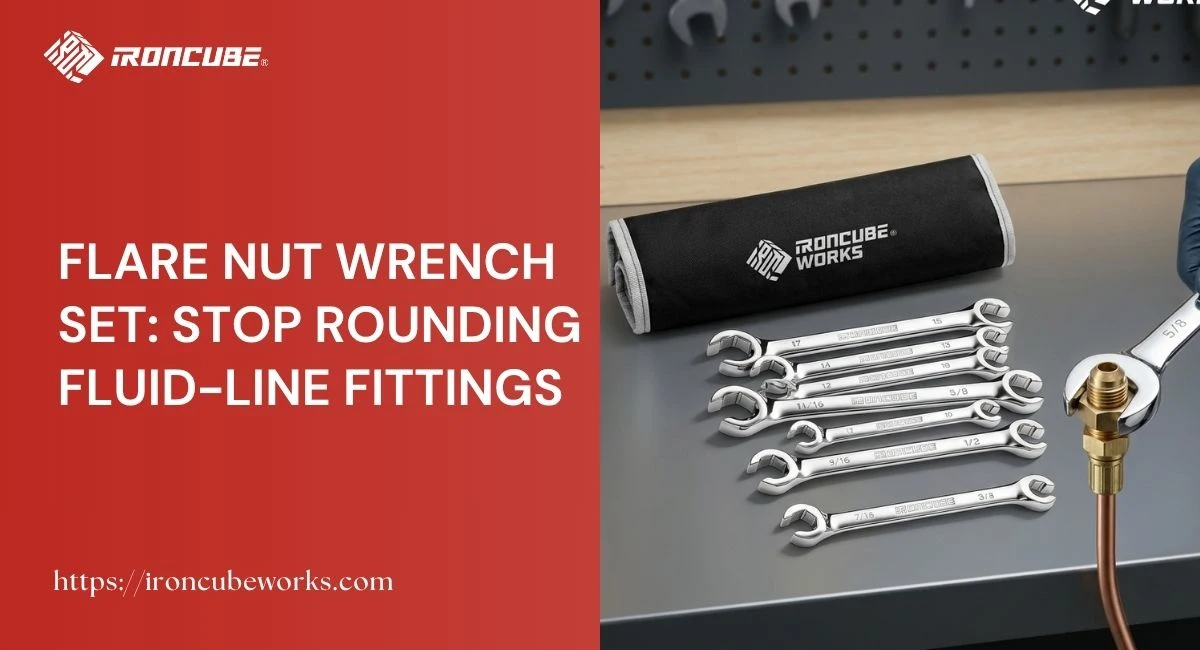
A stubborn fluid-line fitting can turn a routine repair into an expensive problem. The nut looks ordinary, yet one small slip can flatten a corner. A second attempt makes the damage worse. Soon, the fitting will not accept any normal wrench.
A Flare Nut Wrench Set reduces that risk. Its slotted, near-closed head slides over a tube while wrapping around more of the fitting than a standard open-end wrench. That extra contact matters on brake, fuel, transmission, hydraulic, and air-conditioning lines, where fittings are often small, tight, corroded, or made from relatively soft metal.
The tool is simple. Choosing and using it correctly is not.
This guide explains how a Flare Nut Wrench Set works, why fluid-line nuts round, which sizes matter, and how to handle a fitting without damaging the line. It also reviews the practical coverage of the IRONCUBE six-piece SAE and metric flare nut wrench set without pretending that one set fits every vehicle or machine.
What Is a Flare Nut Wrench Set?
A flare nut wrench is often called a line wrench or brake line wrench. Its head resembles a six-point box wrench with a narrow slot cut through one side. The slot lets the tube pass into the head. Meanwhile, the remaining walls surround most of the hex fitting.
That geometry solves a specific access problem. A closed box wrench usually provides strong engagement, but it cannot pass over an attached tube. An open-end wrench reaches the fitting, yet it contacts only two main flats. A Flare Nut Wrench Set combines much of the box-end grip with the access of an open end.
The general purpose of any wrench is to apply torque to a fastener. However, fluid-line fittings demand more control than ordinary bolts. The tubing limits access, and the fitting may deform before a larger steel fastener would.
The current SAE J533 standard for tubing flares covers performance and dimensional requirements for 45-degree single and double flares. Those standardized flare forms help create a sealed tube connection, but the nut still needs the correct tool and service procedure.
A Flare Nut Wrench Set does not make the fitting stronger. Instead, it spreads turning force across more contact area and reduces the chance that the jaws will spread apart.
Why Fluid-Line Fittings Round So Easily
Rounded fittings usually result from several small problems acting together.
A slightly oversized wrench creates clearance. Under load, the tool rotates before the fitting moves, then concentrates force on the corners. Mixing near-matching SAE and metric sizes creates the same problem.
Corrosion raises breakaway force. The technician pulls harder, while an open-end wrench may flex because its jaws remain unsupported on one side. Once the tool climbs over the hex, damage accelerates.
Fluid-line nuts also face harsh conditions. Brake fittings encounter water, road salt, heat cycles, and debris. Fuel, transmission, and A/C connections often sit in cramped areas where the handle is difficult to keep square.
Federal rules show why brake-system connections require care. FMVSS No. 106 sets performance requirements for brake hoses, assemblies, and end fittings. It includes a 24-hour salt-spray corrosion-resistance test for hydraulic brake-hose end fittings. That test does not prevent years of road corrosion, but it confirms that these parts belong to a safety-critical pressure system.
A Flare Nut Wrench Set helps only when it fits fully. Dirt, side loading, partial seating, or the wrong size can still round the nut.
Flare Nut Wrench Set vs. Other Wrench Types
The best wrench depends on the fitting, access, and required force. No single design wins every job.
| Wrench type | Contact and access | Best use | Main limitation |
|---|---|---|---|
| Flare nut wrench | Slides over tubing and surrounds most of the hex | Brake, fuel, transmission, A/C, and hydraulic line fittings | Requires the exact size and enough side access |
| Open-end wrench | Contacts two flats and enters from the side | Light-duty fittings that already turn freely | Greater slip and jaw-spreading risk |
| Box-end wrench | Fully encloses the fastener | Loose components before the tube is installed | Cannot pass over a connected line |
| Adjustable wrench | Variable opening | Backup use on larger, low-risk fittings | Clearance and jaw movement can damage small nuts |
| Flare nut crowfoot | Flare-style head used with a ratchet or torque wrench | Deep or obstructed fittings | Changes torque setup and can twist off-axis |
| Locking pliers | Clamps damaged surfaces | Last-resort removal before replacement | Usually marks or crushes the fitting |
A well-fitted Flare Nut Wrench Set is the normal first choice for an installed tube fitting. That does not mean it should be used as a general replacement for combination wrenches.
For regular bolts, browse the broader IRONCUBE wrench range. Confined fasteners may suit a 10-piece metric ratcheting wrench set, while oversized industrial nuts require a very different tool class.
The distinction matters. A brake-line fitting needs controlled engagement. A structural nut may need long handles, high torque, and heavy-duty construction. Trying to make one wrench perform both jobs usually creates poor results.
Where a Flare Nut Wrench Set Is Used
Brake lines
Brake work is the best-known application. The wrench reaches tube nuts at master cylinders, hose unions, wheel cylinders, calipers, and proportioning valves.
Use a backup wrench when the mating body has its own hex. If the hard line begins twisting like a spring, stop. Follow the vehicle’s service procedure, bleed the system correctly, and inspect for leaks before driving.
Fuel and transmission lines
Fuel filters, rails, carburetors, transmission coolers, and transmission cases may use threaded line fittings. A Flare Nut Wrench Set gives better control than an open end, especially on thin nuts.
Fuel work adds fire risk. Depressurize the system, remove ignition sources, ventilate the area, and never apply open flame to a fuel fitting.
Air-conditioning and refrigeration lines
Some A/C connections accept line wrenches, but the correct wrench does not replace refrigerant-recovery equipment. Confirm that the system has been legally and safely recovered before loosening a line.
Hydraulic and equipment lines
Power-steering, lubrication, instrumentation, and small hydraulic systems may use flare-style fittings. However, several flare angles and connection families exist. A wrench size alone does not prove compatibility.
For example, 37-degree and 45-degree systems are not interchangeable merely because their threads look similar. Parker’s flare-fitting catalog lists multiple flare families for different service requirements.
Identify the fitting standard before replacing parts.
How to Use a Flare Nut Wrench Set Without Rounding the Nut
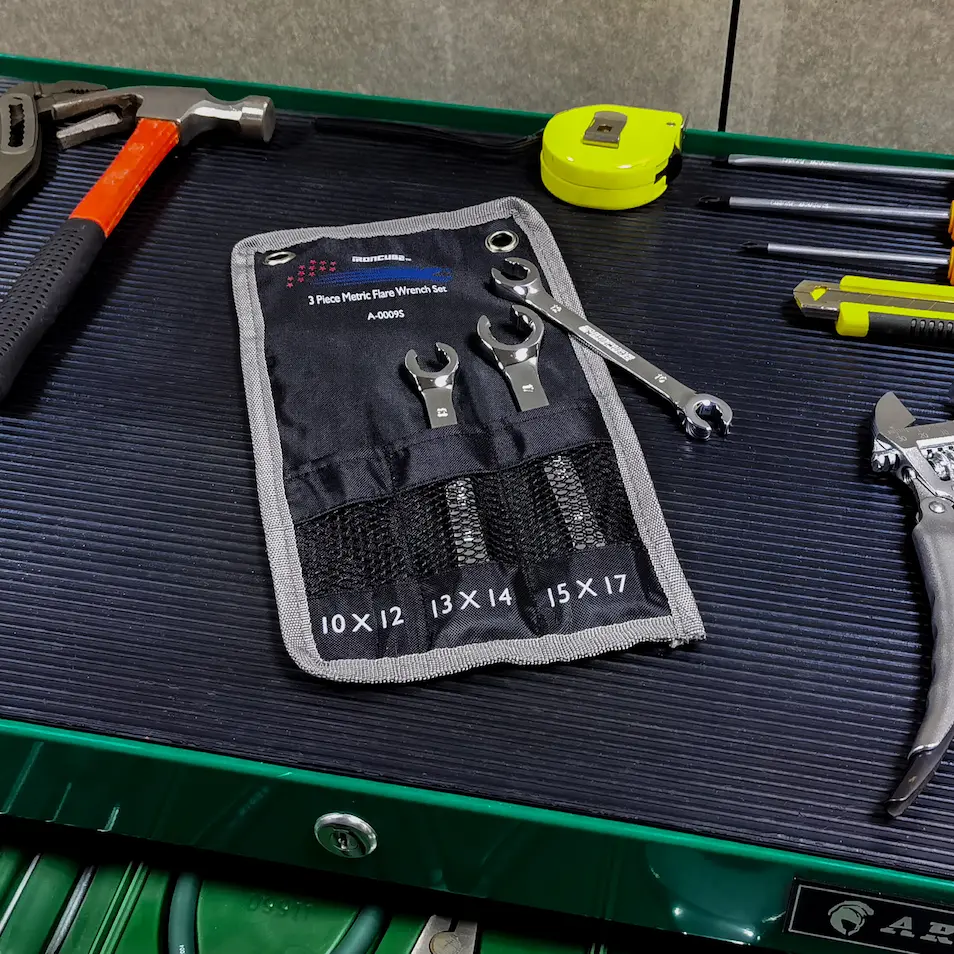
Correct technique matters more than brute force.
1. Identify and depressurize the system
Determine whether the line carries brake fluid, fuel, refrigerant, air, oil, or hydraulic fluid. Release pressure through the approved procedure and protect nearby surfaces.
2. Clean and inspect the fitting
Brush away loose rust and packed dirt. Wipe the flats so the wrench contacts metal, not debris. Inspect for cracks, severe corrosion, or previous rounding.
Where appropriate, apply a compatible penetrating product around external threads. Keep chemicals away from open hydraulic circuits, brake friction surfaces, rubber parts, and paint unless approved.
3. Select the exact size
The correct wrench should sit tightly with minimal rocking. Do not use a size because it feels “close.”
A 3/8-inch wrench measures 9.525 mm, so it is not automatically a safe substitute for a 10 mm fitting. Likewise, 7/16 inch equals 11.1125 mm, not 11 mm.
4. Seat the head fully
Push the wrench to the full depth of the hex. Partial engagement concentrates force near the outer edge and can peel over the corners.
5. Counter-hold the mating body
When a union has two hex sections, hold the stationary side with a second wrench. This keeps torque out of the hose, valve, bracket, and thin metal tube.
6. Pull straight and steadily
Keep the wrench square to the fitting. Avoid lifting or pushing sideways.
Torque equals force multiplied by perpendicular distance. Twenty pounds applied at a six-inch handle creates about 10 lb-ft. Extra handle length increases torque, but it also magnifies poor fit and side loading.
Do not slide a long pipe over a small line wrench. Extreme force is a signal to reassess corrosion, access, and replacement options.
7. Stop at the first slip
Release force immediately if the wrench moves on the nut. Recheck the size, seating, head condition, and visible flats. Repeating the same failed pull quickly turns minor damage into a rounded fitting.
8. Tighten to the specified method
A Flare Nut Wrench Set applies force, but it does not determine final torque. Follow the vehicle, equipment, or fitting manufacturer’s specification.
Overtightening can distort the flare, damage threads, or crack tubing. Undertightening can leak. Parker’s hydraulic guidance uses controlled assembly methods, including flats-from-wrench-resistance procedures for certain flare connections, rather than unlimited force.
What to Do With a Seized or Partly Rounded Fitting
The first rule is simple: do not keep repeating the same failed pull.
Clean the nut again and confirm the exact size. A higher-quality, tighter-tolerance Flare Nut Wrench Set may grip a fitting that a worn wrench cannot. A six-point flare nut crowfoot may improve access when a straight handle cannot stay square.
Apply penetrating fluid only where it is compatible and safe. Allow time for it to work. Light tapping around a non-pressurized steel fitting can sometimes disturb corrosion, but striking delicate valves, aluminum bodies, or thin tubing can cause damage.
Heat requires much greater caution. Never use flame near fuel, brake fluid residue, refrigerant, rubber hoses, sealed pressure, or unknown coatings. In many vehicle repairs, replacing the corroded line or fitting is safer than trying to save it with heat.
Once the corners are visibly deformed, plan for replacement. Locking pliers, extractor-style tools, or cutting the line may remove the part, but those are removal methods, not repair methods. A damaged tube nut should not return to service merely because it can still be tightened.
For brake systems, inspect the entire nearby line. Severe corrosion rarely stops at one nut.
SAE and Metric Sizes: What Coverage Do You Need?
Vehicle origin does not always predict every fitting size. A modern vehicle may combine metric fasteners with supplier-specific components. Older American equipment may use SAE sizes. Imported machines may contain both due to repairs or aftermarket assemblies.
The safest approach is to identify the fitting directly and consult service information.
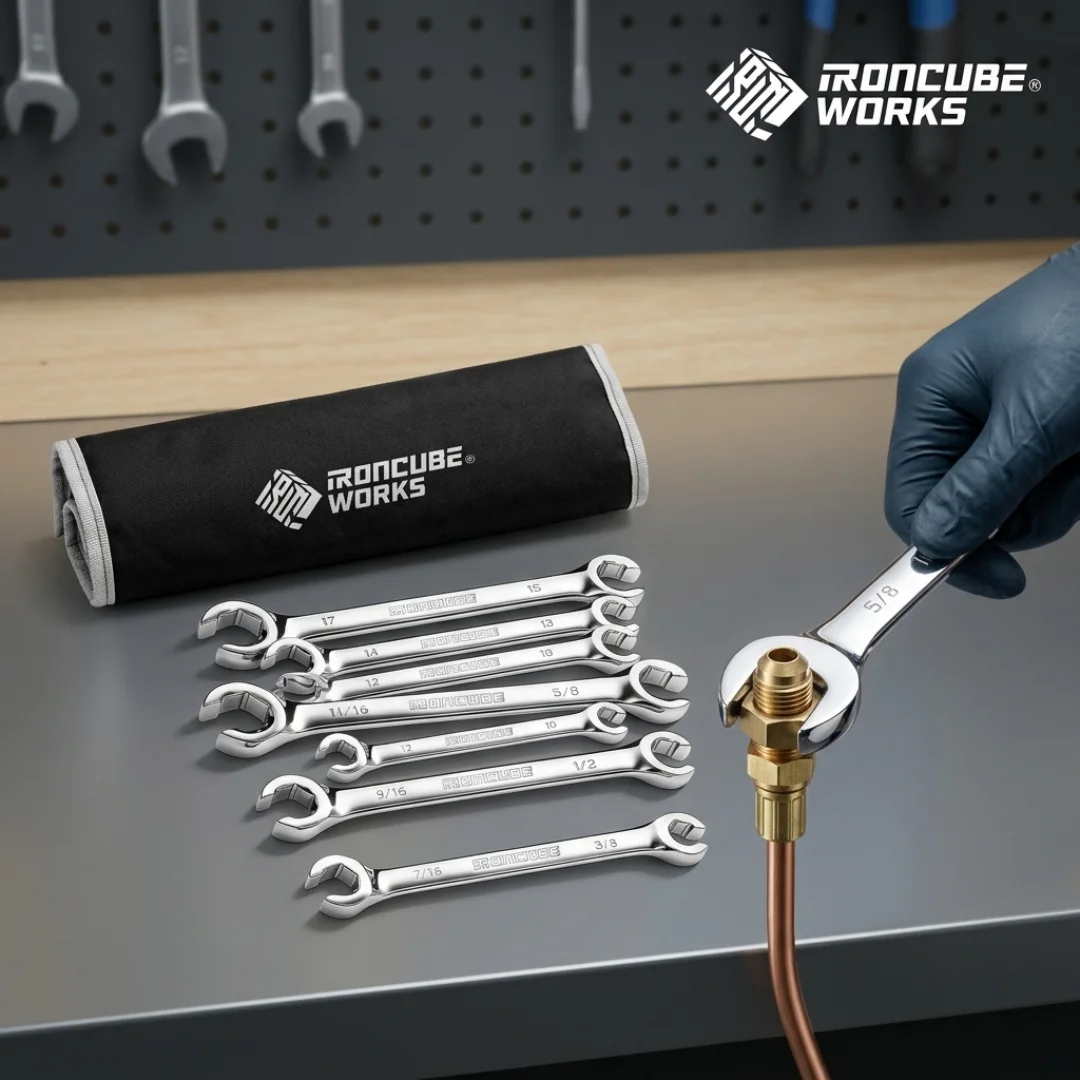
The listed IRONCUBE Flare Nut Wrench Set contains six double-ended wrenches and covers 12 sizes:
| System | Included sizes |
| Metric | 10, 12, 13, 14, 15, and 17 mm |
| SAE | 3/8, 7/16, 1/2, 9/16, 5/8, and 11/16 inch |
The product listing states that the head grips five sides of the fitting. It also describes a chrome-plated, full-polish finish intended to simplify cleaning and resist corrosion.
That coverage suits many common automotive line jobs, but it is not universal. The set does not include every smaller or larger metric and SAE size. Before buying, compare the included range with the fittings on your vehicles, workshop equipment, or service manuals.
This is the key buying principle: coverage should follow your work, not the piece count printed on the package.
How to Choose the Best Flare Nut Wrench Set
Prioritize accurate fit
A polished wrench can still fit poorly. Look for cleanly formed internal flats, minimal play, and strong walls around the slot. The head should reach the base of the nut rather than balance on its outer corners.
Match your SAE and metric work
A mixed Flare Nut Wrench Set suits a home garage with several vehicles. Specialists may prefer broader, separate metric and SAE sets.
Record the sizes used during recent repairs. That list is better buying data than a generic “most common sizes” claim.
Balance head strength and access
Thicker heads resist spreading but may not fit beside a bracket. Thin heads improve access yet depend more heavily on material quality and heat treatment.
A slight offset can protect your knuckles. Too much offset may encourage side loading in narrow spaces.
Choose controlled handle length
Longer handles create more torque. That helps with corrosion but can damage a small fitting faster. Select a handle that you can keep square.
Check finish, storage, and support
Chrome or polished finishes wipe clean easily. A pouch protects the heads and makes missing sizes obvious. Warranty or replacement support matters because line-wrench heads carry concentrated loads.
IRONCUBE describes its range as hand tools for automotive, electrical, and home repair. Its contact page provides a route for product questions.
Is the IRONCUBE Flare Nut Wrench Set a Practical Choice?
The IRONCUBE set offers a useful mixed range in a compact six-wrench format. Its 12 listed sizes cover several common brake, fuel, and A/C fittings. Double-ended construction reduces storage space, while the polished surface should be easier to clean than a rough finish.
Its strongest advantage is balanced SAE and metric coverage. A user maintaining different vehicles may avoid buying two separate starter sets.
The limitation is equally clear. Missing sizes can stop a repair. A technician who regularly encounters 8, 9, 11, 16, 18, or 19 mm line fittings will need additional wrenches. The same applies to SAE fittings outside the listed range.
Therefore, judge the IRONCUBE flare nut wrench product listing by fit and coverage, not by a claim that it replaces every line wrench. That is the realistic way to buy any Flare Nut Wrench Set.
Building a Complete Wrench and Hand-Tool System
Specialty tools work best inside a well-planned kit. The IRONCUBE® WORKS hand-tool catalog covers tools for surrounding fasteners, while the flare wrench remains dedicated to tubing connections.
For high-torque industrial work, read the guide to extra-large heavy-duty ratcheting wrenches. The articles on torque friction wrench design and friction wrench versus torque wrench explain why grip and measured tightening are different functions.
Buyers comparing larger sizes can review the 2026 friction wrench set buying guide, the guide to friction wrench sets for structural steel and bridge work, and the sourcing article for wholesale jumbo wrench sets.
Specific options include the 1-7/8-inch friction wrench, the 36 mm high-torque friction wrench, and jumbo ratchet wrenches for heavy-duty work. An additional jumbo friction ratcheting wrench listing shows how different those tools are from a line wrench.
A complete bench also needs suitable drivers. Browse the IRONCUBE screwdriver category and the guide to magnetic screwdriver sets. Product demonstrations are available through the IRONCUBE Tools YouTube channel.
Care and Storage
Wipe every Flare Nut Wrench Set after use. Remove brake fluid, fuel residue, penetrating oil, and dirt before placing the tools in a pouch.
Inspect the slot and internal flats under good light. A spread head or rolled edge will not grip correctly on the next repair. Replace damaged tools rather than filing the head and changing its size.
Keep metric and SAE markings readable. Mixing similar sizes during a hurried repair is a common path to rounded fittings.
Store the wrenches dry. Even a corrosion-resistant finish can be damaged by trapped moisture, chemicals, or impact against other tools.
Summary
A Flare Nut Wrench Set protects fluid-line fittings by combining side access with broader engagement than a standard open-end wrench. That design is especially useful on brake, fuel, transmission, A/C, and small hydraulic connections.
The tool still depends on exact sizing, full seating, straight pulling, counter-holding, and the correct tightening specification. Stop when a fitting slips. Replace badly rounded or corroded parts instead of forcing them back into service.
Choose a Flare Nut Wrench Set by the sizes you actually use. The right coverage and careful technique will prevent more damage than extra leverage ever will.
FAQs
Is a flare nut wrench the same as a line wrench?
Usually, yes. “Line wrench,” “brake line wrench,” and “flare nut wrench” describe the same slotted box-style tool. A Flare Nut Wrench Set lets tubing pass through the slot while the head grips most of the nut. Designs still differ in point count, thickness, offset, and coverage.
Can I use a regular wrench on a brake line fitting?
An open-end wrench may work when a clean fitting turns easily. However, it provides less surrounding contact and may spread under load. A Flare Nut Wrench Set is the safer first choice. Stop if the nut slips, twists the line, or begins deforming.
Should I buy metric or SAE flare nut wrenches?
Buy the sizes specified for your vehicles and equipment. Many garages need both. A mixed Flare Nut Wrench Set is convenient, but verify every included size. Never assume a near-matching SAE wrench safely replaces a metric size.
Can a flare nut wrench remove an already rounded fitting?
Sometimes, when damage is minor and solid flats remain. A tighter Flare Nut Wrench Set may grip better than the worn tool that slipped. Severe rounding usually requires extraction or line replacement. Replace the damaged nut after removal.
How tight should a flare nut fitting be?
Use the manufacturer’s torque or assembly method. A Flare Nut Wrench Set applies force but does not control the final value. Overtightening can distort the flare or threads; undertightening can leak.
What sizes are most useful for automotive work?
Needs vary by vehicle, year, and system. A starter Flare Nut Wrench Set should cover the fittings you service most often. Check the service manual and measure the nut before starting a safety-critical repair.