Choosing the right jumbo ratchet spanner for large nut work is not only about buying the biggest wrench on the shelf. Large fasteners need better grip, more leverage, safer handling, and the right head design for the space around the nut.
A standard wrench may work on small repair jobs. But once you move into heavy machinery, structural steel, construction equipment, bridge work, farm equipment, or industrial maintenance, the tool choice becomes more serious.
Large nuts often sit in awkward positions. Some are rusted. Some are over-tightened. Others sit close to frames, pipes, brackets, or hydraulic parts. That is where a jumbo ratchet spanner for large nut applications becomes valuable.
A wrench, or spanner, is a hand tool used to grip fasteners and apply torque. Wikipedia’s wrench overview explains that wrenches provide grip and mechanical advantage for turning nuts and bolts. That simple definition matters because a jumbo spanner is really a leverage tool first and a convenience tool second.
This guide explains how to choose the right size, type, handle length, head design, material, and maintenance routine. It also includes product links from IRONCUBE Works, practical size tables, and safety notes for real job-site use.
What Counts as a Jumbo Ratchet Spanner?
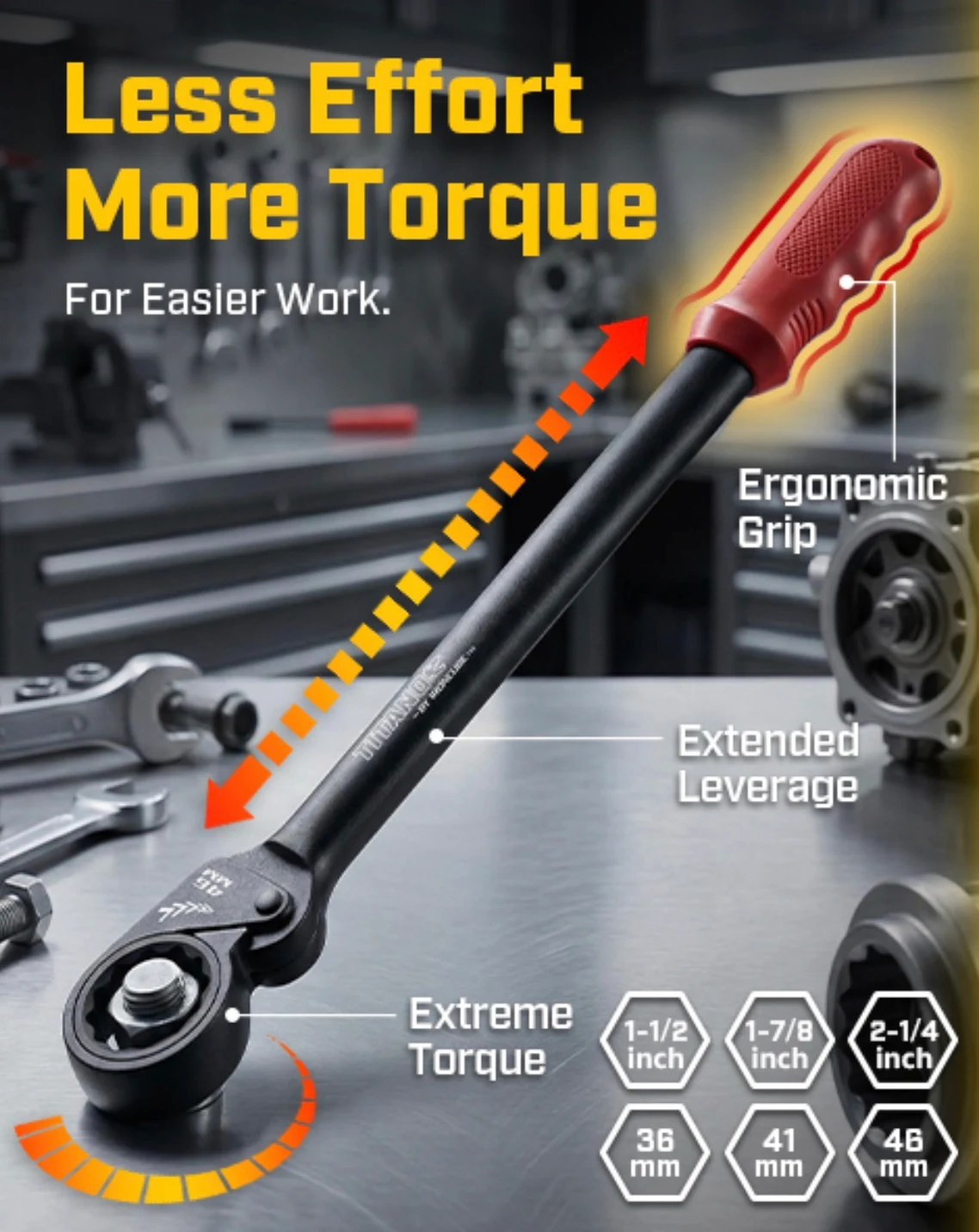
A jumbo ratchet spanner for large nut work is a ratcheting wrench built for oversized fasteners. It gives the user a larger gripping head and a longer handle than standard workshop spanners.
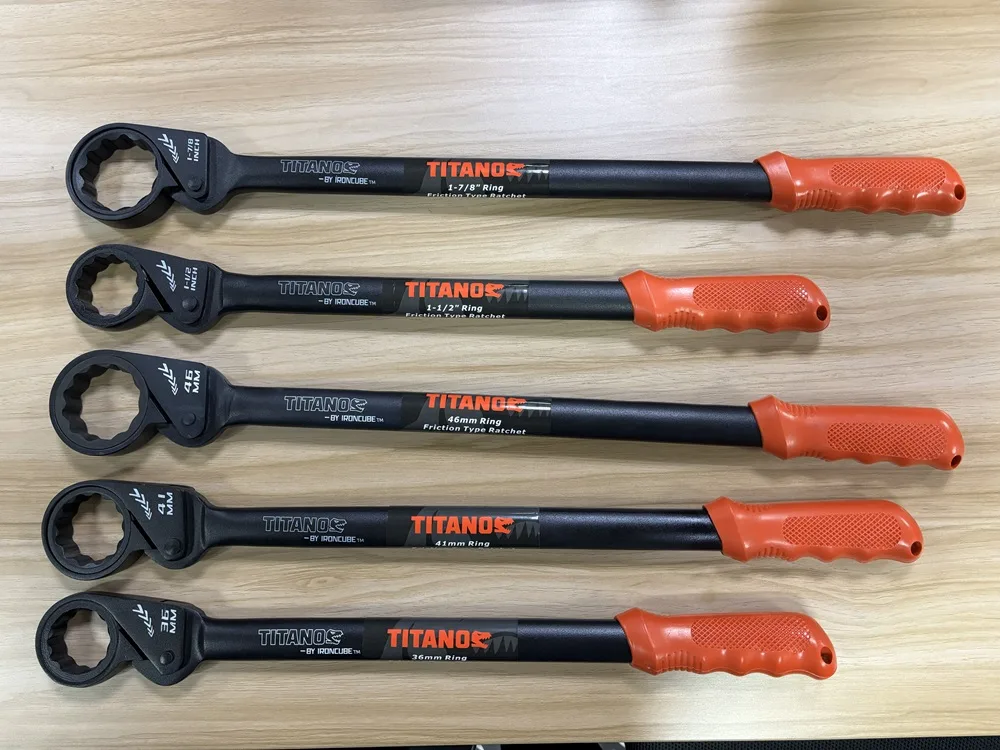
The word “jumbo” is not a single universal standard. In practical tool buying, it usually means a wrench made for fasteners above normal automotive or household sizes.
For many buyers, that starts around 30mm and above in metric sizes or 1-1/4 inch and above in SAE sizes.
These tools are common in machinery repair, steel erection, heavy vehicle maintenance, agricultural equipment, plant maintenance, and pipe-fitting work.
If you are comparing large-format tools, start with the IRONCUBE wrench category to see available heavy-duty wrench options.
Size Threshold: 30mm+ or 1-1/4″+
A 10mm, 13mm, or 19mm wrench is common in home garages. A 32mm, 41mm, 46mm, or 2-1/4 inch wrench belongs in a different category.
That larger size changes the whole job.
The nut has more surface area. The bolt may carry higher load. The tightening force can be much greater. The work area may also be less forgiving.
Metric hex nut dimensions are commonly standardized through ISO-based systems. For example, ISO 4032-style dimension charts list nut dimensions by thread size, width across flats, and height.
For inch-size nuts, ASME B18.2.2-style tables show width across flats and related dimensions for normal and heavy hex nuts. Heavy hex nuts are often wider and thicker than standard finished hex nuts.
That is why the best jumbo ratchet spanner for large nut work should match the actual across-flat size, not just the bolt diameter.
Design Differences From Standard Ratchets
A normal ratcheting wrench is usually slim, compact, and quick. It works well in engine bays, cabinets, small machinery, and general repair.
A jumbo ratchet spanner has different priorities.
It needs a larger head, stronger pawl or friction drive, stronger steel, a longer handle, and better load distribution. It also needs enough head thickness to survive force, but not so much that it cannot fit into restricted areas.
This is where a jumbo ratchet spanner beats a basic open-end wrench. You can keep the tool on the fastener and move the handle back and forth without removing it every stroke.
For users comparing heavy-duty ratcheting options, IRONCUBE’s guide to extra-large heavy-duty ratcheting wrenches is a useful internal reference.
When You Need a Jumbo Ratchet Spanner for Large Nut Work
You need a jumbo ratchet spanner for large nut work when a standard wrench slows you down, slips, damages corners, or does not provide enough leverage.
A large nut wrench is not only for huge factories. It can be useful anywhere large fasteners are used.
Common examples include excavator parts, tractor assemblies, trailer hardware, steel structure connections, large valves, industrial fittings, press equipment, cranes, and fabrication tables.
IRONCUBE’s jumbo ratchet wrenches for heavy-duty work page explains how jumbo ratchet wrenches are used for torque, speed, and industrial work efficiency.
Signs a Standard Wrench Is Not Enough
A standard wrench is not enough when it slips under load. That is the first warning.
You may also notice rounded nut corners, bruised knuckles, slow repositioning, handle flex, or the need to add unsafe pipe extensions.
A wrench should fit the nut cleanly. If the wrench rocks on the fastener, it is the wrong size or the nut is already worn.
Using the wrong size creates two problems. It reduces torque transfer, and it increases the chance of rounding the nut.
A jumbo ratchet spanner for large nut work gives better coverage and makes repeated tightening or loosening easier.
Torque Failure Warning Signs
Torque failure does not always look dramatic.
Those signs matter.
A ratcheting tool that skips under heavy load should not be forced. Stop and inspect the tool, the fastener, and the working angle.
OSHA groups hand and power tool hazards under workplace safety standards, which is a reminder that hand tools still create real injury risks when used incorrectly.
The safest rule is simple: use the correct size, pull smoothly, keep your balance, and never overload a tool beyond its design.
Large Nut Sizes You Will Meet on Site
The right jumbo ratchet spanner for large nut work starts with measurement.
Do not guess by eye. Measure the nut across the flats. That is the distance from one flat side of the hex nut to the opposite flat side.
Thread size and wrench size are not always the same.
For example, a metric M30 nut does not take a 30mm wrench. The wrench size depends on the standard and the nut pattern.
Common Metric Ranges: 32mm–60mm
Large metric wrench sizes often run from 32mm to 60mm in industrial work.
Here is a practical reference table for large nut work. Always confirm the actual fastener standard before buying tools.
| Common wrench size | Typical work area | Buying note |
|---|---|---|
| 32mm | Machinery, vehicles, equipment frames | Often the first “large” size |
| 36mm | Industrial machinery, steel assemblies | Good bridge between medium and jumbo |
| 41mm | Heavy equipment, structural parts | Strong jumbo category size |
| 46mm | Heavy machinery nuts, large fittings | Popular oversized industrial size |
| 50mm | Plant maintenance, large bolting | Requires strong handle control |
| 55mm–60mm | Large equipment and fittings | Check clearance before buying |
For a direct 41mm option, see the Friction Wrench 41mm jumbo ratchet spanner for large nut.
For 46mm work, IRONCUBE also has a dedicated guide on the friction wrench set 46mm for heavy machinery nuts and a product-focused page for the friction wrench set 46mm.
Common SAE Ranges: 1-1/4″–2-1/2″
SAE sizes are common in North American equipment, old machinery, fabrication shops, trailers, and imported industrial systems.
A large nut wrench may be needed for 1-1/4 inch, 1-1/2 inch, 1-7/8 inch, 2-1/4 inch, or 2-1/2 inch fasteners.
Finished hex nut dimensions and heavy hex nut dimensions differ. For example, heavy hex nuts are larger and thicker than standard hex nuts, and ASME B18.2.2-style references list separate across-flat values.
| SAE wrench size | Typical use | Product direction |
| 1-1/4″ | Large machinery and equipment | Entry jumbo size |
| 1-1/2″ | Heavy-duty large nuts | See 1-1/2″ product |
| 1-7/8″ | Oversized industrial fittings | See 1-7/8″ product |
| 2-1/4″ | Big bolts and nuts | See 2-1/4″ product |
| 2-1/2″ | Very large assemblies | Check torque and clearance first |
For SAE options, compare the Friction Wrench 1-1/2 Inch heavy-duty ratcheting spanner, the Friction Wrench 1-7/8 Inch, and the Friction Wrench 2-1/4 Inch.
You can also view IRONCUBE listings through the official IRONCUBE Amazon store.
Jumbo Ratchet Spanner Types
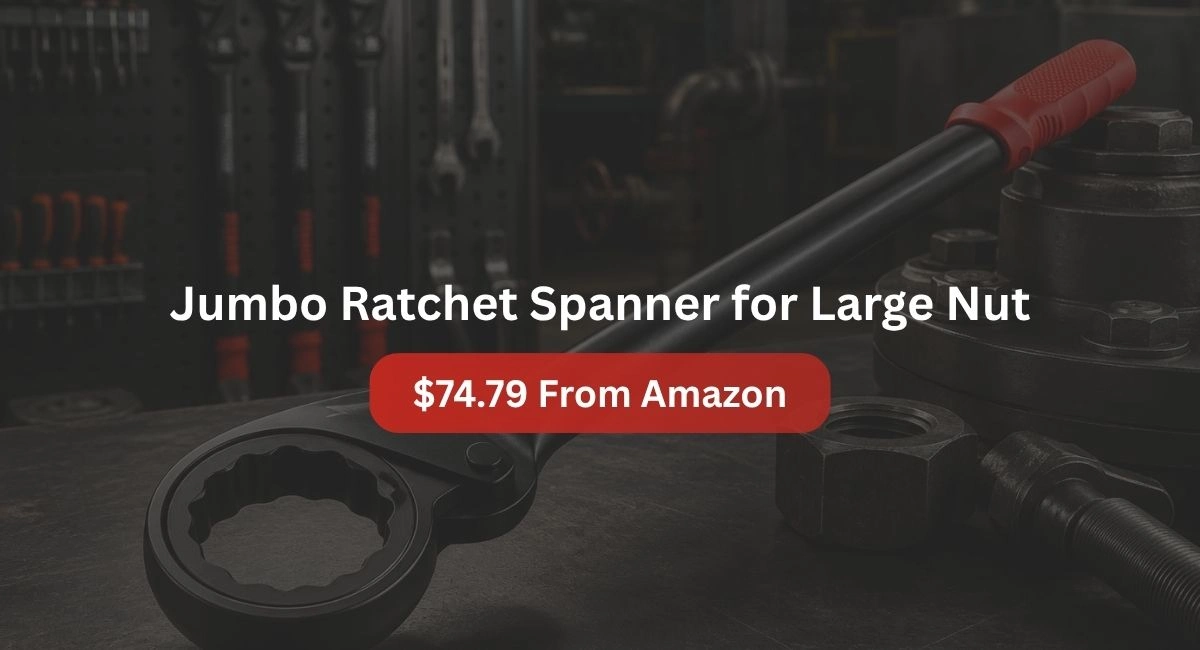
Not every oversized ratchet spanner works the same way.
Before buying a jumbo ratchet spanner for large nut use, compare the drive style. The three common types are ratcheting box end, friction ratchet design, and offset-handle ratchet.
Each one solves a different problem.
Ratcheting Box End
A ratcheting box end surrounds the fastener and turns it with a ratchet mechanism.
This design gives better contact than an open-end wrench. It also reduces the need to lift and reposition the tool.
A box-end style is useful when the nut is accessible from above and there is enough clearance around the fastener.
The main buying point is tooth count. A higher tooth count usually needs a smaller swing arc. That helps in tight spaces.
For comparison, many standard ratcheting wrench sets use 72-tooth mechanisms, which can require about 5 degrees of swing. Better Homes & Gardens highlighted this 72-tooth, 5-degree swing concept in its wrench set review.
Friction Ratchet Design
A friction ratchet design uses friction-based ratcheting action to keep work moving without repeated repositioning.
This can be useful for oversized fasteners where a normal ratchet head may be bulky or slow.
IRONCUBE’s wrench category lists several friction-type large wrench products, including 1-1/2 inch, 2-1/4 inch, 41mm, and 46mm options.
This makes a friction-type jumbo ratchet spanner for large nut applications attractive when speed and clearance matter.
For a broader buying comparison, read the friction wrench set buying guide 2026.
Offset Ratchet Handle
An offset handle raises the grip away from the fastener plane.
That extra clearance helps protect your fingers and knuckles. It also gives better access when the nut sits near a frame, plate, flange, or bracket.
However, offset can change how force feels in your hand. Use steady pressure and avoid side-loading the head.
For structural steel or bridge-style applications, IRONCUBE’s guide on the best friction wrench set for structural steel and bridge construction gives more context.
How Handle Length Changes Torque Delivery
A jumbo ratchet spanner for large nut work depends heavily on handle length.
Long handles feel powerful because they increase leverage. That does not mean longer is always better.
Torque is force multiplied by lever length when force is applied perpendicular to the handle. NASA explains this relationship as T = F × L in a simple torque example.
So, if the same person pulls with the same force, a longer handle can create more torque.
Leverage Physics in Simple Terms
Imagine pulling on a short wrench with 100 pounds of force.
Now imagine pulling with the same force on a wrench that is twice as long.
The longer handle creates more turning effect because the force acts farther from the fastener center.
That is why a big bolt ratcheting wrench often has an extended handle. It helps loosen stubborn fasteners without forcing the user to apply extreme body strain.
But leverage has a limit.
Too much force can damage the nut, stretch the bolt, break the tool, or injure the user.
When Longer Helps and When It Hurts
A longer handle helps when the nut is large, the space is open, and the tool is designed for the load.
It hurts when clearance is limited, the fastener is soft, the wrench is not fully seated, or the user pulls at a bad angle.
Never add a pipe to a wrench unless the manufacturer approves it. A pipe extension can overload the handle and head.
A properly selected jumbo ratchet spanner for large nut work should give enough leverage without unsafe improvisation.
If exact tightening matters, use a torque wrench instead. This is especially important for critical assemblies. For more context, see IRONCUBE’s comparison of a friction wrench vs torque wrench.
Buying a Jumbo Ratchet Spanner: 6 Features to Compare
A good buying decision comes from six checks: head thickness, tooth count, steel grade, handle safety, rated torque, and storage.
Do not buy only by size.
A cheap oversized ratchet spanner can become expensive if it rounds fasteners or fails under load.
1. Head Thickness for Tight-Clearance Work
Head thickness matters because large nuts often sit near other parts.
A thick head may be strong, but it may not fit. A thin head may fit, but it may not handle heavy force.
The right choice depends on the work.
For tight spaces, look for a slim but reinforced head. For open machinery work, choose strength first.
If your shop handles mixed fasteners, IRONCUBE’s product-category wrench page is the best starting point.
2. Tooth Count for Fine Control
Tooth count controls swing arc.
A low-tooth ratchet needs more handle movement to advance the fastener. A high-tooth ratchet needs less movement.
This matters near beams, housings, pipes, and brackets.
For tight work, a finer ratchet can save time. For extreme load, the drive strength and tooth geometry matter more than tooth count alone.
3. Steel Grade and Heat Treatment
Large wrenches need strong material.
Chrome vanadium steel is widely used in professional hand tools because it balances strength, wear resistance, and durability. Tool steel also benefits from heat treatment, which can increase hardness and stress resistance.
Still, material labels alone are not enough.
Look for forged construction, clean machining, stable finish, and clear size marking. A good oversized ratchet spanner should feel solid without rough play in the head.
IRONCUBE product pages also mention forged and machined wrench construction on several standard wrench listings.
4. Handle Grip and Safety
Large fastener work is physical.
The handle should feel stable in the hand. It should not have sharp edges or slippery surfaces.
A flat handle may be easy to clean. A textured handle may give better grip. A longer handle may reduce effort but increase the need for control.
When using a jumbo ratchet spanner for large nut work, pull with your body balanced. Keep your face away from the line of force. Do not jerk the handle.
5. Rated Torque Capacity
Rated torque capacity matters most on critical jobs.
Not every jumbo ratcheting wrench publishes the same torque data. If the manufacturer provides torque limits, use them.
If not, treat the tool as a heavy-duty hand wrench, not a calibrated torque tool.
For critical tightening, use a calibrated torque wrench or torque multiplier system that matches the job specification.
The ANSI webstore describes ASME B107.110 as a standard that covers performance and safety requirements for socket wrenches, handles, nutdrivers, and attachments.
That does not mean every jumbo spanner follows that exact standard. It does mean serious tool buying should consider safety and performance standards, not only appearance.
6. Storage Case Options
Large tools are easy to misplace because they do not always fit standard toolboxes.
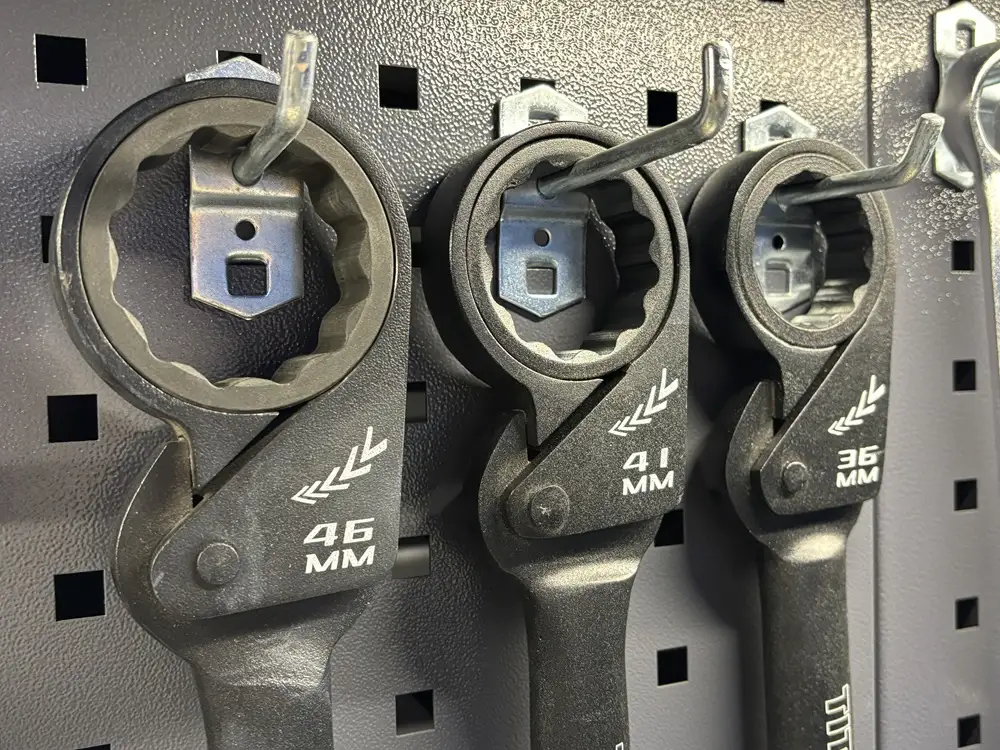
A case, rack, wall board, or drawer label saves time.
Storage also protects the ratcheting mechanism from dust, grit, and impact.
If you are buying for a crew, storage matters even more. A missing 46mm or 2-1/4 inch wrench can stop work.
For bulk tool buying, read IRONCUBE’s guide on how to find quality wholesale jumbo wrench sets.
Product Options for Jumbo Large Nut Work
The right jumbo ratchet spanner for large nut use depends on your most common fastener size.
If you mainly work with metric heavy machinery, start with 41mm and 46mm options.
If you handle SAE industrial equipment, compare 1-1/2 inch, 1-7/8 inch, and 2-1/4 inch tools.
Recommended product paths:
1-1/2 inch work, see the IRONCUBE Friction Wrench 1-1/2 Inch.
larger SAE fasteners, check the IRONCUBE Friction Wrench 2-1/4 Inch.
41mm metric nuts, compare the IRONCUBE Friction Wrench 41mm.
For Amazon buying, compare the IRONCUBE Jumbo Friction Ratcheting Wrench listing and this second IRONCUBE Amazon jumbo wrench listing.
Amazon product data for one IRONCUBE jumbo friction ratcheting wrench describes it as designed for 36mm large nuts used in industrial machinery, steel structures, construction assemblies, and heavy automotive maintenance.
Jumbo Ratchet Spanner vs Other Large Nut Tools
A jumbo ratchet spanner for large nut work is not the only option.
Here is a simple comparison.
| Tool type | Best use | Main limitation |
| Jumbo ratchet spanner | Repeated large nut work | Not always calibrated for exact torque |
| Large open-end wrench | Quick access on exposed nuts | Higher slip risk under heavy load |
| Breaker bar and socket | High loosening force | Needs vertical socket clearance |
| Torque wrench | Controlled final tightening | Should not be abused for breaking loose |
| Torque multiplier | Very high torque work | Needs correct setup and reaction point |
Use the tool that matches the task.
A jumbo ratchet spanner is excellent for speed and leverage. A torque wrench is better for final precision. A breaker bar may be better for the first breakaway movement.
Care and Maintenance Tips
A large ratcheting spanner lives a hard life.
It may see mud, rust flakes, metal dust, rain, oil, grease, and impact. Without maintenance, the ratcheting action can become rough.
A clean tool also helps safety. Dirt can hide cracks, wear, or damage.
For more detail, read IRONCUBE’s guide to friction wrench maintenance.
Cleaning After Heavy Site Use
After use, wipe the head and handle with a clean cloth.
Remove grit from the ratcheting area. Use a brush if needed.
Do not leave the tool wet. Moisture encourages corrosion, especially around moving parts.
If the wrench was used around cement dust, salt, fertilizer, or chemicals, clean it sooner. These materials can attack finishes and moving joints.
Lubrication Schedule
A ratcheting mechanism needs light lubrication.
Do not flood the head with thick grease unless the manufacturer recommends it. Thick buildup can trap grit.
Use a light tool oil when the mechanism feels dry, rough, or noisy.
After lubrication, cycle the wrench several times and wipe off excess oil.
Store the jumbo ratchet spanner for large nut work in a dry place. Avoid throwing it into a bin where the head can take repeated impact.
Building a Complete Shop Kit
A large nut wrench is only one part of a proper shop setup.
A useful kit may include jumbo ratchet spanners, standard combination wrenches, screwdrivers, magnetic screwdrivers, sockets, torque tools, and measuring tools.
For general hand tools, browse the IRONCUBE screwdriver category and the guide to the best magnetic screwdriver sets.
For help choosing the right wrench size or product line, use the IRONCUBE contact page.
You can also watch product videos and tool content on the IRONCUBE YouTube channel.
FAQ
What is a jumbo wrench?
A jumbo wrench is an oversized wrench designed for large fasteners, usually starting around 30mm or 1-1/4 inch in practical workshop use. A jumbo ratchet spanner for large nut work adds ratcheting action, so you can turn large nuts without lifting and repositioning the wrench after every stroke.
What is the biggest ratchet wrench you can buy?
The biggest ratchet wrench depends on the manufacturer and market. Common jumbo sizes include 41mm, 46mm, 50mm, 1-1/2 inch, 1-7/8 inch, and 2-1/4 inch. For a practical jumbo ratchet spanner for large nut choice, buy the size that matches the nut across flats rather than choosing the biggest tool available.
Can jumbo ratchet spanners be used with a torque multiplier?
Usually, no. A torque multiplier is designed for sockets and specific reaction setups, not for most ratcheting spanners. A jumbo ratchet spanner for large nut work is better for manual tightening and loosening. For controlled high-torque work, use the correct socket, torque multiplier, and manufacturer-approved setup.
Is a jumbo ratchet spanner better than a breaker bar?
It depends on the job. A breaker bar is often better for first loosening a seized fastener. A jumbo ratchet spanner for large nut work is better once the fastener starts moving because the ratcheting action saves time. Many mechanics use both tools on the same job.
How do I choose the correct jumbo ratchet spanner size?
Measure the nut across the flats. Then choose the wrench size that matches that measurement. Do not guess from bolt diameter alone. A jumbo ratchet spanner for large nut work must fit cleanly, sit flat, and grip the fastener without rocking.
Final Summary
A jumbo ratchet spanner for large nut work is a serious tool for serious fasteners. It gives better leverage, faster repeated turning, and stronger engagement than many standard hand wrenches.
The best choice depends on size, head clearance, ratchet design, handle length, steel quality, torque needs, and maintenance habits.
For most buyers, the smartest path is simple: measure the nut across flats, match the wrench size, choose a strong ratcheting or friction design, and avoid unsafe extensions.
If you work with industrial machinery, structural steel, big bolts, or heavy equipment, the right jumbo ratchet spanner can save time, protect fasteners, and make large nut work safer.