A longer wrench moves your hand farther from the fastener’s center. As a result, the same hand force can produce more turning torque. NASA’s basic explanation of torque describes it as the product of force and the perpendicular lever arm. Increase that lever distance, and torque rises when the applied force stays the same.
However, more leverage is not automatically better.
Extra length also needs more swing room. It can reduce the need for feedback when tightening small fasteners. More importantly, the additional mechanical advantage makes it easier to apply excessive torque if you rely only on feel.
So, choosing between a Long Wrench Set and standard-length wrenches is not simply about buying the tool that produces the most force.
You need to consider torque, reach, clearance, control, fastener condition, and the type of tightening job.
This guide explains those trade-offs using real engineering principles, manufacturer specifications, and recognized safety standards.
What Is a Long Wrench Set?
A Long Wrench Set contains wrenches with handles longer than the manufacturer’s conventional pattern for comparable fastener sizes.
Manufacturers use several terms for this design. You may see:
long pattern, extra long, XL, extended reach, or long beam.
There is no single universal percentage that makes every wrench “long.” Length varies by manufacturer, wrench size, head design, and product family.
For example, GEARWRENCH states that its XL 120XP ratcheting wrench beam can be up to 25% longer than standard wrenches, specifically to increase reach, leverage, and torque.
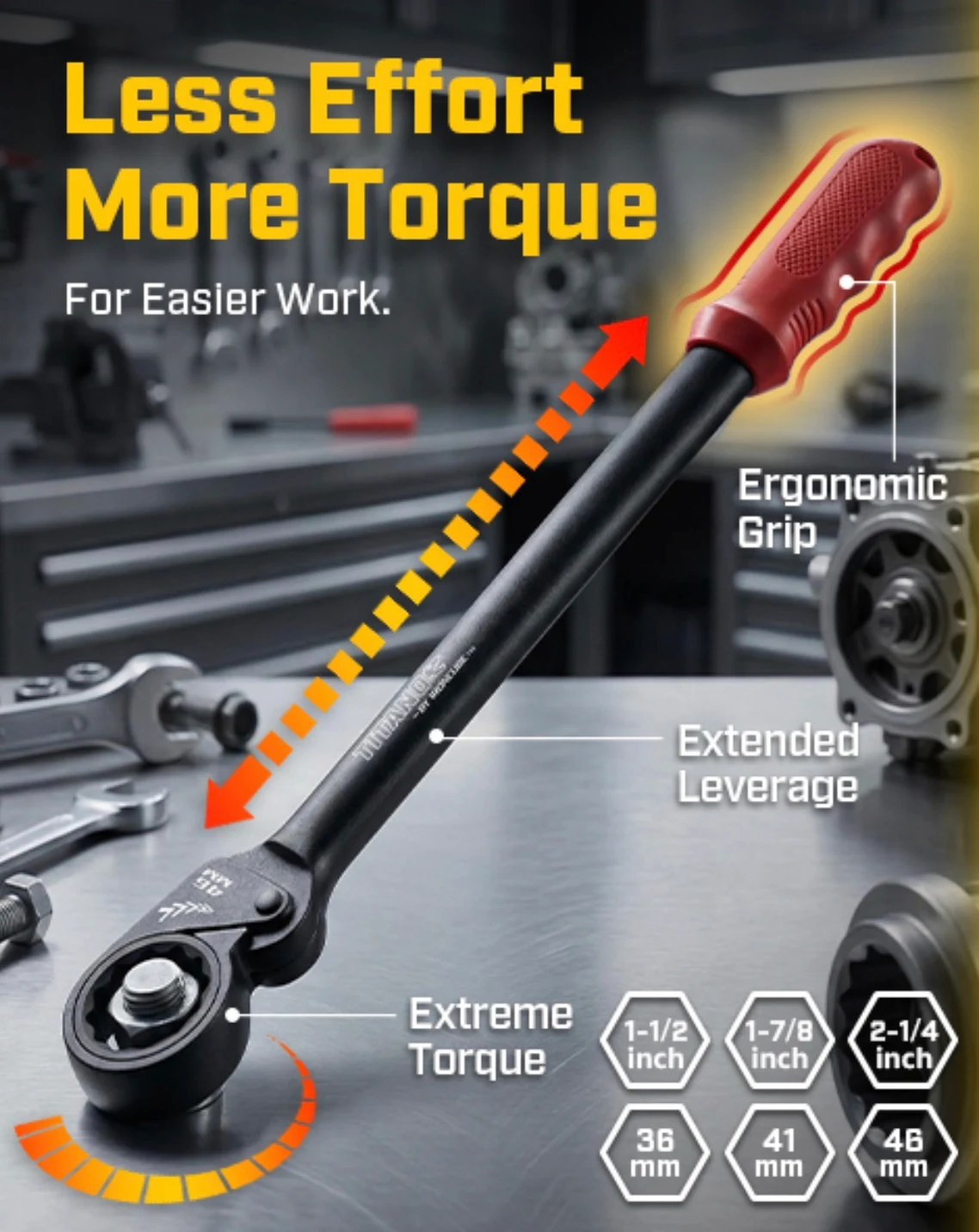
IRONCUBE takes the same leverage concept much further with its extra-large heavy-duty ratcheting wrenches. The current product range lists handle lengths from 510 mm to 660 mm for large industrial fasteners.
A standard-length wrench, in contrast, tries to balance leverage with portability and clearance.
That balance makes standard wrenches excellent general-purpose tools.
The difference becomes important when access or resistance pushes the standard tool beyond its comfortable working range.
Long Wrench Set vs Standard Wrench: Quick Comparison
| Factor | Long Wrench Set | Standard-Length Wrench |
|---|---|---|
| Mechanical leverage | Higher | Moderate |
| Hand force for same torque | Lower | Higher |
| Deep reach | Better | Moderate |
| Swing clearance required | More | Less |
| Control on small fasteners | Requires care | Often easier |
| Breaking stubborn fasteners loose | Strong advantage | Adequate for normal work |
| Tight engine compartments | Depends on geometry | Often easier to position |
| Tool weight | Usually higher | Usually lower |
| Risk of accidental over-tightening | Higher if used carelessly | Lower, but still possible |
| General everyday use | Specialized advantage | Excellent |
| Heavy machinery | Often preferred | Can be insufficient |
Neither tool automatically wins.
A Long Wrench Set becomes more valuable as resistance, depth, and required leverage increase.
How a Long Wrench Set Creates More Torque
The physics is straightforward.
For a force applied perpendicular to a wrench:
Torque = Force × Lever Arm
NASA uses this same relationship when explaining torque and moment arms.
Suppose you apply 200 newtons of hand force.
With a 0.20-meter wrench:
200 N × 0.20 m = 40 N·m
Use a 0.30-meter wrench:
200 N × 0.30 m = 60 N·m
Move to 0.40 meters:
200 N × 0.40 m = 80 N·m
The hand force did not change.
Only the lever length changed.
Yet the 0.40-meter wrench produces twice the torque of the 0.20-meter wrench under the simplified perpendicular-force example.
Torque Example
| Effective Handle Length | Hand Force | Theoretical Torque |
|---|---|---|
| 200 mm | 200 N | 40 N·m |
| 300 mm | 200 N | 60 N·m |
| 400 mm | 200 N | 80 N·m |
| 500 mm | 200 N | 100 N·m |
These values illustrate leverage rather than a wrench’s rated capacity.
A tool must still be designed to withstand the load you apply.
That distinction is critical.
More theoretical leverage does not mean an unlimited torque rating.
Why a Long Wrench Set Can Require Less Physical Effort
Now reverse the calculation.
Suppose a fastener needs 60 N·m of turning torque.
With a 200 mm effective handle:
60 ÷ 0.20 = 300 N of hand force
With a 300 mm handle:
60 ÷ 0.30 = 200 N
With a 400 mm handle:
60 ÷ 0.40 = 150 N
The longer tool lets the worker achieve the same torque with less hand force.
This is the fundamental mechanical benefit of a Long Wrench Set.
IRONCUBE applies the same principle in its explanation of torque friction wrench leverage and operator effort. The page correctly notes that a longer effective radius can reduce the force required to reach a given torque.
However, the exact reduction depends on effective wrench length, hand position, force angle, and the actual resistance at the fastener.
Claims such as “30% less effort” should therefore be tied to specific geometry rather than treated as universal for every user.
Long Wrench Set Advantage No. 2: Better Reach
Torque gets most of the attention, but reach can matter just as much.
Some fasteners are not difficult because they are extremely tight.
They are difficult because they sit deep inside the machine.
Consider bolts behind:
engine accessories, suspension components, hydraulic lines, machine guards, structural members, agricultural equipment, large brackets, or industrial housings.
A standard wrench may fit the fastener but leave your hand pressed against surrounding components.
A Long Wrench Set places the gripping area farther away.
You can sometimes reach past an obstruction while keeping your hand in open space.
GEARWRENCH explicitly lists improved reach alongside leverage and torque as benefits of its extra-long beam design.
That makes long-pattern tools valuable even when extreme torque is unnecessary.
Reach Is Different From Swing Clearance
This distinction prevents many purchasing mistakes.
A long wrench gives you more reach.
It does not automatically give you better swing clearance.
Imagine a bolt located 300 mm below a bracket.
The long wrench may reach it perfectly.
However, the handle may then hit a firewall, pipe, chassis rail, or another machine component after only a short movement.
In that situation, a Long Wrench Set with a ratcheting box end can become more effective than a long fixed wrench.
The tool provides depth, while the ratchet reduces the need to remove and reposition it after each stroke.
IRONCUBE’s Jumbo Ratchet Wrenches for Heavy-Duty Work follows this same logic for large industrial fasteners, combining long-handle leverage with ratcheting action.
Does a Long Wrench Set Always Produce Better Control?
Not necessarily.
This is where leverage becomes a trade-off.
A longer handle reduces the hand force required for a given torque. That can improve smoothness during a hard pull because you do not need to strain as much.
Yet the same leverage also makes it easier to apply more torque than you intended.
For loosening stubborn fasteners, that extra leverage is usually desirable.
For tightening, especially on smaller bolts, control becomes more important.
A small additional movement at the end of a long wrench can create substantial fastener torque.
Therefore, “feel” should never replace a specified torque procedure on critical assemblies.
ISO 6789-1:2017 specifically covers hand torque tools intended for controlled tightening of screws and nuts, while ISO 6789-2:2017 addresses calibration and measurement uncertainty for those tools.
If the service manual says 85 N·m, use the appropriate calibrated torque tool for final tightening.
Do not assume that an experienced hand using a Long Wrench Set can reproduce the required value accurately.
Long Wrench Set and Fastener Safety
More leverage changes the safety margin for both the tool and the fastener.
This matters because bolts do not simply become “tighter forever.”
Tightening creates preload in the joint.
NASA defines preload as the tensile force in the fastener, accompanied by compressive force in the clamped joint members. Its threaded-fastening standard also explains that tightening torque includes torque associated with preload plus running torque and friction effects.
Push a fastener too far and several problems can occur.
You may stretch the bolt beyond its intended range.
Threads can strip.
The nut can deform.
The joint can crush a soft gasket or component.
The wrench may also slip if the engagement is poor.
A Long Wrench Set does not cause those failures by itself.
Incorrect force does.
The longer handle simply gives you enough mechanical advantage to reach damaging torque more easily.
Why Torque Does Not Equal Exact Bolt Tension
This is another important point.
Torque is what you apply rotationally.
Preload is the tension created in the bolt and compression in the joint.
They are related, but they are not identical.
Thread friction and under-head or nut-face friction consume a large part of the input torque. Surface finish, lubricant, contamination, coatings, thread condition, and reuse can therefore change the resulting preload. NASA’s fastening standards explicitly account for friction and running torque in controlled fastening procedures.
NASA research on preloaded joints has even noted substantial preload uncertainty from hand-operated torque tightening under some conditions.
That is why a Long Wrench Set should not become an improvised torque-measuring device.
Use it to turn the fastener.
Use a controlled tightening method when the joint specification requires one.
Long Wrench Set vs Torque Wrench: Do Not Confuse Them
The tools serve different functions.
A normal long wrench provides mechanical advantage.
A torque wrench provides a way to control or indicate applied torque.
Those are not interchangeable purposes.
IRONCUBE explains this distinction in its friction wrench vs torque wrench comparison. A heavy friction or ratcheting wrench suits loosening, run-down, and high-load turning. Final tightening to a specified value calls for an appropriate calibrated torque tool.
A practical workflow is therefore:
Break the fastener loose with the suitable high-leverage wrench.
Perform removal or run-down efficiently.
Then use the specified torque procedure during final assembly.
This workflow gives you speed without sacrificing fastener control.
When a Long Wrench Set Is Better Than Standard Length
A Long Wrench Set makes the most sense when the job repeatedly presents one of three problems.
The first is insufficient leverage.
A normal combination wrench may require an uncomfortable amount of force to free large or corroded fasteners.
The second is insufficient reach.
The wrench head can reach the fastener, but your hand cannot work comfortably near it.
The third is repetitive heavy work.
Reducing required hand force can become valuable when a mechanic must turn many large fasteners during a shift.
Industrial equipment, diesel repair, agricultural machinery, plant maintenance, steel fabrication, and heavy vehicle work often create these conditions.
IRONCUBE’s extra-large heavy-duty ratcheting wrench range illustrates this heavier end of the market, with current models spanning 510–660 mm in length.
When Standard-Length Wrenches Are Better
More leverage does not make a Long Wrench Set the best choice for every job.
Standard-length tools usually win when space is limited around the handle.
They are also lighter and easier to maneuver during routine maintenance.
A standard wrench may give better tactile feedback when working on smaller fasteners.
It also occupies less toolbox space.
For general automotive, household, appliance, motorcycle, and light mechanical work, a quality standard combination set can handle a large percentage of everyday jobs.
For example, the IRONCUBE 10-piece metric ratcheting wrench set offers a conventional-size solution when ratcheting speed matters more than extreme leverage.
TEKTON likewise sells separate stubby and standard-length combination-wrench systems, demonstrating that manufacturers treat handle length as an application choice rather than a simple quality hierarchy.
Long, Standard, and Stubby Wrenches Solve Different Problems
Think of wrench length as three different optimization strategies.
| Type | Main Advantage | Main Limitation |
|---|---|---|
| Stubby | Fits very confined areas | Low leverage |
| Standard | Balanced size and leverage | May lack reach or torque |
| Long | High leverage and deeper reach | Requires more room |
| Extra-long ratcheting | Reach + leverage + short reset | Larger, heavier, more specialized |
A professional toolbox can justify all three.
Trying to make one pattern perform every job usually creates more compromise than savings.
How Much More Torque Can a Longer Wrench Produce?
The answer depends on the length increase.
If the effective handle becomes 25% longer and your hand applies the same perpendicular force, theoretical torque also rises by about 25%.
For example:
A 300 mm handle becomes 375 mm.
At 200 N of force:
0.30 m × 200 N = 60 N·m
0.375 m × 200 N = 75 N·m
That is a 25% increase.
This is why GEARWRENCH’s claim that an XL beam up to 25% longer improves leverage is mechanically reasonable.
However, do not confuse that with GEARWRENCH’s separate claim that some of its off-corner-loading wrench designs can deliver up to 25% more torque to fasteners. That figure involves head engagement geometry as well as the wrench design and should not be treated as a universal law for every long wrench.
A Long Wrench Set gains leverage according to actual effective length.
The engineering calculation remains more useful than a generic percentage claim.
Ratcheting Long Wrenches vs Fixed Long Wrenches
A fixed long combination wrench offers simplicity.
The head contains no ratchet mechanism, so the tool can provide a direct mechanical connection between your hand and the fastener.
A long ratcheting wrench adds speed.
After each drive stroke, you reverse the handle without removing the wrench.
The benefit becomes especially noticeable when you have enough room for the long handle but only a small angular swing.
Some modern ratcheting systems need very little reset movement. GEARWRENCH’s 120XP design, for example, uses 120 ratcheting positions and specifies a 3-degree swing arc.
That is useful in congested machinery.
Still, every wrench should remain within its designed load.
Do not assume a fine ratcheting mechanism should automatically replace a dedicated heavy-duty breaker or industrial wrench for extreme loosening loads.
Why Fastener Fit Matters Even More With a Long Wrench Set
The more torque you apply, the more important head fit becomes.
A loose wrench concentrates force poorly.
An open end can spread.
A worn fastener can round.
A damaged wrench can suddenly slip.
OSHA specifically states that wrenches, including adjustable, pipe, end, and socket types, must not be used when their jaws have sprung enough to permit slippage.
That rule becomes especially relevant with a Long Wrench Set because the longer lever can generate substantial load.
Inspect the wrench before heavy use.
Make sure the size matches exactly.
Seat the tool fully on the fastener.
Avoid working only from the tips of open jaws.
For very high resistance, a fully engaged box end or suitable socket may be safer than an open end.
ASME’s current B107.100-2023 standard covers general, dimensional, performance, and safety requirements for combination wrenches.
Long Wrench Set for Heavy Machinery
Heavy equipment pushes wrench design into a different category.
A 13 mm automotive fastener and a 46 mm machinery nut may both be hexagonal, but they do not place comparable demands on the tool.
Large industrial fasteners require stronger heads, larger cross-sections, greater leverage, and appropriate material strength.
For those jobs, IRONCUBE provides a range of related resources.
The Friction Wrench Set Buying Guide 2026 covers heavy-duty size selection.
The 1-7/8-inch friction wrench provides a single-size example for large-nut work.
The 36 mm torque friction wrench targets metric heavy-equipment applications.
For crews dealing with oversized nuts regularly, the guide to quality wholesale jumbo wrench sets provides sourcing context.
A Long Wrench Set in this environment is not simply a stretched automotive wrench. Head construction, ratchet design, handle strength, material, and rated application all matter.
Structural Steel, Bridges, and Large Fasteners
Construction work adds another issue: installation procedure.
A long handle can help bring parts together, run down nuts, and overcome resistance.
However, high-strength structural bolts may require specified installation methods rather than “tighten until it feels right.”
That distinction is why the Long Wrench Set should be viewed as a force-delivery tool, not an automatic bolt-preload controller.
For related industrial applications, see IRONCUBE’s guide to friction wrench sets for structural steel and bridge work and the detailed torque friction wrench guide.
For controlled tightening, recognized torque-tool standards remain more relevant. ISO 6789 addresses torque tools specifically designed for controlled fastening.
Can a Long Wrench Set Damage a Fastener?
Yes—but only if the operator applies inappropriate torque or uses poor engagement.
The extra length does not magically damage bolts.
It simply changes the mechanical advantage.
Suppose you normally apply 150 N of hand force.
With a 200 mm wrench, that produces about 30 N·m.
With a 500 mm wrench, the same force theoretically produces 75 N·m.
If the fastener should only receive 30 N·m, your normal hand effort can now exceed the intended torque dramatically.
This is one of the biggest practical risks of a Long Wrench Set.
Use the tool’s leverage intelligently.
When tightening a critical fastener, stop relying on perceived resistance once you reach the final stage.
Follow the manufacturer’s torque specification and use the specified tightening method.
Does a Longer Wrench Mean More Control or Less Control?
Both answers can be correct.
During heavy loosening, a long handle can improve control because it reduces the amount of muscular force required.
Instead of jerking a short wrench, you can apply a smoother pull.
During delicate tightening, however, the mechanical advantage may make it easier to overshoot.
Therefore, control depends on the task.
For resistance: extra leverage often improves practical control.
For precise final torque: a calibrated torque tool provides better control.
For limited working space: a shorter wrench can provide better positional control.
A Long Wrench Set should therefore complement—not replace—standard and torque-controlled tools.
Choosing the Right Long Wrench Set
Begin with the fasteners you actually service.
Do not choose only by piece count.
A 30-piece set has little value if your equipment repeatedly uses six sizes.
Next, consider handle length.
Longer gives more leverage but also demands more clearance.
Then examine the head.
A standard box end may suit heavy initial force. A ratcheting box end can improve speed in limited swing areas. A flexible head can solve access problems, but it adds another mechanical joint.
Material and manufacturing quality also matter because leverage increases tool stress.
For large industrial applications, browse the IRONCUBE wrench collection and compare it with the company’s extra-large ratcheting range.
For one large-size retail example, IRONCUBE also lists a Jumbo Friction Ratcheting Wrench on Amazon.
What About Brake and Fluid-Line Fasteners?
A Long Wrench Set does not solve every fastener problem.
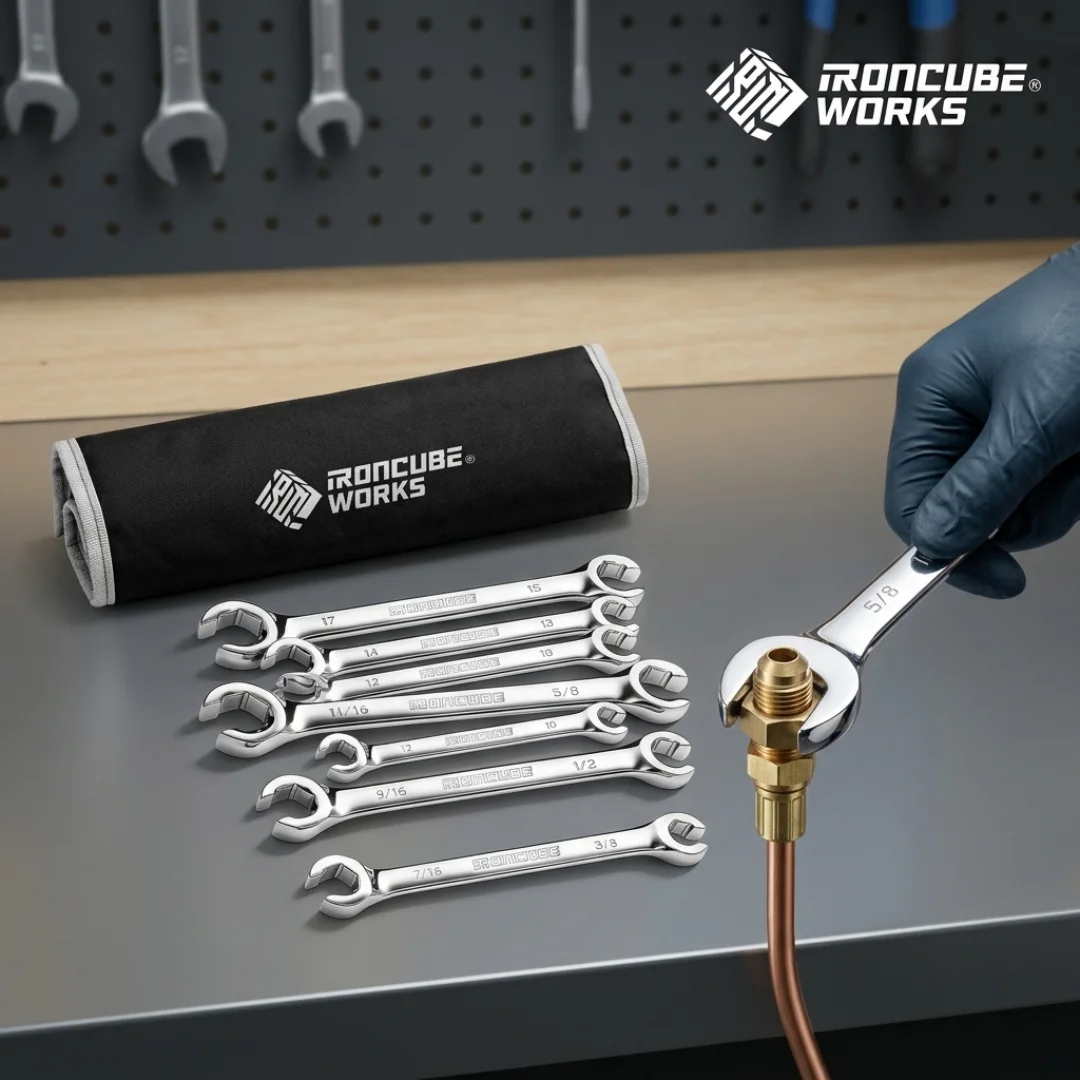
Brake, fuel, and hydraulic line fittings often benefit from a wrench that wraps around more of the fitting than an ordinary open end.
For this type of work, a dedicated line or flare-nut wrench may reduce the chance of damaging softer fittings.
An example is the IRONCUBE 18 mm Brake Line Wrench.
The lesson is broader than one product.
Choose wrench geometry before choosing leverage.
A long handle attached to the wrong head type is still the wrong tool.
Long Wrench Set Safety: Five Rules That Matter
A few habits prevent most leverage-related mistakes.
Use the correct size and seat the wrench fully.
Inspect jaws and ratcheting parts before applying high force.
Keep your hand path clear in case the fastener suddenly releases.
Do not extend a wrench with random pipe unless the tool manufacturer specifically permits that method.
Most importantly, separate loosening torque from controlled final tightening.
OSHA requires employers to maintain hand tools safely and specifically prohibits continued wrench use when sprung jaws permit slippage.
For controlled tightening, ISO 6789 standards provide the relevant framework for hand torque tools.
Long Wrench Set vs Standard Length: Which Should You Buy?
For most general-purpose users, start with a complete standard-length wrench set.
It covers the widest range of ordinary tasks while remaining compact and manageable.
Add a Long Wrench Set when you repeatedly encounter bolts that are deep, highly resistant, or uncomfortable to turn with your standard tools.
Professionals working on trucks, heavy machinery, industrial equipment, structural steel, agricultural machines, or large plant components will normally gain more value from long-pattern tools.
For lighter DIY work, a standard set may remain the better everyday choice.
The strongest workshop setup does not force one wrench type to do everything.
Instead, it matches length, head design, leverage, and access to the job.
Readers comparing broader hand-tool systems can browse IRONCUBE® WORKS, its wrench category, or the company’s screwdriver range. For smaller fastening work, the guide to magnetic screwdriver sets provides additional selection advice.
For demonstrations and tool content, see the IRONCUBE Tools YouTube channel. A general historical overview of wrench types is also available through Wikipedia’s wrench reference, although engineering standards and manufacturer specifications should take priority for technical decisions.
FAQs
Does a long wrench really provide more torque?
Yes. A Long Wrench Set increases the lever arm between your hand and the fastener. When you apply the same perpendicular force at a greater distance, theoretical torque increases proportionally. NASA explains the same force-times-lever-arm relationship in its torque reference.
Is a Long Wrench Set better than standard-length wrenches?
A Long Wrench Set is better when you need extra leverage or deeper reach. Standard wrenches are usually easier to maneuver in confined areas and work well for routine fastening. Therefore, the best option depends on resistance, clearance, fastener size, and access direction.
Can a Long Wrench Set overtighten bolts?
Yes. A Long Wrench Set makes high torque easier to produce, so accidental over-tightening becomes possible if you rely only on hand feel. Use the manufacturer’s specified tightening value and a suitable controlled torque tool when the final torque matters. ISO 6789-1 specifically addresses torque tools used for controlled tightening.
Are extra-long ratcheting wrenches good for tight spaces?
A Long Wrench Set can help when the fastener sits deep inside machinery, while a ratcheting mechanism can reduce the required reset angle. However, a long handle still needs physical swing room. GEARWRENCH’s 120XP system, for example, specifies a 3-degree ratcheting swing arc, but the full handle still has to fit the surrounding space.
Should I use a long wrench to break loose a seized bolt?
A properly rated Long Wrench Set can provide useful leverage for stubborn fasteners. However, first confirm correct fit and tool condition. Do not keep increasing force on damaged jaws or a rounded fastener. OSHA states that wrenches with sprung jaws that allow slippage should not be used.
Is a Long Wrench Set the same as a torque wrench?
No. A Long Wrench Set increases leverage and reach, while a torque wrench controls or indicates applied tightening torque. If the final assembly requires a specified torque, use the correct calibrated torque tool. ISO 6789-2 covers calibration and measurement uncertainty for applicable hand torque tools.
Final Summary
A Long Wrench Set offers two major advantages over standard-length tools: greater leverage and greater reach.
The physics is simple. Increasing the lever arm increases torque for the same hand force. It can also reduce the effort required to produce a target torque.
However, longer is not automatically safer or more effective.
Extra length requires additional workspace. It can also make accidental over-tightening easier. Correct wrench fit becomes more important as applied torque rises.
Use standard-length tools for balanced everyday work. Choose a Long Wrench Set when stubborn or deeply positioned fasteners make extra reach and leverage worthwhile. Use a calibrated torque tool whenever the final tightening specification requires controlled torque.
For heavy-duty applications, compare IRONCUBE extra-large ratcheting wrenches, the Friction Wrench Set Buying Guide, and the Jumbo Ratchet Wrench guide. For product or wholesale guidance, use the IRONCUBE contact page.