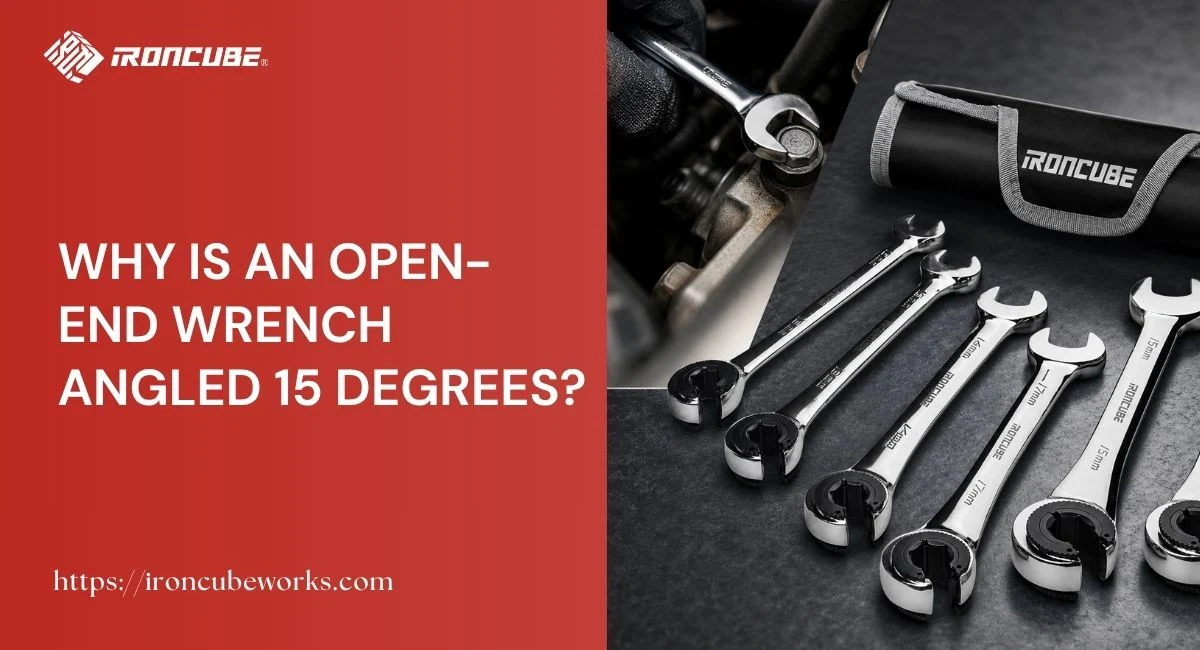
Pick up a typical combination wrench and look closely at the open end. The jaws are not always aligned straight with the handle. On many designs, the open end sits at a slight angle.
That small detail is easy to ignore until you are trying to turn a nut beside a bracket, pipe, engine component, or machine housing.
The reason an Open-End Wrench Angled 15 Degrees works so well is geometry. A six-sided hex fastener repeats its equivalent flat positions every 60 degrees. By setting the open jaw at 15 degrees and flipping the wrench between strokes, the handle can approach the same fastener from two different orientations.
In practical terms, this can reduce the repositioning interval from about 60 degrees to 30 degrees.
That is why the 15-degree angle is not decoration. It is an access feature.
TEKTON explains this principle directly in its combination-wrench documentation. Its angled open end is designed to reduce the working swing arc, allowing the wrench to be flipped and engage the fastener twice as often.
The broader engineering framework for these tools is covered by ASME B107.100-2023 Flat Wrenches, which is the current ASME flat-wrench standard. ASME states that its B107 hand-tool standards address matters including design, performance, tolerances, configurations, and safety.
For mechanics, maintenance technicians, fabricators, plumbers, and industrial users, understanding this simple geometry makes wrench selection much easier.
What Does “Open-End Wrench Angled 15 Degrees” Actually Mean?
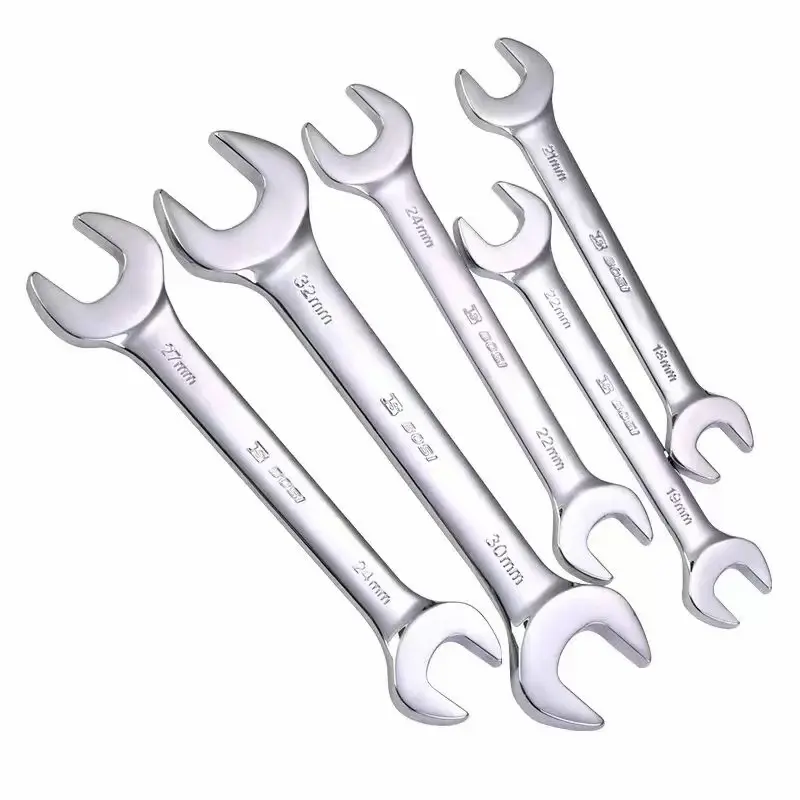
The phrase Open-End Wrench Angled 15 Degrees refers to the in-plane relationship between the open jaws and the wrench handle.
Imagine drawing a centerline through the handle. The open jaw is rotated slightly relative to that line instead of opening perfectly square to it.
This is different from the raised or dropped offset found on many box-end wrenches.
A box end may be offset above the handle to create space for fingers or to clear surrounding parts. An open end, meanwhile, can be angled sideways within the same plane as the handle.
Those features solve two different access problems.
The sideways 15-degree angle changes where the handle sits around the nut. A vertical offset changes how high the handle sits above the work surface.
Some combination wrench designs use both concepts on opposite ends.
The distinction matters because people often describe every bend or angle as an “offset.” When discussing the flip technique, however, the important feature is the in-plane 15-degree open-jaw angle.
GEARWRENCH, for example, lists a 15-degree open-end offset on several professional combination wrench designs.
The Geometry Behind the 15-Degree Wrench Angle
A regular hexagonal nut or bolt head has six sides.
A full rotation contains 360 degrees.
Divide 360 by six:
360° ÷ 6 = 60°
Therefore, the same geometric relationship between flats repeats every 60 degrees.
Now imagine using a completely straight open-end wrench.
Once the handle reaches an obstruction, you remove the wrench and try to place it back on another usable pair of flats. With a straight head, flipping the wrench does not create the same useful change in handle position.
Under severe space restrictions, you may therefore need close to a 60-degree opportunity before achieving another equivalent working position.
An Open-End Wrench Angled 15 Degrees changes that geometry.
When the head faces one way, the handle occupies roughly a +15-degree relationship to the jaw orientation. Flip the wrench over and that geometry mirrors to approximately -15 degrees.
The difference is:
15° − (-15°) = 30°
That is the key.
15-Degree Wrench Geometry at a Glance
| Geometry | Practical Meaning |
|---|---|
| Full rotation | 360° |
| Hexagonal fastener sides | 6 |
| Repeating hex orientation | 60° |
| Common open-end angle | 15° |
| Flipped orientation | -15° |
| Difference between positions | 30° |
| Practical benefit | Two useful handle orientations within one 60° hex cycle |
This does not mean every wrench job provides exactly 30 degrees of usable motion.
Real clearance also depends on the width of the wrench head, handle thickness, nearby brackets, hoses, castings, tubing, and other obstructions.
However, the underlying advantage remains the same: the 15-degree geometry creates an extra useful engagement orientation.
TEKTON describes this benefit as allowing the open end to engage the fastener twice as often compared with a straight arrangement.
How the Wrench Flip Technique Works Step by Step
The flip technique becomes simple once you understand what the angle is doing.
First, place the correct-size open end completely over the hex fastener. Both jaw surfaces should sit firmly against the flats.
Pull the handle through the available working arc.
Eventually, a bracket, housing, pipe, wall, or another component may stop the handle.
At this point, remove the wrench.
Turn the entire wrench over so the opposite face is now upward.
Then place the open end back onto the fastener.
Because the head is angled, the handle now occupies another position relative to the same nut.
You can make another short stroke.
The working sequence becomes:
Pull → lift → flip → reseat → pull again.
This is why an Open-End Wrench Angled 15 Degrees sometimes feels almost like it has an additional indexing position despite having no ratcheting mechanism.
Williams Industrial applies a related access principle in its dedicated angle-head open-end wrench range. Its 15-degree/60-degree double-open-end models use the same fastener size at both ends specifically to create several working positions.
Why 15 Degrees Instead of Another Angle?
The 15-degree choice works neatly with the 60-degree symmetry of a hex fastener.
Flipping the tool converts the head relationship from +15 degrees to -15 degrees. The resulting handle positions sit about 30 degrees apart.
Thirty degrees is exactly half of the hexagon’s 60-degree repeating interval.
Therefore, the user gains a useful intermediate working position without requiring an extreme bend in the wrench.
Other angles remain valuable.
Manufacturers produce dedicated 30-degree, 60-degree, 75-degree, 80-degree, and other angle-head wrench patterns for special clearance requirements.
For example, TEKTON’s specialized access-wrench range uses 30-degree and 60-degree heads to provide four handle positions around a single set of hex flats.
Williams also manufactures open-end tools using combinations such as 15 and 60 degrees or 15 and 80 degrees.
The Open-End Wrench Angled 15 Degrees, however, remains an effective general-purpose configuration because it adds useful indexing while preserving a conventional wrench shape.
Why the 15-Degree Angle Matters in Tight Spaces
In a completely open workspace, the advantage may not feel significant.
Put the same nut beside an engine bracket and everything changes.
Imagine that the available space lets the wrench handle travel only 35 degrees before striking something.
A straight wrench that effectively needs another 60-degree engagement opportunity can become frustrating.
An Open-End Wrench Angled 15 Degrees may still work because flipping the tool creates another useful position about 30 degrees away.
That matters around:
engine accessories, hydraulic components, pipe fittings, suspension assemblies, generators, industrial machines, agricultural equipment, appliance frames, steel structures, and other tightly packaged systems.
The open end also has another important advantage.
It approaches the fastener from the side.
A socket normally needs space above the nut so it can slide down over it. A closed box wrench also needs an axial path onto the fastener.
An open jaw can instead slide sideways onto the flats.
That makes an open-end wrench especially useful when a shaft, tube, long threaded rod, or surrounding component prevents top-down access.
The combination of side entry and flip indexing explains why this basic wrench design remains useful even in workshops full of sockets and ratchets.
Open-End Wrench Angled 15 Degrees vs. a Straight Open-End Wrench
A straight open-end wrench is not automatically a poor design.
Some applications need a zero-angle head because it positions the handle correctly around a specific obstruction.
Thin service wrenches, specialty fitting wrenches, long-pattern tools, and dedicated access wrenches may therefore use different geometry.
The difference is versatility.
A typical Open-End Wrench Angled 15 Degrees provides two mirrored handle positions simply by flipping the tool.
A straight open end offers less benefit from flipping when working against the same pair of fastener flats.
Access Comparison
| Wrench Type | Typical Access Behavior | Best Use |
| Straight open end | Direct side access | Open spaces and special alignment |
| 15° angled open end | Approx. 30° flip indexing | General maintenance and confined spaces |
| 30°/60° angle-head wrench | Multiple dedicated access positions | Severe obstructions |
| Ratcheting box wrench | Very small reset arc | Repetitive tightening where box access exists |
| Socket and ratchet | Fast, secure engagement | Locations with sufficient axial clearance |
Ratcheting tools can achieve dramatically smaller return angles.
A 72-tooth mechanism mathematically corresponds to a 5-degree tooth interval, while GEARWRENCH’s 120XP system advertises 120 ratcheting positions and a 3-degree swing arc.
That makes a ratcheting wrench faster when it can fully surround the fastener.
However, an open end can still win when the fastener must be accessed laterally.
Therefore, the smallest swing angle does not automatically identify the best tool. Access direction matters just as much.
Open End vs. Box End: Which Side Should You Use?
A combination wrench provides two approaches to the same fastener size.
The open end is quick to position and excellent for side access.
The box end surrounds more of the fastener and generally provides more secure engagement.
That makes the box end preferable when a fastener is very tight, corroded, or likely to require substantial force.
A practical workshop routine is simple.
Use the box end to break a stubborn fastener loose whenever clearance allows. Then switch to the open end if its faster positioning or lateral access becomes useful.
If the box end has a ratcheting mechanism, it may remain the fastest option throughout the operation.
The IRONCUBE® WORKS wrench range includes standard combination, ratcheting, and heavy-duty formats. The current category page includes numerous metric and SAE wrench sets as well as larger industrial friction wrenches.
For general metric work, the IRONCUBE 10-piece metric ratcheting wrench set offers another approach when repeated repositioning is the main problem.
Does a 15-Degree Open-End Angle Increase Torque?
No.
The 15-degree angle itself is primarily an access feature, not a torque multiplier.
Torque depends on force and the effective perpendicular lever distance from the fastener’s rotational axis.
In simplified form:
Torque = Force × Lever Arm
A longer handle can therefore reduce the force needed to produce the same torque.
The small 15-degree jaw angle does not create that mechanical advantage.
An Open-End Wrench Angled 15 Degrees may still make a difficult job feel easier because it places the handle in a more usable position. That can improve posture and access.
However, that should not be confused with increasing the wrench’s torque capacity.
For genuinely high-load applications, tool length, material strength, engagement style, fastener condition, and manufacturer ratings become much more important.
IRONCUBE explains this leverage principle in its guide to torque friction wrench design and reduced operator effort. That guide also correctly distinguishes a heavy-duty friction wrench used to deliver turning force from a calibrated torque-measuring instrument.
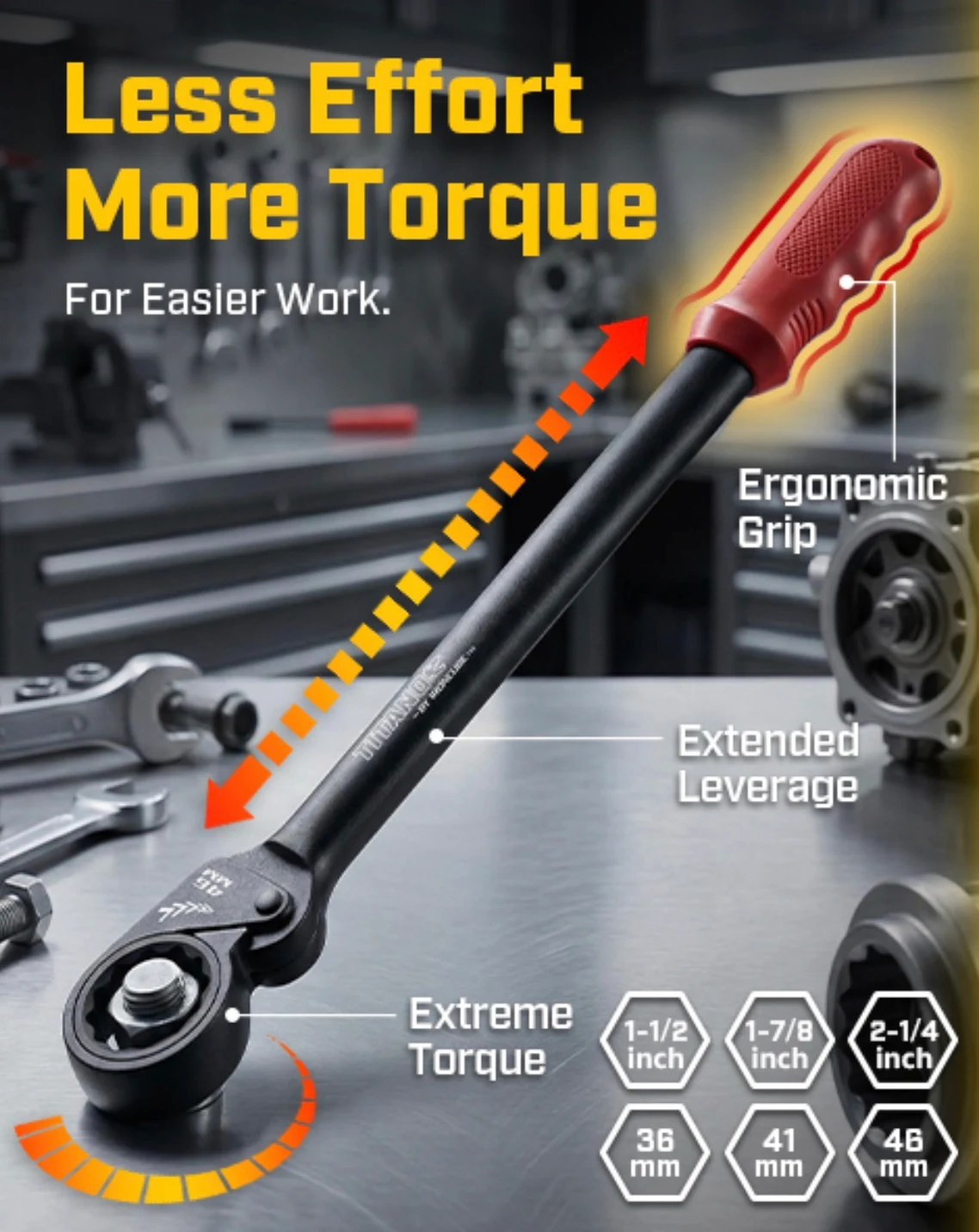
For oversized industrial fasteners, IRONCUBE’s extra-large heavy-duty ratcheting wrenches use extended handles from 510–660 mm across the listed range, demonstrating how larger tools rely heavily on leverage and robust construction.
When You Should Not Rely on the Open End
Open-end wrenches contact fewer surfaces of a fastener than a closed box end.
Therefore, fit becomes especially important.
If a nut is severely seized, heavily corroded, partially rounded, or requires very high force, a snug-fitting six-point socket, box wrench, or appropriately rated heavy-duty wrench may provide more secure engagement.
Do not compensate for poor engagement by simply pulling harder.
OSHA’s hand-tool requirements provide a particularly useful rule. Under 29 CFR 1926.301, wrenches—including adjustable, pipe, end, and socket types—must not be used when their jaws have sprung enough to create slippage.
That principle applies directly to an Open-End Wrench Angled 15 Degrees.
If the wrench rocks noticeably on the correct fastener, repeatedly slips, or shows spread or damaged jaws, stop and inspect the tool.
The geometry cannot compensate for worn contact surfaces.
How to Choose the Right 15-Degree Open-End Wrench
Start with exact fastener size.
Metric and SAE dimensions occasionally appear close enough to interchange, but “almost correct” is not a good standard when significant force is involved.
Use a wrench that matches the fastener’s actual across-flats dimension.
Next, examine head thickness.
A slimmer head can enter smaller gaps, while a larger or thicker head may provide additional strength depending on the tool design.
Neither is automatically superior. The right choice depends on the application.
Handle length matters as well.
A longer wrench creates more potential mechanical advantage. A shorter wrench fits smaller spaces.
Professional toolkits therefore often contain standard, stubby, long-pattern, angled, and ratcheting designs rather than expecting one wrench shape to solve every problem.
Finally, inspect the jaws.
Look for spreading, corrosion, chips, burrs, deformation, or unusual wear.
OSHA specifically addresses wrench-jaw conditions because excessive spreading creates a slippage hazard.
For formal engineering requirements, ASME B107.100-2023 Flat Wrenches is the relevant current ASME standard.
Readers who want a broad terminology overview can also consult the general wrench reference on Wikipedia, although manufacturer documentation and engineering standards are better sources for specific technical specifications.
15-Degree Open Ends vs. Specialty 30/60-Degree Angle Wrenches
Another common point of confusion is the difference between the 15-degree open end on a general combination wrench and a dedicated angle-head wrench.
These are related ideas, but they are not identical tools.
Williams Industrial manufactures double open-end wrenches with 15-degree and 60-degree heads of the same size. The company states that this arrangement allows the wrench to be used in four different positions.
TEKTON’s dedicated angle-head access wrenches use 30-degree and 60-degree heads for a similar reason: more working positions around a fastener when surrounding components severely restrict handle movement.
These products do not mean that 15 degrees is somehow outdated.
They demonstrate that different access problems require different geometry.
A standard Open-End Wrench Angled 15 Degrees remains a versatile everyday tool.
A dedicated 30/60-degree set becomes useful when fasteners frequently sit behind fittings, housings, lines, or other obstacles that make conventional handle positioning impossible.
Professional workshops often use both.
Safe Technique: Pull, Seat, and Inspect
Good geometry does not replace good technique.
First, push the wrench completely onto the fastener.
The flats should sit deeply inside the jaws. Avoid applying heavy force while only the jaw tips contact the nut.
Second, keep the wrench aligned with the fastener.
Twisting the handle sideways or applying force outside the normal working plane can reduce contact quality.
Third, pull the wrench when practical.
The Canadian Centre for Occupational Health and Safety advises users to pull on a wrench or pliers rather than push whenever possible. This can reduce the chance of striking nearby equipment or losing balance if the tool suddenly slips.
Fourth, inspect the tool.
OSHA specifically prohibits using a wrench when sprung jaws create a slippage risk.
Finally, avoid improvising additional leverage with a pipe or “cheater bar” unless the manufacturer specifically rates the wrench for such use.
If a normal wrench repeatedly requires excessive force, choose a longer or higher-capacity tool instead.
The purpose of an Open-End Wrench Angled 15 Degrees is improved access—not encouraging unsafe overload.
Matching the Wrench to Heavy-Duty Work
The flip technique works extremely well for ordinary maintenance fasteners.
Heavy industrial fasteners introduce different priorities.
As nut size and resistance increase, operators need stronger engagement, greater leverage, and often ratcheting action that avoids repeatedly lifting a large, heavy wrench.
IRONCUBE’s Jumbo Ratchet Wrenches for Heavy-Duty Work guide discusses this larger scale of fastening work.
Individual examples include the IRONCUBE 1-7/8-inch friction wrench and 36 mm high-torque friction wrench.
For buyers selecting multiple large sizes, the Friction Wrench Set Buying Guide 2026 provides additional size and application guidance.
Industrial procurement teams may also benefit from IRONCUBE’s guide on how to find quality wholesale jumbo wrench sets and its field guide to friction wrench sets for structural steel and bridge construction.
For jobs where a specified final tightening torque matters, users should also understand the difference between a turning tool and a torque-measuring instrument. IRONCUBE’s friction wrench vs. torque wrench comparison covers that distinction.
The principle is simple:
An Open-End Wrench Angled 15 Degrees solves access. Heavy-duty ratcheting tools solve load and repetitive repositioning. Calibrated torque tools solve controlled final tightening.
Selecting a Complete Workshop Tool System
No single wrench geometry handles every fastener.
A practical toolkit often combines traditional combination wrenches, ratcheting wrenches, flare-nut tools, stubby wrenches, long-pattern tools, sockets, and specialty angle-head wrenches.
If hydraulic or brake-line fittings are involved, a flare-nut or line wrench can provide more contact around the fitting than an ordinary open end. IRONCUBE lists an 18 mm brake-line wrench for this type of service work.
For very large fasteners, users can also view the IRONCUBE jumbo friction ratcheting wrench.
Mechanics building a broader hand-tool setup can browse the IRONCUBE screwdriver category or its guide to magnetic screwdriver sets.
For tool demonstrations and product-use content, the IRONCUBE Tools YouTube channel provides another reference.
FAQs
Why is an open-end wrench angled 15 degrees?
An Open-End Wrench Angled 15 Degrees provides another useful handle position when the wrench is flipped. A hex fastener repeats its geometry every 60 degrees. Changing the wrench from +15 degrees to -15 degrees creates positions about 30 degrees apart, reducing the working arc needed in confined spaces. TEKTON specifically identifies this design as a way to engage the fastener twice as often.
How do you use the 15-degree wrench flip technique?
Seat the Open-End Wrench Angled 15 Degrees completely on the fastener and pull through the available arc. Remove the wrench, flip it onto its opposite face, reseat it, and pull again. The mirrored 15-degree angle moves the handle to a different position, allowing another stroke without requiring a full 60-degree working area.
Does a 15-degree angled wrench give more torque?
No. An Open-End Wrench Angled 15 Degrees improves access rather than multiplying torque. Mechanical torque depends primarily on applied force and effective lever distance. A longer wrench can increase leverage, but the 15-degree jaw angle itself does not increase the tool’s rated torque capacity.
Is every open-end wrench angled exactly 15 degrees?
No. The Open-End Wrench Angled 15 Degrees is common on general-purpose wrench designs, but specialty access wrenches use other angles. Williams offers 15/60-degree designs, while TEKTON also uses 30/60-degree angle-head configurations for restricted-access work.
Is a 15-degree open end better than a ratcheting wrench?
It depends on access. An Open-End Wrench Angled 15 Degrees is especially useful when the wrench must slide onto the fastener from the side. A ratcheting box wrench usually requires less return movement and is faster when it can completely surround the fastener. The best choice depends on both swing clearance and the available approach direction.
Can I use the open end on a very tight or rounded nut?
Use caution. An Open-End Wrench Angled 15 Degrees still provides less wraparound engagement than a box end or properly fitting six-point socket. A badly corroded, rounded, or extremely tight fastener often calls for a more secure tool. OSHA also states that wrenches with jaws sprung enough to permit slippage should not be used.
Final Summary
The 15-degree angle on an open-end wrench is a small engineering feature with a clear purpose.
A hex fastener repeats its geometry every 60 degrees. A 15-degree angled open end can be flipped from one orientation to its mirror image, creating two useful handle positions approximately 30 degrees apart.
That is the logic behind the flip technique.
An Open-End Wrench Angled 15 Degrees can therefore reach and turn fasteners where a straight wrench may run out of swing room.
It does not increase torque by itself. It also does not replace a ratcheting wrench, socket, box wrench, or heavy-duty wrench.
Instead, it gives mechanics something equally valuable: better access through smarter geometry.
Choose the exact wrench size, seat the jaws fully, inspect the tool for wear, and use a more secure engagement style when unusually high force is necessary.
For general, ratcheting, and industrial wrench options, browse IRONCUBE® WORKS and its complete wrench category. For wholesale, customized, or product inquiries, use the IRONCUBE contact page.