Finding the correct wrench for a large fastener sounds simple until the machine is already down, the nut is half-covered in rust, and the only tool that seems close has visible play. On heavy equipment, that small mismatch can round a fastener, damage an expensive assembly, or turn a routine repair into hours of extra work.
This guide explains large bolt wrench sizes for construction machinery, tractors, excavators, industrial equipment, structural assemblies, marine hardware, and mixed fleets. It covers metric and SAE sizing, common bolt-to-wrench relationships, jumbo wrench selection, and the point where a normal combination wrench is no longer the best tool. A general wrench overview explains the basic tool families and terminology.
The most important rule comes first: a wrench is selected by the width across the flats of the bolt head or nut, not by the diameter of the threaded shank.
An M24 bolt, for example, does not take a 24 mm wrench in the common ISO hex series. It commonly uses a 36 mm wrench. Likewise, a 3/4-inch standard hex bolt commonly uses a 1-1/8-inch wrench.
Standards matter because head dimensions are not universal. ISO 272 specifies preferred widths across flats for metric hex products, while ISO 4014 covers characteristics of metric hex-head bolts. In inch-based systems, standard hex and heavy-hex fasteners can require different wrench sizes even when the thread diameter is identical.
Why Large Bolt Wrench Sizes Matter on Heavy Equipment
Heavy machinery creates a difficult environment for threaded fasteners.
Loads change. Frames twist. Attachments vibrate. Dirt and moisture reach exposed hardware. Paint, corrosion, and damaged corners also reduce the usable contact area between a wrench and a nut.
That is why guessing at large bolt wrench sizes is risky.
A wrench that is slightly oversized may feel acceptable under light hand pressure. Under high torque, however, the loose fit concentrates force at the corners. The wrench can slip, and the fastener may round.
For that reason, a serious field kit often needs both metric wrench sizes for heavy equipment and SAE wrench sizes for heavy equipment.
A mixed metric and standard wrench size chart can help with identification. However, it should not encourage approximate substitutions on high-load fasteners.
How Large Bolt Wrench Sizes Relate to Bolt Diameter
A common mistake is to read “M24” or “3/4 inch” and assume that number is the wrench opening.
It is not.
The thread designation describes the nominal outside diameter of the threaded portion. The wrench fits the hex head or nut. That hex dimension is measured across two opposite flat faces.
For example:
| Fastener designation | What the number describes | Common wrench size |
|---|---|---|
| M12 metric hex bolt | About 12 mm nominal thread diameter | 18 mm |
| M16 metric hex bolt | About 16 mm nominal thread diameter | 24 mm |
| M24 metric hex bolt | About 24 mm nominal thread diameter | 36 mm |
| 5/8-inch standard hex bolt | 5/8-inch nominal thread diameter | 15/16 inch |
| 3/4-inch standard hex bolt | 3/4-inch nominal thread diameter | 1-1/8 inch |
| 1-inch standard hex bolt | 1-inch nominal thread diameter | 1-1/2 inch |
These are common relationships, not universal guarantees.
Flange bolts, structural heavy-hex bolts, older DIN patterns, reduced-head designs, and manufacturer-specific fasteners may use different dimensions.
ISO’s official page for ISO 272 widths across flats confirms that wrench-opening dimensions are defined separately within product standards. ISO 4014:2022 covers hex-head bolts in steel and stainless steel, while ISO 4032:2023 covers regular metric hex nuts.
Before applying force, measure the fastener or consult the service manual. Correct large bolt wrench sizes come from the head or nut dimension, not the thread label.
Common Metric Large Bolt Wrench Sizes Chart
The following industrial wrench size chart shows common ISO-style metric relationships. It is useful for initial identification when working on excavators, loaders, tractors, agricultural implements, machine bases, and structural frames.
| Metric thread size | Common width across flats | Typical wrench size |
| M12 | 18 mm | 18 mm |
| M14 | 21 mm | 21 mm |
| M16 | 24 mm | 24 mm |
| M18 | 27 mm | 27 mm |
| M20 | 30 mm | 30 mm |
| M22 | 34 mm | 34 mm |
| M24 | 36 mm | 36 mm |
| M27 | 41 mm | 41 mm |
| M30 | 46 mm | 46 mm |
| M33 | 50 mm | 50 mm |
| M36 | 55 mm | 55 mm |
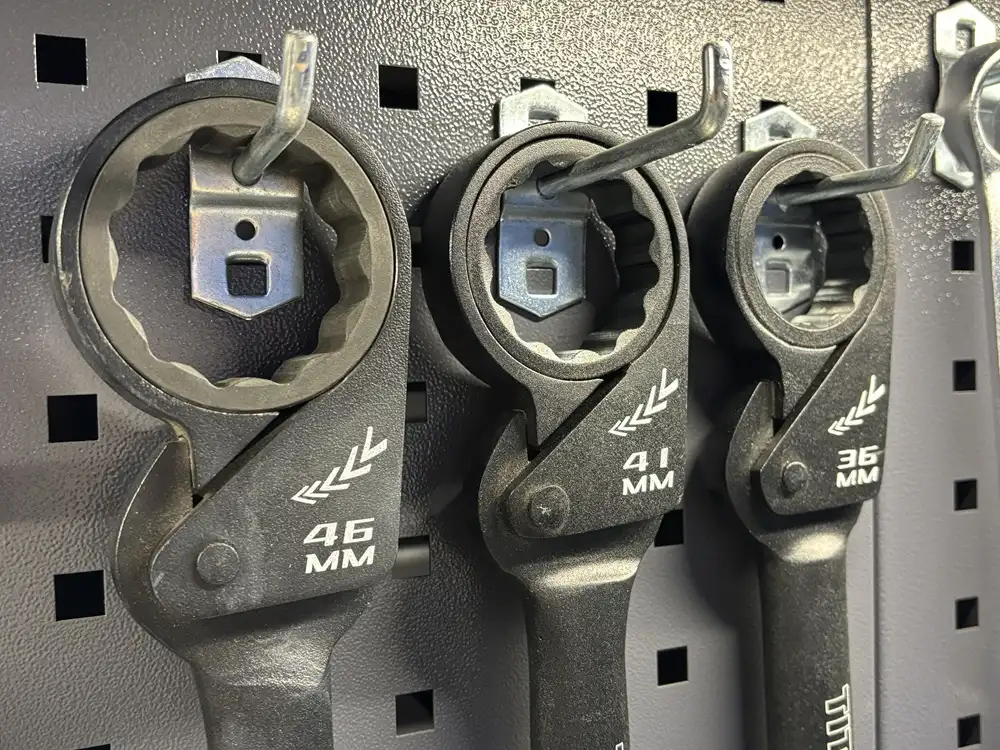
For workshops that regularly encounter 36, 41, and 46 mm nuts, a standard automotive wrench set stops being enough.
Those sizes sit firmly in the jumbo wrench sizes category.
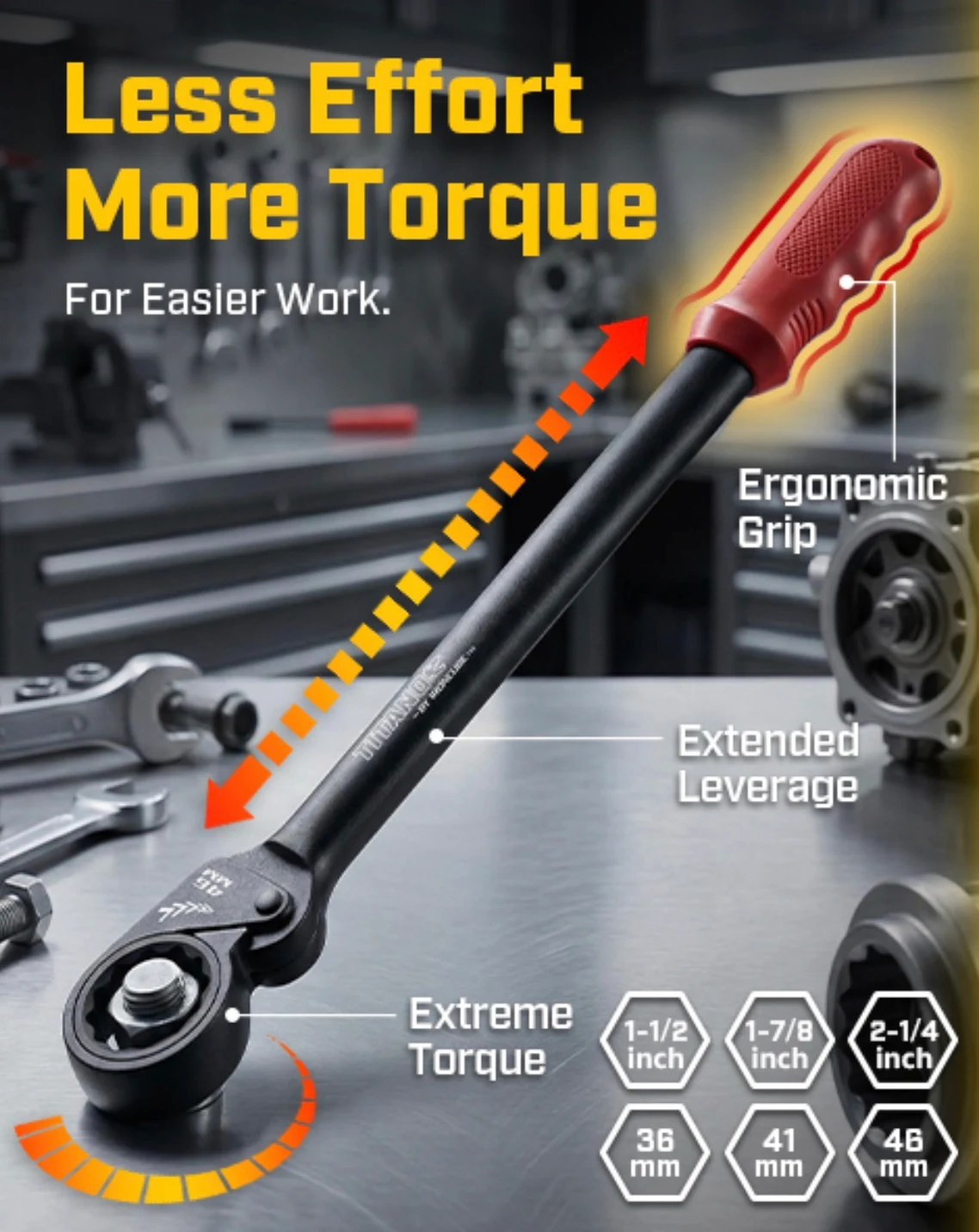
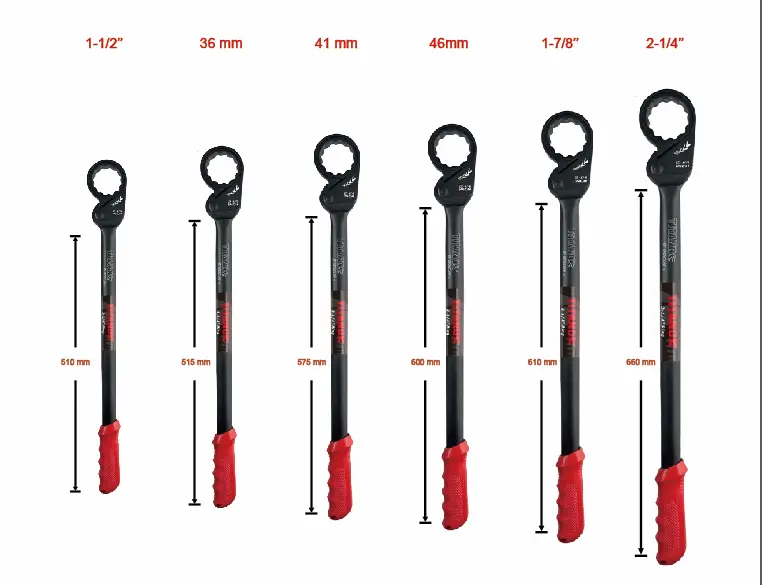
IronCube’s extra-large heavy-duty ratcheting wrench range covers 36 mm, 41 mm, and 46 mm, as well as large inch sizes. The product page lists the corresponding common-thread applications for M24, M27, and M30.
What 18, 24, 36, 41, and 46 mm Wrenches Commonly Fit
An 18 mm wrench commonly fits current ISO-style M12 hardware, while a 24 mm wrench commonly fits M16.
Larger workshops often need:
- 36 mm for M24
- 41 mm for M27
- 46 mm for M30
These large bolt wrench sizes appear around frames, brackets, mounting plates, agricultural equipment, and industrial assemblies.
Older standards and special flange designs may differ. Therefore, measure the actual head before applying force.
IronCube offers a 36 mm high-torque friction wrench, a 41 mm jumbo ratchet spanner, and a 46 mm industrial friction wrench.
Common SAE Large Bolt Wrench Sizes Chart
SAE or inch-based hardware remains common on U.S. equipment, older machinery, trailers, structural work, agricultural attachments, and replacement assemblies.
The table below shows common standard-hex relationships.
| Nominal bolt diameter | Standard hex wrench size | Heavy-hex wrench size |
| 1/2 inch | 3/4 inch | 7/8 inch |
| 5/8 inch | 15/16 inch | 1-1/16 inch |
| 3/4 inch | 1-1/8 inch | 1-1/4 inch |
| 7/8 inch | 1-5/16 inch | 1-7/16 inch |
| 1 inch | 1-1/2 inch | 1-5/8 inch |
| 1-1/8 inch | 1-11/16 inch | 1-13/16 inch |
| 1-1/4 inch | 1-7/8 inch | 2 inches |
| 1-3/8 inch | 2-1/16 inches | 2-3/16 inches |
| 1-1/2 inch | 2-1/4 inches | 2-3/8 inches |
This distinction is critical.
A 3/4-inch standard hex bolt and a 3/4-inch heavy-hex bolt do not use the same wrench. Bolt Depot’s U.S. bolt head and wrench size chart provides a practical reference for standard and heavy-hex dimensions.
What 15/16, 1-1/8, 1-7/8, and 2-1/4-Inch Wrenches Fit
A 15/16-inch wrench commonly fits a 5/8-inch standard hex bolt.
A 1-1/8-inch wrench commonly fits a 3/4-inch standard hex bolt.
In the oversized range, 1-7/8 inch commonly matches a 1-1/4-inch standard hex head. A 2-1/4-inch wrench commonly matches a 1-1/2-inch standard hex head.
These large bolt wrench sizes appear on frames, hitches, trailers, agricultural implements, and industrial assemblies. They are rarely included in ordinary mechanic sets.
Metric sizes can look deceptively close.
NIST defines one inch as exactly 25.4 mm. Therefore, 15/16 inch equals 23.8125 mm, while 1-1/8 inch equals 28.575 mm. A close metric wrench may still fit loosely under high torque. NIST’s SI length guidance confirms the exact conversion.
IronCube’s 1-7/8-inch friction wrench and 2-1/4-inch friction wrench cover this oversized SAE range.
Where Big Fasteners Live
Large fasteners clamp thick parts and resist shock, vibration, and static loads.
That places them throughout construction, agriculture, marine service, industrial plants, and structural steel work.
Construction Equipment
Excavators, loaders, bulldozers, cranes, and backhoes use large hardware around frames, guards, attachments, undercarriage parts, and hydraulic supports.
Exact excavator wrench sizes depend on the model and assembly.
A technician may use 24 or 30 mm wrenches for general components. The same technician may then need 36, 41, or 46 mm tools for heavier connections.
The 36 mm torque friction wrench guide explains why a large wrench works well for removal and positioning. Critical final tightening may still require calibrated equipment.
Tractors and Agricultural Machinery
Tractors often combine hardware from the machine, hitch, implement, axle, hydraulic system, and previous repairs.
Common tractor wrench sizes may range from 18 and 24 mm through 36 mm and above. Inch-based implements may require 15/16, 1-1/8, 1-1/2, or larger tools.
A jumbo combination wrench set makes sense when those sizes repeat across a fleet.
Maintenance records should decide the set, not piece count alone.
Marine, Industrial, and Structural Work
Marine and industrial equipment adds corrosion and restricted access.
A large open-end wrench may reach fittings that a socket cannot. However, a box end or six-point socket often grips stubborn fasteners better.
Structural assemblies may use heavy-hex bolts with larger head dimensions. Never apply a standard-hex chart to heavy-hex hardware.
For related selection, review the friction wrench set guide for structural steel and bridge work.
How to Identify the Correct Wrench Size for Large Bolts
When the equipment manual is available, use it first.
The manual may specify the fastener, tool size, tightening torque, lubrication condition, and replacement requirements.
When documentation is missing, follow a measured process.
First, clean the head or nut. Paint, packed dirt, and corrosion can distort the reading.
Next, measure across two opposite flat faces with a caliper. Do not measure corner to corner. Compare the result with known metric and SAE sizes.
Then inspect the fastener type. A flange nut, heavy-hex nut, reduced-head bolt, or damaged head may not follow the relationship you expected.
Finally, test the wrench without applying high force.
The tool should seat fully and show minimal movement. If it rocks visibly, stop and select a closer size.
These steps make large bolt wrench sizes easier to identify without relying on guesswork. They also reduce the chance of rounding an expensive nut.
Large Bolt Wrench Sizes: Metric-to-SAE Comparison
Metric and SAE sizes sometimes sit close together.
Close does not mean interchangeable.
| Metric wrench | Decimal inches | Nearest common SAE size | Practical note |
| 18 mm | 0.7087 | 23/32 inch, uncommon | Use 18 mm |
| 21 mm | 0.8268 | 13/16 inch | 13/16 is smaller |
| 24 mm | 0.9449 | 15/16 inch | Very close, exact tool preferred |
| 27 mm | 1.0630 | 1-1/16 inch | Very close, exact tool preferred |
| 30 mm | 1.1811 | 1-3/16 inch | Close, not identical |
| 36 mm | 1.4173 | 1-7/16 inch | SAE tool is slightly larger |
| 41 mm | 1.6142 | 1-5/8 inch | SAE tool is slightly larger |
| 46 mm | 1.8110 | 1-13/16 inch | Very close, exact tool preferred |
This large bolt wrench sizes table helps with identification, not substitution.
Rust, high torque, worn corners, and safety-critical work all increase the need for an exact fit.
For a broader comparison, read the IronCube metric-to-SAE wrench conversion chart. Use conversions as a reference, then select the proper tool.
When Large Bolt Wrench Sizes Need Specialty Tools
A longer handle increases mechanical advantage.
A ratcheting or friction-reset action reduces repositioning in tight spaces. A box end surrounds more of the fastener than an open end.
These features become important when large bolt wrench sizes move beyond a typical 24 or 32 mm set.
IronCube’s jumbo ratchet wrench guide explains the benefit of repeated reset strokes on large fasteners. The company’s friction wrench buying guide also compares practical sizes for heavy machinery.
A friction or ratcheting wrench is not automatically a torque wrench.
It may improve speed and leverage, but it usually does not measure final torque. For that distinction, see friction wrench versus torque wrench.
Torque Considerations for Large Bolt Wrench Sizes
Larger wrench size does not tell you the correct torque.
Torque depends on thread diameter, pitch, fastener grade, joint design, lubrication, coatings, washers, surface condition, and the manufacturer’s target preload.
Two bolts with the same head size can require very different torque.
NASA’s Fastener Design Manual explains that calculated torque values depend strongly on friction at the threads and under the bolt head or nut.
A separate NASA preloaded-joint report notes that preload uncertainty for a hand-operated torque wrench on a lubricated fastener may reasonably be around ±25 percent.
The familiar equation is:
T = K × D × F
Here:
- T is installation torque.
- K is the torque coefficient or nut factor.
- D is nominal fastener diameter.
- F is desired preload.
Nord-Lock reports a useful rule of thumb: around 50 percent of applied torque may be lost under the head or nut, around 40 percent in thread friction, and only about 10 percent may create useful bolt stretch.
Therefore, never create a torque value from large bolt wrench sizes alone.
Use the equipment manual, approved engineering data, or a validated torque chart for the exact fastener and condition.
Fastenal’s torque-tension reference guide provides useful technical background. However, its values are advisory and condition-dependent.
Choosing a Set for Large Bolt Wrench Sizes
A useful heavy-duty wrench set starts with verified applications.
Review recent maintenance records and list the metric and SAE sizes used most often. Also note where technicians borrowed tools, used adjustable wrenches, or reached for improvised extensions.
An oversized wrench set does not need every possible opening. It needs dependable coverage of the fasteners that cause downtime.
Metric-heavy fleets may prioritize:
- 24 mm
- 27 mm
- 30 mm
- 32 mm
- 36 mm
- 41 mm
- 46 mm
SAE-heavy work may require:
- 15/16 inch
- 1-1/8 inch
- 1-1/2 inch
- 1-7/8 inch
- 2-1/4 inches
Choose the head style around access and load.
A combination wrench offers flexibility. A six-point box end gives strong contact. A 12-point end offers more engagement positions. Long ratcheting or friction designs speed repetitive movement.
Browse IronCube’s wrench product category, read how to find quality wholesale jumbo wrench sets, or view the jumbo friction ratcheting wrench on Amazon.
For application or volume questions, use the IronCube contact page.
Safety and Tool Care
Large tools transmit considerable energy.
Inspect the head, handle, and ratcheting mechanism before every high-load job. Remove tools with spreading jaws, cracks, severe corrosion, or unreliable engagement.
OSHA recommends keeping tools in good condition, using the right tool, checking for damage, and following manufacturer instructions. Construction tools must also be maintained in safe condition.
Avoid improvised pipe extensions unless the manufacturer permits them.
Use a longer rated wrench, breaker bar, torque multiplier, or hydraulic system instead.
After work, clean grit from the head and dry the tool before storage. Follow the friction wrench maintenance guide for moving mechanisms.
Related workshop tools are available in the IronCube screwdriver category and its guide to magnetic screwdriver sets.
Frequently Asked Questions About Large Bolt Wrench Sizes
What wrench size do I need for a large bolt?
To choose large bolt wrench sizes, measure the width across two opposite flats of the bolt head or nut.
Do not use the thread diameter as the wrench opening. Confirm whether the fastener follows metric, standard hex, heavy-hex, flange, or manufacturer-specific dimensions.
What wrench fits an M24 bolt?
In the common ISO hex series, an M24 bolt or regular nut usually takes a 36 mm wrench.
However, large bolt wrench sizes can vary with the fastener standard and head design. Verify the equipment manual or measure the actual width across flats before applying high torque.
What wrench fits a 3/4-inch bolt?
A 3/4-inch standard hex bolt commonly uses a 1-1/8-inch wrench.
A 3/4-inch heavy-hex bolt commonly uses a 1-1/4-inch wrench. This difference shows why large bolt wrench sizes must account for head style, not only nominal thread diameter.
Can I use a metric wrench on an SAE bolt?
Sometimes a metric opening sits very close to an SAE size, such as 24 mm and 15/16 inch.
Still, large bolt wrench sizes should match exactly when torque is high, corners are worn, or the joint is safety-critical. A loose fit can concentrate force and round the fastener.
Are ratcheting wrenches safe for heavy-equipment bolts?
A properly rated ratcheting or friction wrench can handle removal, installation, and repetitive movement on heavy equipment.
Yet large bolt wrench sizes do not prove that a tool has sufficient load capacity. Check the manufacturer’s rating, inspect the mechanism, and use calibrated equipment for final torque where required.
How do I know whether a bolt is metric or SAE?
Measure the thread diameter, pitch, and head width. Check markings and compare the measurements with reliable charts.
When identifying large bolt wrench sizes, remember that close metric and SAE openings are not automatically interchangeable. The service manual remains the best reference.
Summary
Selecting large bolt wrench sizes correctly starts with one measurement: the width across the flats.
The thread designation alone does not identify the wrench.
For common metric hardware:
- M12 often uses 18 mm.
- M16 often uses 24 mm.
- M24 often uses 36 mm.
- M27 often uses 41 mm.
- M30 often uses 46 mm.
For common SAE standard hex hardware:
- A 5/8-inch bolt often uses 15/16 inch.
- A 3/4-inch bolt often uses 1-1/8 inch.
- A 1-inch bolt often uses 1-1/2 inch.
Those relationships are starting points.
Heavy-hex, flange, reduced-head, older-standard, and manufacturer-specific fasteners can differ. Measure the actual head, use the correct wrench, and follow the equipment maker’s torque procedure.
For workshops building a reliable large-fastener kit, explore IronCube Works and its range of professional wrenches.
You can also follow practical tool demonstrations on the IronCube Tools YouTube channel.